Category: Commercial Ice Cream Machine Guides

  • GB-1 vs GB-2 vs GB-4 vs GB-6 Hard Ice Cream Machine Guide

    GB-1 vs GB-2 vs GB-4 vs GB-6 Hard Ice Cream Machine Guide

    Quick answer: choose the GB-1 for a compact single-flavor counter, the GB-2 for two visible flavors, the GB-4 for a busy shop that needs four flavors and two independent refrigeration circuits, and the GB-6 for high-traffic service with six flavors and three circuits. Match the machine to peak-hour demand and flavor count, not to the largest output in the catalog.

    The GB-series models share a showcase concept: the freezing bowls are visible, so customers can watch the product being made. The difference is not only size. Each step adds output, flavor positions, electrical load, weight, and cleaning work.

    This guide compares the GB-1, GB-2, GB-4, and GB-6 using published specifications and realistic operating scenarios. Use it alongside the [commercial ice cream machine buying guide](https://fantehub.com/blog/posts/wp/wp-commercial-ice-cream-machine-buying-guide/).

    Reviewed by the GLACIO Machinery equipment team | Updated September 15, 2026 | 8 minute read
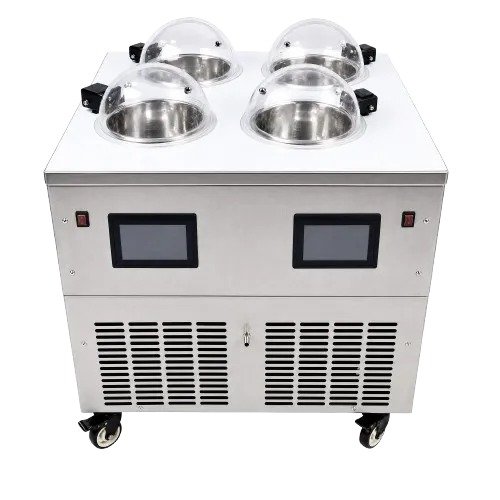
    GLACIO GB-4 showcase hard ice cream machine at counter height
    The GB-4 balances four visible flavors, 56 L/h nominal output, and two independent refrigeration circuits.

    Full GB-series specification comparison

    ModelBowlsNominal outputBatch timeCircuitsPowerDimensions (mm)WeightContainer
    GB-11 x 6 L14 L/h15-20 min11.6 kW / 220 V640 x 640 x 98096 kg24 units / 20GP
    GB-22 x 6 L28 L/h15-20 min12.5 kW / 220 V860 x 640 x 980138 kg16 units / 20GP
    GB-44 x 6 L56 L/h15-20 min24.8 kW / 220 V1080 x 980 x 1010235 kg8 units / 20GP
    GB-66 x 6 L84 L/h15-20 min37.2 kW / 220 V1500 x 980 x 1010330 kg6 units / 20GP

    All models in the published specification use a Tecumseh compressor, R290 refrigerant, heated clear domes, 304 stainless steel construction, touch controls, and a one-key auto-wash cycle. Confirm final configuration, voltage, certification, and options in the quotation for your destination.

    Start with the service model

    The machine should fit the way customers order, not the other way around.

    One flavor is enough

    A one-flavor counter can work in a bakery, coffee bar, small cafe, dessert kiosk, or restaurant that offers a fixed dessert. The menu is simple, changeovers are limited, and staff can become efficient with one recipe.

    The GB-1 fits this model. It uses one 6 L bowl, produces a nominal 14 L/h, and occupies a 640 x 640 mm footprint. It is the easiest model to place in a small front-of-house area.

    The limitation is obvious: if the single flavor sells out during peak service, the machine must complete another batch before the display is restored.

    Customers expect two or three choices

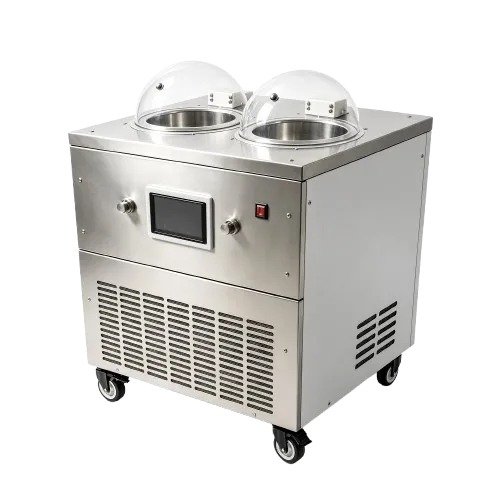
    Two flavors can cover a standard and a rotating seasonal option. That is enough for many cafes, hotels, restaurants, and small dessert counters. The GB-2 provides two 6 L bowls and 28 L/h nominal output in an 860 x 640 mm footprint.

    The GB-2 uses one refrigeration circuit. That keeps the machine simpler, but it also means the two bowls are not fully independent from a service standpoint. Ask about how the circuit is zoned and how the controller manages each bowl.

    Four flavors create a complete display

    Four flavors allow a shop to combine familiar staples with rotating options. A typical menu might include vanilla, chocolate, pistachio, and a fruit sorbet. The mix gives customers choice without requiring a very large production room.

    The GB-4 is the first model with two independent refrigeration circuits. It provides four 6 L bowls, 56 L/h nominal output, and a 1080 x 980 mm footprint. The two-circuit design supports flavor availability and allows half the machine to be serviced or turned off separately.

    For many independent gelato shops, this is the practical sweet spot.

    Six flavors require a high-traffic plan

    The GB-6 provides six 6 L bowls, 84 L/h nominal output, and three independent circuits. It suits a high-traffic gelato bar, a flagship store, a busy tourist location, or a business that wants a deep flavor display at all times.

    The operational requirements also increase. The machine is 1500 mm wide and weighs 330 kg. It needs more counter space, stronger logistical planning, and a workflow that keeps six flavors fresh without excessive waste.

    Capacity planning by model

    Nominal output is not the same as daily sellable volume. The machine must stop for loading, flavor changes, cleaning, and recovery. Use the published output as a ceiling, then apply an efficiency factor based on your operation.

    ModelNominal outputConservative planning outputBest fit
    GB-114 L/h8-11 L/hFixed menu or low-volume cafe
    GB-228 L/h17-22 L/hTwo-flavor counter
    GB-456 L/h34-45 L/hBusy shop with four flavors
    GB-684 L/h50-67 L/hHigh-traffic bar or flagship store

    The conservative range assumes normal cleaning, loading, and flavor changes. A high-volume operation with dedicated staff may achieve more. A shop with frequent single-batch changes may achieve less.

    Simple sizing example

    A shop sells 90 ml scoops and expects 180 scoops during a four-hour peak. The theoretical volume is 180 x 0.09 = 16.2 L. With 15% waste and refill loss, it needs about 19 L of production.

    If the peak is spread evenly over four hours, the average requirement is 4.8 L/h. That could fit the GB-1 on average. But if 70% of sales happen during one hour, the one-hour requirement is about 13.3 L. The GB-1 is at its nominal limit before allowing for recovery, and the GB-2 provides a safer buffer.

    This is why average daily demand can understate the required machine. Model the peak, then check how quickly the machine can recover.

    Power and installation differences

    The published models use 220 V power, but the total load rises from 1.6 kW on the GB-1 to 7.2 kW on the GB-6. Verify the exact running current, starting current, plug, breaker, and cable requirement with the final electrical specification.

    ModelPublished powerElectrical planning noteFootprint
    GB-11.6 kWOften suitable for a small dedicated circuit, subject to local codeCompact counter corner
    GB-22.5 kWAllow for refrigeration startup load and service accessNarrow two-bowl counter
    GB-44.8 kWPlan a robust dedicated supply and ventilationMedium front-of-house station
    GB-67.2 kWConfirm building capacity, heat load, and multi-circuit serviceLarge flagship counter

    Every installation should also account for condenser clearance, ambient heat, drainage, floor loading, and the route used to move the machine into position. A 330 kg machine cannot be treated like a countertop appliance.

    Cleaning and labor by model

    More bowls create more cleaning positions. The GB-1 is the fastest to clean and easiest for a small team. The GB-6 offers more production and flavor availability, but it also requires a disciplined closing procedure.

    A practical way to compare labor is to list every task:

    1. Remove and clean bowl covers.
    2. Drain or remove remaining product.
    3. Wash the bowl, dasher, scraper, and seals.
    4. Clean the control area and exterior stainless steel.
    5. Reassemble and sanitize.
    6. Run the auto-wash or rinse cycle.
    7. Record temperatures and maintenance issues.

    For a shop with high staff turnover, simpler equipment can be more valuable than maximum flexibility. For a stable team, a larger multi-circuit machine can improve service without creating an operational bottleneck.

    Which GB model should you choose?

    Choose GB-1 if:

    • You serve one flavor or change flavors only occasionally.
    • Your counter is small and the electrical supply is limited.
    • You are testing whether hard ice cream will sell.
    • You can refill the bowl before the peak period.

    Choose GB-2 if:

    • You need two staple flavors visible at once.
    • The shop has moderate traffic with predictable peaks.
    • You want a compact footprint with more output than the GB-1.
    • A single refrigeration circuit fits your service plan.

    Choose GB-4 if:

    • Customers expect four flavors during the main service period.
    • You want two independent refrigeration circuits.
    • You need 56 L/h nominal output without moving to a flagship-size machine.
    • The counter can support a 1080 x 980 mm machine.

    Choose GB-6 if:

    • Flavor variety is central to the customer experience.
    • The shop has high peak-hour demand and a large counter.
    • Three independent circuits improve production resilience.
    • The team can manage the additional cleaning and service work.

    Common model-selection mistakes

    Buying output without checking recovery. A machine that reaches temperature quickly still needs time between batches. Compare batch time, recovery, and cleaning time as one production cycle.

    Counting bowls instead of flavors sold. Four bowls are useful only if the shop can sell and maintain four flavors. Otherwise the additional capacity creates waste and cleaning work.

    Ignoring electrical reality. The largest model is not an upgrade if the building cannot support it without expensive electrical work.

    Using catalog output as daily output. Nominal output is a controlled rating. Real production includes loading, cleaning, changeovers, product removal, and operator breaks.

    Choosing the lowest quote without landed cost. Include freight, duties, electrical work, lifting, service, and spare parts when comparing suppliers.

    Frequently asked questions

    What is the difference between GB-2 and GB-4?

    The GB-2 has two 6 L bowls, 28 L/h nominal output, one circuit, and a smaller footprint. The GB-4 has four 6 L bowls, 56 L/h nominal output, two independent circuits, and requires more space and power.

    Is the GB-6 too large for a small shop?

    It can be. The GB-6 is designed for high traffic, six simultaneous flavors, and larger production. A small shop may pay more for capacity and cleaning work that it cannot use consistently.

    Can the GB-4 run with only half the machine on?

    The GB-4 has two independent refrigeration circuits, so the service plan can use or isolate sections. Confirm the exact control behavior and operating instructions for the final configuration.

    Which GB model is best for gelato?

    All four models can be considered for gelato production when the recipe, operating settings, and capacity fit the machine. Choose by flavor count and peak demand: GB-1 for one flavor, GB-2 for two, GB-4 for four, and GB-6 for six.

    What power supply do the machines need?

    The published specifications list 220 V for all four models, with power increasing from 1.6 kW to 7.2 kW. Final voltage, phase, current, plug, and breaker requirements must be confirmed for the exact model and destination.

    Match the model to the demand pattern

    The best GB model is the one that keeps the required flavors available during peak service without creating unnecessary capital cost or cleaning work. Begin with the number of flavors and the busiest hour, then apply a realistic recovery and waste factor.

    View the GB series specifications or send GLACIO your expected daily liters, scoops per hour, flavor count, voltage, and available counter dimensions. We will recommend the smallest model that still provides a safe production buffer.

    Which is more important in your shop: maximum flavor choice, lower cleaning workload, or the smallest possible footprint? Leave a comment and tell us how you would choose.
  • Commercial Ice Cream Machine Buying Guide: Cost and ROI

    Commercial Ice Cream Machine Buying Guide: Cost and ROI

    Quick answer: choose a commercial ice cream machine by matching sellable output, flavor count, peak-hour demand, available power, and service access – not by the lowest purchase price. For most independent shops, a batch freezer between 28 and 56 liters per hour is the practical starting range. Calculate payback with the installed cost, not the machine price alone, and target a defensible result within 12 to 24 months.

    That answer sounds straightforward, but equipment quotes often make comparison harder. One supplier advertises a large cylinder, another emphasizes horsepower, and a third lists a theoretical output that assumes perfect conditions. None of those numbers tells you whether the machine can serve a busy Saturday, hold enough flavors, or operate on the power already available in your building.

    This guide explains how to compare commercial ice cream machines as production tools. It covers machine types, hard ice cream versus soft serve, capacity math, refrigeration, installation, operating cost, total cost of ownership, and return on investment.

    Reviewed by the GLACIO Machinery equipment team | Updated September 15, 2026 | 12 minute read

    GLACIO GB-4 commercial hard ice cream machine with four open freezing bowls
    A four-bowl hard ice cream machine provides four visible flavors, two refrigeration circuits, and 56 L/h nominal output in the GLACIO GB series.

    What is a commercial ice cream machine?

    A commercial ice cream machine is production equipment designed to freeze a mix continuously or in batches, then hold the finished product at serving temperature. The category includes soft-serve freezers, hard-serve batch freezers, continuous freezers, gelato machines, frozen beverage machines, and combination units.

    For a cafe, gelato shop, restaurant, bakery, or small manufacturer, the most important distinction is not the shape of the machine. It is the production method and the texture the business needs to sell.

    Hard ice cream and hard serve

    Hard ice cream, also called hard serve, is frozen to a firm, scoopable consistency and usually held below serving temperature before display. The product can be packed into tubs, displayed in a dipping cabinet, or hardened for later distribution.

    A batch freezer is the common machine for this workflow. It freezes one measured batch in a cylinder or an open bowl, then discharges it when the target texture is reached. Typical batch times range from 15 to 30 minutes, depending on mix, starting temperature, overrun, and machine design.

    Soft serve

    Soft serve is drawn directly from a freezing cylinder at a warmer, softer consistency. It is usually served immediately in a cone or cup. A soft-serve machine can be excellent for high-volume counter service, but it is not a direct replacement for a hard ice cream batch freezer.

    If you are comparing the two formats, read the full hard ice cream machine vs soft serve machine guide.

    Gelato production

    Gelato is a formulation and process style rather than a machine size. Many gelato makers use a batch freezer with careful control of temperature, overrun, and ingredient addition. A hard ice cream machine can make gelato, sorbet, frozen yogurt, and other frozen desserts when the recipe and operating settings are suitable.

    The equipment question is therefore: what do you need to produce, how quickly, in what flavor mix, and at what serving temperature?

    How much capacity do you actually need?

    Do not size a machine from daily sales alone. Peak demand, flavor variety, batch time, cleaning, and recovery between batches determine whether the machine can keep the display full.

    Use this calculation:

    Required output per production hour = peak servings per hour x serving size / sellable yield factor

    Suppose a shop expects to sell 120 scoops during its busiest three-hour period. Each scoop is 90 ml, or 0.09 L. The theoretical product requirement is 10.8 L. If waste, samples, and incomplete tubs reduce sellable yield by 10%, the production requirement becomes about 12 L over those three hours.

    That does not mean a 4 L/h machine is sufficient. Production is not perfectly spread across the period. If most demand occurs in one hour, the machine must refill the display before it runs empty. A machine rated at 14 L/h can nominally cover that hour, but the operator still needs time for loading, flavor changes, cleaning, and recovery.

    A practical sizing buffer

    For a new shop, plan for at least 25% to 40% more output than the average day requires. The buffer protects the menu during weekends, holidays, catering orders, and local events.

    Daily sellable demandPractical production rangeLikely configurationPlanning note
    20-60 L/day14-28 L/h1-2 bowlsFirst cafe counter or limited menu
    60-120 L/day28-56 L/h2-4 bowlsBusy shop with several staple flavors
    120-220 L/day56-84 L/h4-6 bowlsHigh-traffic gelato bar or multi-channel sales
    More than 220 L/dayMultiple machinesParallel productionSeparate base flavors from seasonal batches

    These ranges are starting points, not guarantees. A 28 L/h machine that runs efficiently for six hours can produce more than a 56 L/h machine that is stopped for frequent cleaning and flavor changes.

    Flavor count changes the decision

    A machine with four freezing bowls does not only provide four times the nominal output. It gives the operator four simultaneous flavor positions. That matters when customers expect choice during a short lunch period.

    If a shop needs six flavors available all day, a two-bowl machine may require repeated emptying, cleaning, and refilling. The lost labor and missed sales can matter more than the difference in purchase price.

    The five machine types buyers compare

    Batch freezer with open bowls

    Open-bowl batch freezers combine production and display. The operator can see the product freeze, add inclusions, and serve from the same unit. They are popular in gelato shops and cafes because the equipment supports front-of-house theater.

    Consider an open-bowl machine when flavor visibility, small-batch flexibility, and counter service are important. Confirm that the bowls have adequate frost protection and that each refrigeration circuit can operate independently when the model claims separate circuits.

    Closed-cylinder batch freezer

    A closed-cylinder batch freezer uses a sealed freezing barrel. Product is frozen inside the cylinder and discharged through a door or chute. This design can produce consistent texture and is common in small manufacturing, catering, and hard ice cream production.

    It may offer less visual display value than an open-bowl machine, but it can be easier to load and clean for certain recipes. Compare cylinder volume, discharge method, beater design, and the maximum batch size.

    Continuous freezer

    A continuous freezer receives mix from a hopper and freezes it in a steady flow. It is designed for larger production volumes and often works with a hardening system. Output can be high, but changeovers between flavors are more complex.

    Choose a continuous freezer when demand is predictable and volume justifies dedicated production. For a shop that sells many small flavor batches, a batch freezer is often more flexible. See continuous freezer vs batch freezer for the full comparison.

    Soft-serve freezer

    A soft-serve machine freezes mix and dispenses it at a softer consistency. It can be highly efficient for cones, sundaes, and quick-service menus. It may include one, two, or more cylinders and can offer twists or separate flavors.

    The main limitation is product format. If the business sells scooped hard ice cream, tubs, cakes, or takeaway pints, soft serve is usually an additional product line rather than the main machine.

    Combination or multi-purpose machine

    Some machines claim to make gelato, hard ice cream, sorbet, pastry cream, and other products. Consider whether the machine can actually reach the required temperature, handle the mix viscosity, and provide the needed batch size. A broad product list is useful only when the controls and refrigeration system support repeatable results.

    Core specifications that affect real performance

    Compressor and refrigeration capacity

    The compressor is the heart of the machine. A larger nominal compressor does not automatically mean better freezing, because performance also depends on condenser design, refrigerant, ambient temperature, bowl geometry, and control logic.

    Ask for the rated cooling capacity and the ambient temperature used for the rating. A machine tested at a comfortable 20 C may behave differently in a hot kitchen. For commercial operation, verify that the refrigeration system can recover between batches instead of running continuously without pulling the product down.

    The GLACIO GB series uses a Tecumseh compressor and R290 refrigerant in the specifications shown on the product page. Confirm local refrigerant rules and service support before importing any machine.

    Freezing cylinder or bowl volume

    Batch size affects how much product can be made in one cycle. A machine with four 6 L bowls can produce up to four separate flavor batches, but the practical yield will be lower after losses and overrun.

    Do not compare total bowl volume with hourly output as if they are the same number. The hourly output depends on cycle time, how quickly the machine recovers, and how many batches the operator can complete.

    Independent circuits

    Independent refrigeration circuits allow one section to continue operating while another is cleaned or serviced. They also let the operator turn off unused bowls during slow periods.

    For a four-bowl machine, two circuits are a meaningful operational feature. For a six-bowl machine, three circuits reduce the risk that one fault stops the entire display. Ask how the circuits are controlled and whether each has independent temperature settings.

    Power and voltage

    Check voltage, phase, running current, starting current, and plug type before ordering. Many small batch freezers use 220 V single-phase power, but larger machines may require three-phase service or a dedicated circuit.

    The electrical connection is only one part of the installation. Confirm breaker capacity, cable size, isolation, and local code requirements with a qualified electrician.

    ModelBowlsNominal outputCircuitsPowerDimensions (mm)Weight
    GB-11 x 6 L14 L/h11.6 kW / 220 V640 x 640 x 98096 kg
    GB-22 x 6 L28 L/h12.5 kW / 220 V860 x 640 x 980138 kg
    GB-44 x 6 L56 L/h24.8 kW / 220 V1080 x 980 x 1010235 kg
    GB-66 x 6 L84 L/h37.2 kW / 220 V1500 x 980 x 1010330 kg

    See the detailed GB-1, GB-2, GB-4, and GB-6 selection guide for scenario-based recommendations.

    Cooling, ventilation, and drainage

    Refrigeration equipment moves heat into the surrounding space. A machine placed in a small room without ventilation will work harder, recover more slowly, and may shorten compressor life.

    Plan for clear airflow around the condenser, a service gap, and a route for cleaning water. If the machine is installed in a cabinet or under a counter, obtain the required clearance dimensions in writing. Never assume that the machine will fit simply because the external dimensions fit.

    Controls, cleaning, and service access

    A touchscreen is not automatically better than a simple mechanical control. Look for controls that operators can understand during a busy shift. Check whether the machine has automatic wash, frost protection, temperature display, batch timers, and diagnostic codes.

    Cleaning time affects effective output. A machine that takes 45 minutes to clean after every flavor change can lose more production time than a smaller machine that cleans in 15 minutes.

    Ask these service questions before buying:

    • Which parts wear first, and what do they cost?
    • How long does a typical repair take?
    • Are spare bowls, gaskets, seals, boards, and compressors available?
    • Does the supplier provide English wiring diagrams and error-code instructions?
    • Can a local technician obtain support without waiting for an overseas reply?

    What does a commercial ice cream machine cost?

    The purchase price is only one line in the project budget. A realistic budget should include transport, import duties, unloading, installation, electrical work, ventilation, water treatment, staff training, initial spare parts, and a maintenance reserve.

    For planning, separate the costs into four groups:

    Cost groupExamplesHow to plan
    AcquisitionMachine, options, cratingGet a landed-cost quote, not only FOB
    InstallationElectrical, drainage, ventilation, movingObtain local contractor quotes
    LaunchTraining, recipe trials, packagingBudget for product waste during testing
    OperationEnergy, labor, cleaning, maintenance, downtimeModel monthly cash cost

    A cheap machine can become expensive if it cannot maintain temperature during peak service or if replacement parts take weeks to arrive. Conversely, an oversized machine can tie up cash and consume more cleaning time than the business needs.

    How to calculate commercial ice cream machine ROI

    ROI should answer a simple question: how much incremental cash contribution does the machine create, and how long does that contribution take to repay the installed cost?

    Start with the contribution per serving:

    Contribution per serving = selling price – ingredients – packaging – variable labor – payment fees

    Then estimate monthly contribution:

    Monthly contribution = incremental servings x contribution per serving – added fixed costs

    Finally, calculate payback:

    Payback months = total installed cost / monthly contribution

    A worked example

    Assume a new machine has a landed and installed cost of $18,000. It creates an average contribution of $3.20 per incremental serving after ingredients, packaging, and variable labor. The shop expects 450 additional servings per month, while added energy, maintenance, and cleaning labor cost $650 per month.

    Monthly contribution before fixed operating costs is $3.20 x 450 = $1,440. After $650 of added operating costs, the net monthly contribution is $790. Simple payback is $18,000 / $790, or about 23 months.

    That result may still be acceptable if the machine also protects flavor availability, supports catering, or allows the shop to remove a slower production process. But the decision should be made with the downside case visible.

    Use the commercial ice cream machine ROI calculator guide to test low, base, and high demand scenarios.

    Total cost of ownership: what buyers forget

    Total cost of ownership includes everything required to keep the machine producing saleable product over its service life.

    CostTypical planning questionRisk if ignored
    EnergyHow many production hours per day?Understated monthly operating cost
    LaborWho loads, cleans, and changes flavors?Hidden overtime and inconsistent batches
    MaintenanceWhat is the annual service reserve?Surprise downtime during peak season
    WasteHow much product is lost during trials and changeovers?Lower effective yield and weaker margins
    DowntimeWhat happens if the only machine stops?Lost sales and damaged customer trust
    FinancingWhat is the cost of capital?A positive cash flow can still have a weak return

    For a small shop, a practical maintenance reserve is often 3% to 6% of the machine’s purchase price per year. Use the higher end when the machine runs long shifts in a hot environment or has limited local service.

    Installation planning before the machine arrives

    The best time to solve installation problems is before the shipping crate reaches the door.

    1. Measure the route from the truck to the final position, including turns, door widths, lifts, and floor protection.
    2. Confirm the floor can support the machine’s weight plus product and accessories.
    3. Verify voltage, phase, breaker size, cable route, and earth connection.
    4. Provide the required ventilation and condenser clearance.
    5. Plan drainage and cleaning-water access without creating a slip hazard.
    6. Leave enough service clearance for a technician to reach the compressor and controls.
    7. Train at least two people on startup, cleaning, and fault recovery.

    The commercial ice cream machine installation checklist contains a more detailed pre-delivery inspection list.

    How to evaluate a supplier

    Machine specifications matter, but supplier capability determines whether the equipment remains productive after installation.

    Ask for:

    • Actual photos or video of the exact model, not only a catalog render.
    • A test report showing batch time and product temperature.
    • A complete electrical diagram and parts list.
    • Clear packaging dimensions and container loading data.
    • Warranty terms that explain labor, parts, shipping, and exclusions.
    • Evidence of service experience in your country or region.
    • A reference customer using the machine in a similar application.

    For a new business, start with a written requirement sheet. Include the expected daily output, flavor count, voltage, ambient temperature, available space, cleaning workflow, and maximum acceptable downtime. A supplier that answers those constraints with numbers is easier to trust than one that only promises "high quality."

    Which machine should you buy?

    There is no universal best commercial ice cream machine. The right choice depends on the business model.

    Choose a smaller 1-bowl or 2-bowl machine if you are testing demand, serving a limited menu, or working in a small cafe. Choose a 4-bowl machine if you need several flavors visible at once and want two refrigeration circuits. Choose a 6-bowl machine if flavor variety and peak-hour availability are core to the customer experience.

    If you also sell wholesale, catering, or takeaway pints, add the required hardening and storage capacity to the calculation. Production output without enough hardening space creates a new bottleneck.

    Frequently asked questions

    What size commercial ice cream machine do I need?

    Start with peak servings per hour, serving size, flavor count, and batch time. A small cafe may need 14-28 L/h. A busy shop with several flavors often needs 28-56 L/h. A high-traffic gelato bar may need 56-84 L/h or multiple machines.

    Is a hard ice cream machine the same as a batch freezer?

    Not always, but batch freezers are the most common machines for hard ice cream and hard serve production. A batch freezer freezes a measured batch, while a continuous freezer produces a steady flow for larger-volume manufacturing.

    How long does a commercial ice cream machine take to make one batch?

    Many batch freezers complete a cycle in 15-30 minutes. The actual time depends on mix temperature, recipe, overrun, ambient conditions, bowl volume, and the target texture. Always compare batch time and recovery time together.

    Do I need three-phase power?

    Not necessarily. Some small and mid-size batch freezers use 220 V single-phase power, while larger or higher-output systems may require three-phase service. Check the exact model specification and have an electrician verify the building supply.

    Can one machine make ice cream, gelato, and sorbet?

    Many batch freezers can process those products if the machine reaches a suitable temperature and the recipe is adjusted for the mix. Confirm the product range, batch size, and cleaning method with the supplier before purchase.

    How long should the payback period be?

    There is no universal target. A 12-24 month payback is a useful planning range for many small food businesses. A longer payback may be justified by strategic value, but it should be supported by conservative demand and operating assumptions.

    Should I buy the cheapest machine with the required capacity?

    Only after comparing refrigeration performance, service access, parts availability, installation cost, cleaning time, and warranty support. A lower purchase price can be offset by downtime, energy use, or poor batch consistency.

    Compare the machine against your actual production plan

    A commercial ice cream machine is a capacity investment. The saleable output, flavor availability, labor workflow, and service support determine whether it helps the business. Start with peak-hour demand, add a realistic buffer, then compare installed cost and operating cost against incremental cash contribution.

    Browse the GB series product line or send the GLACIO team your expected daily output, flavor count, voltage, and available space. We will help you compare the GB-1, GB-2, GB-4, and GB-6 on the same production assumptions.

    What is the hardest number for you to estimate: peak servings, flavor changes, power, or payback? Leave a comment and tell us which part of the buying decision needs the most work.