Quick answer: choose the GB-1 for a compact single-flavor counter, the GB-2 for two visible flavors, the GB-4 for a busy shop that needs four flavors and two independent refrigeration circuits, and the GB-6 for high-traffic service with six flavors and three circuits. Match the machine to peak-hour demand and flavor count, not to the largest output in the catalog.
The GB-series models share a showcase concept: the freezing bowls are visible, so customers can watch the product being made. The difference is not only size. Each step adds output, flavor positions, electrical load, weight, and cleaning work.
This guide compares the GB-1, GB-2, GB-4, and GB-6 using published specifications and realistic operating scenarios. Use it alongside the [commercial ice cream machine buying guide](https://fantehub.com/blog/posts/wp/wp-commercial-ice-cream-machine-buying-guide/).
Reviewed by the GLACIO Machinery equipment team | Updated September 15, 2026 | 8 minute read
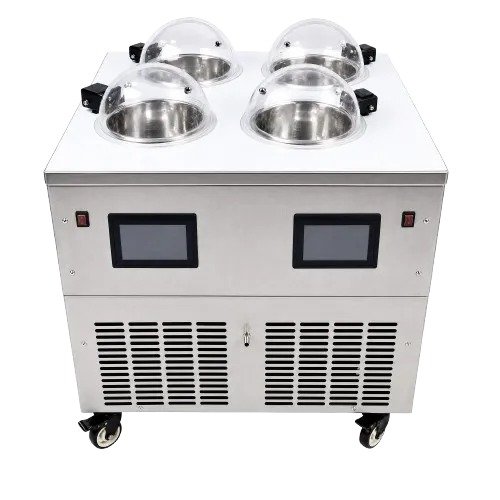
Full GB-series specification comparison
| Model | Bowls | Nominal output | Batch time | Circuits | Power | Dimensions (mm) | Weight | Container |
|---|---|---|---|---|---|---|---|---|
| GB-1 | 1 x 6 L | 14 L/h | 15-20 min | 1 | 1.6 kW / 220 V | 640 x 640 x 980 | 96 kg | 24 units / 20GP |
| GB-2 | 2 x 6 L | 28 L/h | 15-20 min | 1 | 2.5 kW / 220 V | 860 x 640 x 980 | 138 kg | 16 units / 20GP |
| GB-4 | 4 x 6 L | 56 L/h | 15-20 min | 2 | 4.8 kW / 220 V | 1080 x 980 x 1010 | 235 kg | 8 units / 20GP |
| GB-6 | 6 x 6 L | 84 L/h | 15-20 min | 3 | 7.2 kW / 220 V | 1500 x 980 x 1010 | 330 kg | 6 units / 20GP |
All models in the published specification use a Tecumseh compressor, R290 refrigerant, heated clear domes, 304 stainless steel construction, touch controls, and a one-key auto-wash cycle. Confirm final configuration, voltage, certification, and options in the quotation for your destination.
Start with the service model
The machine should fit the way customers order, not the other way around.
One flavor is enough
A one-flavor counter can work in a bakery, coffee bar, small cafe, dessert kiosk, or restaurant that offers a fixed dessert. The menu is simple, changeovers are limited, and staff can become efficient with one recipe.
The GB-1 fits this model. It uses one 6 L bowl, produces a nominal 14 L/h, and occupies a 640 x 640 mm footprint. It is the easiest model to place in a small front-of-house area.
The limitation is obvious: if the single flavor sells out during peak service, the machine must complete another batch before the display is restored.
Customers expect two or three choices
Two flavors can cover a standard and a rotating seasonal option. That is enough for many cafes, hotels, restaurants, and small dessert counters. The GB-2 provides two 6 L bowls and 28 L/h nominal output in an 860 x 640 mm footprint.
The GB-2 uses one refrigeration circuit. That keeps the machine simpler, but it also means the two bowls are not fully independent from a service standpoint. Ask about how the circuit is zoned and how the controller manages each bowl.
Four flavors create a complete display
Four flavors allow a shop to combine familiar staples with rotating options. A typical menu might include vanilla, chocolate, pistachio, and a fruit sorbet. The mix gives customers choice without requiring a very large production room.
The GB-4 is the first model with two independent refrigeration circuits. It provides four 6 L bowls, 56 L/h nominal output, and a 1080 x 980 mm footprint. The two-circuit design supports flavor availability and allows half the machine to be serviced or turned off separately.
For many independent gelato shops, this is the practical sweet spot.
Six flavors require a high-traffic plan
The GB-6 provides six 6 L bowls, 84 L/h nominal output, and three independent circuits. It suits a high-traffic gelato bar, a flagship store, a busy tourist location, or a business that wants a deep flavor display at all times.
The operational requirements also increase. The machine is 1500 mm wide and weighs 330 kg. It needs more counter space, stronger logistical planning, and a workflow that keeps six flavors fresh without excessive waste.
Capacity planning by model
Nominal output is not the same as daily sellable volume. The machine must stop for loading, flavor changes, cleaning, and recovery. Use the published output as a ceiling, then apply an efficiency factor based on your operation.
| Model | Nominal output | Conservative planning output | Best fit |
|---|---|---|---|
| GB-1 | 14 L/h | 8-11 L/h | Fixed menu or low-volume cafe |
| GB-2 | 28 L/h | 17-22 L/h | Two-flavor counter |
| GB-4 | 56 L/h | 34-45 L/h | Busy shop with four flavors |
| GB-6 | 84 L/h | 50-67 L/h | High-traffic bar or flagship store |
The conservative range assumes normal cleaning, loading, and flavor changes. A high-volume operation with dedicated staff may achieve more. A shop with frequent single-batch changes may achieve less.
Simple sizing example
A shop sells 90 ml scoops and expects 180 scoops during a four-hour peak. The theoretical volume is 180 x 0.09 = 16.2 L. With 15% waste and refill loss, it needs about 19 L of production.
If the peak is spread evenly over four hours, the average requirement is 4.8 L/h. That could fit the GB-1 on average. But if 70% of sales happen during one hour, the one-hour requirement is about 13.3 L. The GB-1 is at its nominal limit before allowing for recovery, and the GB-2 provides a safer buffer.
This is why average daily demand can understate the required machine. Model the peak, then check how quickly the machine can recover.
Power and installation differences
The published models use 220 V power, but the total load rises from 1.6 kW on the GB-1 to 7.2 kW on the GB-6. Verify the exact running current, starting current, plug, breaker, and cable requirement with the final electrical specification.
| Model | Published power | Electrical planning note | Footprint |
|---|---|---|---|
| GB-1 | 1.6 kW | Often suitable for a small dedicated circuit, subject to local code | Compact counter corner |
| GB-2 | 2.5 kW | Allow for refrigeration startup load and service access | Narrow two-bowl counter |
| GB-4 | 4.8 kW | Plan a robust dedicated supply and ventilation | Medium front-of-house station |
| GB-6 | 7.2 kW | Confirm building capacity, heat load, and multi-circuit service | Large flagship counter |
Every installation should also account for condenser clearance, ambient heat, drainage, floor loading, and the route used to move the machine into position. A 330 kg machine cannot be treated like a countertop appliance.
Cleaning and labor by model
More bowls create more cleaning positions. The GB-1 is the fastest to clean and easiest for a small team. The GB-6 offers more production and flavor availability, but it also requires a disciplined closing procedure.
A practical way to compare labor is to list every task:
- Remove and clean bowl covers.
- Drain or remove remaining product.
- Wash the bowl, dasher, scraper, and seals.
- Clean the control area and exterior stainless steel.
- Reassemble and sanitize.
- Run the auto-wash or rinse cycle.
- Record temperatures and maintenance issues.
For a shop with high staff turnover, simpler equipment can be more valuable than maximum flexibility. For a stable team, a larger multi-circuit machine can improve service without creating an operational bottleneck.
Which GB model should you choose?
Choose GB-1 if:
- You serve one flavor or change flavors only occasionally.
- Your counter is small and the electrical supply is limited.
- You are testing whether hard ice cream will sell.
- You can refill the bowl before the peak period.
Choose GB-2 if:
- You need two staple flavors visible at once.
- The shop has moderate traffic with predictable peaks.
- You want a compact footprint with more output than the GB-1.
- A single refrigeration circuit fits your service plan.
Choose GB-4 if:
- Customers expect four flavors during the main service period.
- You want two independent refrigeration circuits.
- You need 56 L/h nominal output without moving to a flagship-size machine.
- The counter can support a 1080 x 980 mm machine.
Choose GB-6 if:
- Flavor variety is central to the customer experience.
- The shop has high peak-hour demand and a large counter.
- Three independent circuits improve production resilience.
- The team can manage the additional cleaning and service work.
Common model-selection mistakes
Buying output without checking recovery. A machine that reaches temperature quickly still needs time between batches. Compare batch time, recovery, and cleaning time as one production cycle.
Counting bowls instead of flavors sold. Four bowls are useful only if the shop can sell and maintain four flavors. Otherwise the additional capacity creates waste and cleaning work.
Ignoring electrical reality. The largest model is not an upgrade if the building cannot support it without expensive electrical work.
Using catalog output as daily output. Nominal output is a controlled rating. Real production includes loading, cleaning, changeovers, product removal, and operator breaks.
Choosing the lowest quote without landed cost. Include freight, duties, electrical work, lifting, service, and spare parts when comparing suppliers.
Frequently asked questions
What is the difference between GB-2 and GB-4?
The GB-2 has two 6 L bowls, 28 L/h nominal output, one circuit, and a smaller footprint. The GB-4 has four 6 L bowls, 56 L/h nominal output, two independent circuits, and requires more space and power.
Is the GB-6 too large for a small shop?
It can be. The GB-6 is designed for high traffic, six simultaneous flavors, and larger production. A small shop may pay more for capacity and cleaning work that it cannot use consistently.
Can the GB-4 run with only half the machine on?
The GB-4 has two independent refrigeration circuits, so the service plan can use or isolate sections. Confirm the exact control behavior and operating instructions for the final configuration.
Which GB model is best for gelato?
All four models can be considered for gelato production when the recipe, operating settings, and capacity fit the machine. Choose by flavor count and peak demand: GB-1 for one flavor, GB-2 for two, GB-4 for four, and GB-6 for six.
What power supply do the machines need?
The published specifications list 220 V for all four models, with power increasing from 1.6 kW to 7.2 kW. Final voltage, phase, current, plug, and breaker requirements must be confirmed for the exact model and destination.
Match the model to the demand pattern
The best GB model is the one that keeps the required flavors available during peak service without creating unnecessary capital cost or cleaning work. Begin with the number of flavors and the busiest hour, then apply a realistic recovery and waste factor.
View the GB series specifications or send GLACIO your expected daily liters, scoops per hour, flavor count, voltage, and available counter dimensions. We will recommend the smallest model that still provides a safe production buffer.
Which is more important in your shop: maximum flavor choice, lower cleaning workload, or the smallest possible footprint? Leave a comment and tell us how you would choose.
Leave a Reply