Quick answer: if you want real hard ice cream from a hard ice cream machine at home or for a tiny side project, buy a compressor ice cream maker with at least 1.5 quarts of bowl capacity. Start around $350-380 with the Cuisinart ICE-100 or Whynter ICM-200LS; step up to the Lello 4080 Musso Lussino near $800 when texture and longevity matter more than the sticker price.
Your First Batch Probably Did Not Fail Because of the Recipe
After testing ice cream machines for years, I can usually predict the problem after one taste. The base is balanced. The vanilla is good. But the texture is icy, or the batch comes out so soft that it drains out of the bowl before it reaches the freezer. That is not a recipe problem. That is a machine-selection problem.
Home bakers and small food business owners often buy the cheapest option first, then spend the next year convincing themselves that “you just have to pre-freeze the bowl for 24 hours.” Sometimes that works. Usually it does not survive a busy Sunday or a farmers market deadline.
This guide is built around real choices: how hard ice cream is different from soft serve, which parts of the machine decide texture, and which three mainstream models make sense at different budgets.

Hard Ice Cream vs Soft Serve: Know What You Are Making
Soft serve is frozen, aerated, and dispensed continuously at a warmer serving temperature. It is meant to be served immediately, straight from the machine, usually within seconds of the customer ordering.
Hard ice cream is churned in a batch, then chilled to a lower temperature so it becomes firm enough to scoop, plate, and store. That final firmness is why it can sit in a display case, travel in a pint, or become the centerpiece of a dessert.
Here is the nuance most beginner guides skip: many home compressor machines finish at a soft-serve-like consistency. The machine does the churning and freezing work, but you still need to transfer the batch to your freezer for several hours to develop a true scoopable texture. That is normal, not a defect.
Two Types of Hard Ice Cream Machines
Pre-Freeze Bowl Machines
Budget models use a removable bowl that must sit in a freezer at roughly -18 degrees C for 12-24 hours before use. The bowl then provides the cold during the churn cycle.
- Good for: first experiments, small households, and people who make one batch every few weeks.
- Hard limit: one batch per session. Refreezing the bowl takes most of a day.
- Typical price: $40-150.
Built-in Compressor Machines
Compressor models freeze the bowl themselves, so there is no pre-freezing step and no limit of one batch per day. This is the category this guide recommends for serious home bakers and small sellers.
- Good for: repeat batches, entertaining, gelato experiments, and small-batch product testing.
- Trade-off: heavier, noisier, and more expensive than a bowl machine.
- Typical price: $300-900.
Core Buying Points That Actually Matter
1. Buy the compressor, not the wattage number
A common mistake is comparing “watts” as if a bigger number means better ice cream. In practice, the compressor and bowl design matter more than the motor rating. The compressor must hold a stable freezing temperature while the paddle churns, which is why a well-built 150-180 W compressor machine can outperform a weaker unit with a flashy number on the box.
Scenario: you want to make a second flavor immediately after the first batch. A pre-freeze bowl machine stops you cold; a compressor machine lets you rinse the bowl, pour fresh mix, and start again in minutes.
2. Match bowl capacity to how much you actually serve
The most practical home range is 1.5-2.1 quarts. That is enough for a family batch or a small product test without forcing you to store a huge machine.
Scenario: the Whynter ICM-200LS holds about 2.1 quarts, which is closer to two-and-a-half standard pints of finished product. The Cuisinart ICE-100 and Lello 4080 hold about 1.5 quarts, which suits smaller households and richer recipes. If your plan is selling pints at an event, neither home model is a production machine.
3. Check the freezing bowl and paddle material
Machines in this price range usually use stainless steel bowls or heavy-duty aluminum cylinders. A rigid cylinder transfers cold more consistently, and a well-shaped dasher controls overrun. You should also check whether the model ships a separate gelato-style paddle, because gelato and hard ice cream benefit from different churn speeds.
Scenario: the Cuisinart ICE-100 includes two paddles: one for ice cream and one for gelato. That is not marketing fluff; a slower, softer churn helps you build the denser structure gelato should have.
4. Look for a timer and automatic motor protection
Most compressor machines run a 40-60 minute cycle. A clear timer helps you repeat recipes, and motor protection stops the paddle if the batch freezes solid. If a machine has neither, you have to babysit every batch.
Scenario: you leave the kitchen to answer messages while testing a recipe. With a 60-minute timer and automatic shutoff, the machine stops at a predictable point instead of churning until the motor strains.
5. Plan for noise and waste heat
Compressor machines are not silent. They also push warm air out while they freeze, which is the physics of moving heat out of the bowl. Keep the unit on an open counter, leave clearance around the vents, and run it before your kitchen gets crowded.
6. Buy something you can clean without taking apart
You will use a home hard ice cream machine most often on busy evenings. If cleaning takes 20 minutes and involves scrubbing a sealed system, you will quietly stop using it. Look for a removable bowl, removable dasher, and easy access to the lid seal.
7. Read the warranty and parts situation before paying more
At $800, you are not paying only for capacity; you are paying for build quality and the chance of finding replacement parts later. At any budget, search for the manufacturer warranty and whether paddles, seals, or bowls are sold separately.
Three Mainstream Models Compared
Prices below are U.S. list-price or street-price guides as of 2026. Retail prices change, and the exact current deal matters less than which category fits your kitchen.
| Model | Price guide | Capacity | Freeze system | Best for | Watch out |
|---|---|---|---|---|---|
| Whynter ICM-200LS | ~$350 | 2.1 quarts | Built-in compressor, 180 W | Large family batches and parties under $400 | Controls are simple but less flexible for gelato-style paddle settings |
| Cuisinart ICE-100 | $379.95 list | 1.5 quarts | Built-in compressor, 60-minute timer | People who want ice cream and gelato paddles in one compact unit | Smaller batches than the Whynter; check counter clearance |
| Lello 4080 Musso Lussino | ~$800 | 1.5 quarts | Built-in compressor, 150 W | Home bakers who want pro-style texture, stability, and long service life | Expensive, heavy, and still not a commercial output machine |
Whynter ICM-200LS: the practical under-$400 pick
The Whynter gives you the largest common batch size in this price class at 2.1 quarts, with a stainless steel bowl, LCD timer, and no pre-freezing. If you cook for four to six people or want enough product to test several flavors, this is the machine I recommend starting with.
Cuisinart ICE-100: the easiest ice cream + gelato combo
The ICE-100 is compact, predictable, and includes separate ice cream and gelato paddles. At 1.5 quarts, each batch is smaller, but the two-paddle system makes it easier to compare a dense gelato churn against a standard hard ice cream churn. It is also the model I would hand to a curious home baker who wants clear controls.
Lello 4080 Musso Lussino: the upgrade worth saving for
The Lello is the machine I reach for when a recipe must be reproducible. It is made in Italy, uses a heavy-duty freezer cylinder, and has earned its reputation through years of home use rather than a single viral video. The 1.5-quart capacity and near-$800 price make it a poor impulse buy, but a fair investment if you plan to make hard ice cream and gelato every week for years.
When a Home Machine Is Not Enough
A 1.5-2.1 quart home compressor machine produces roughly 6-8 scoops per batch and one batch per 40-60 minutes. That is excellent for a family or a product test. It is not a production plan for a real ice cream shop, weekend event sales, or wholesale orders.
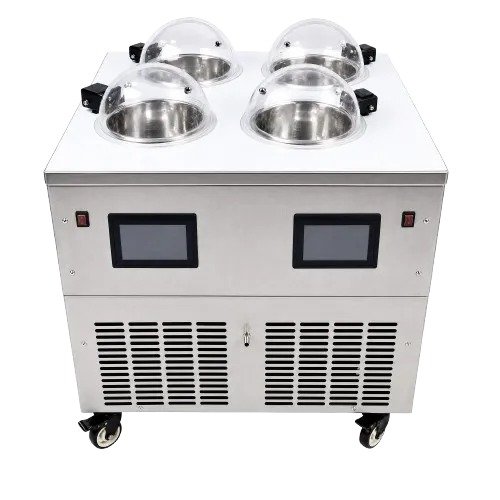
If sales outgrow the kitchen counter, look at commercial hard ice cream batch freezers. A GLACIO GB-Series open-bowl batch freezer, for example, uses 6-liter bowls and produces roughly 14-84 L/h depending on bowl count, with a 15-20 minute cycle. That is the equipment category built for dependable scoop-shop volume, not one more batch before dinner.
Can a home ice cream maker make hard ice cream?
Yes, with one extra step. A compressor home machine churns and partially freezes the mix; you then transfer the batch to the freezer for several hours so it becomes firm enough to scoop.
Do I need a compressor ice cream machine?
If you make ice cream more than a few times per year or want to make multiple flavors, yes. A compressor machine removes the 12-24 hour pre-freeze wait and makes repeat batches practical.
What is the best hard ice cream machine under $400?
Two models stand out: the Whynter ICM-200LS for 2.1-quart batches around $350, and the Cuisinart ICE-100 at $379.95 list for its ice cream and gelato paddles. Choose by whether capacity or recipe flexibility matters more.
Can I use a home machine for a small ice cream business?
Use it to test recipes, but not to meet real production volume. A home machine makes 1.5-2.1 quarts per batch; a commercial batch freezer is designed for continuous scoop-shop output measured in liters per hour.
What should I look for in a hard ice cream machine for home use?
Prioritize a built-in compressor, at least 1.5 quarts of bowl capacity, a stable freezing cycle, and easy cleaning. A hard ice cream machine that makes repeat batches without a 12-24 hour pre-freeze wait is more practical for home bakers who test several flavors.
Pick the Machine You Will Use on a Tuesday
Buy the compressor. Match the bowl size to your counter and your realistic weekly output. Do not spend $800 just because it looks serious, and do not buy a $50 bowl machine when you already know you will want a second batch tonight.

So tell me honestly: which machine is sitting on your counter, and what does your latest batch taste like? Share your model, your budget, and your biggest ice cream failure in the comments, because the best equipment advice comes from people who have already churned through the trial-and-error.
For more guidance, compare hard ice cream vs soft serve machines and read the commercial hard ice cream machine guide when your small-batch tests become a real business.
Leave a Reply