




A new team member can run a commercial hard ice cream machine safely and consistently in one four-hour shift, provided the training is split into four blocks and written down. The failure mode is not skill, it is memory: without a written standard, the second person invents their own cleaning method and the machine starts wearing out.
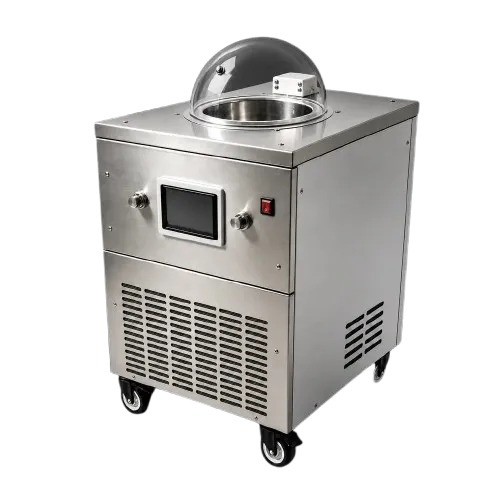
This is the training structure we recommend to shops buying GB series machines. Photograph your own machine at each step and replace the descriptions with your photos — a visual SOP is followed far more often than a printed paragraph.

The one-shift training plan
| Time | Block | What the trainee must do unaided by the end |
|---|---|---|
| 0-30 min | Safety and power-up | Locate the breaker, start the machine, explain the lid interlock and why hands never enter a running cylinder |
| 30-90 min | First batch | Load the correct volume of mix, start the cycle, time it, and record the result |
| 90-150 min | Texture reading | Judge a finished batch by viscosity, ribbon, and drawing temperature without being told |
| 150-210 min | Cleaning and shutdown | Disassemble, clean, sanitise, lubricate gaskets, and reassemble |
| 210-240 min | Supervised solo run | Produce and clean one full batch while the trainer watches without helping |
The final block is the one most shops skip. Watching someone work without correcting them is the only way to find out what they will actually do when you are not standing next to them.
Block 1: safety and power-up
Teach these five points first, before anything touches the machine:
- Never reach into a cylinder while the machine is running or powered. The dasher turns with enough torque to injure a hand.
- Know where the breaker is and how to isolate the machine without touching water.
- Respect hot surfaces around the refrigeration lines and be aware that cold surfaces can burn skin on contact.
- Check the lid interlock and the emergency stop before every shift, and report anything that feels loose.
- Never add mix with the machine running unless the model is designed for it and the manual says so.

Block 2: the first batch
Have the trainee complete these steps in order and write the numbers down:
- Check that the bowl, dasher, and lid are correctly assembled and the gaskets are seated.
- Fill to the marked level, not to the rim. Overfilling lengthens freezing time and stresses the drive.
- Set the timer and record the cycle time. A 6-liter bowl normally finishes in 15 to 20 minutes.
- Record the mix temperature before loading and the product temperature at draw.
- Stop the machine, draw the product, and note the texture against the target for the flavor.
Teach the trainee to compare the recorded time with the baseline on your machine. A cycle that is suddenly 30% longer is an early warning of a worn dasher, a dirty condenser, or mix that is too warm.
Block 3: reading texture without a gauge
Operators learn to judge a batch in seconds with three checks:
- Viscosity: the mix should resist a spatula and leave a clear line when drawn through the surface.
- Ribbon test: lift the spatula; the product should fall back in a ribbon, not pour like mix or clump like butter.
- Surface: the batch should look matte and hold its shape on the blade. Shiny, wet-looking product is under-frozen; a grainy, greasy surface means it has been churned too long.
Scenario: a new operator left a batch running while serving customers. The extra six minutes produced a buttery texture and the batch was scrapped. The trainee did not need more theory, they needed a rule: the machine stops when the batch is done, not when the queue is gone.
Block 4: cleaning and shutdown
Cleaning is where machine life is decided. Write down the daily and weekly tasks separately.
| Frequency | Task |
|---|---|
| End of every production session | Drain and rinse with lukewarm water, wash with a food-safe detergent, sanitise, and dry thoroughly |
| Daily | Wipe the lid and dome, clean the drip tray, check the condenser for dust and grease |
| Weekly | Inspect gaskets and seals, lubricate with food-grade lubricant, check the dasher blades for wear |
| Monthly | Deep clean the condenser and ventilation path, check mountings and fasteners, confirm cycle times against the baseline |
Use lukewarm water for the first rinse. Very hot water on a cold cylinder shocks the metal and hardens dairy residue into the surface. Never use abrasive pads on the cylinder or the dome.
The 10-point shift checklist
- Breaker on, machine powers up, no error codes.
- Lid and gaskets seated correctly.
- Mix at the correct temperature and volume.
- Cycle timer started and recorded.
- Texture checked against the flavor standard.
- Draw temperature recorded.
- Product transferred to the display cabinet at the right temperature.
- Machine cleaned and sanitised.
- Gaskets lubricated and lid left open for airflow.
- Any abnormal noise, longer cycle, or leak reported in writing.
Common new-operator mistakes
| Symptom | Usual cause | Fix |
|---|---|---|
| Batch too soft | Stopped too early, mix too warm | Check mix temperature, teach the ribbon test |
| Buttery or greasy texture | Batch over-churned | Train on cycle time and stop discipline |
| Machine slows over weeks | Dirty condenser, worn dasher blades | Monthly deep clean, replace wear parts on schedule |
| Leaks at the bowl | Gasket not seated or not lubricated | Re-teach assembly, keep spare gaskets in stock |
FAQ
How long does it take to train someone on a batch freezer?
One four-hour shift is enough to produce and clean consistently when the trainee is taught in four blocks and completes a supervised solo run. Reaching full speed on multiple flavors usually takes a week of production days.
Should staff clean the machine every day?
Yes. Daily cleaning after production is the single habit that most affects machine life and food safety. Weekly tasks add gasket inspection and lubrication, and monthly tasks cover the condenser and fasteners.
What is the most common training mistake?
Skipping the supervised solo run. People perform differently when nobody is correcting them, and that is exactly when bad habits become the standard.
Do we need a written SOP for a small shop?
Yes, and it should fit on two pages with photos. A written SOP keeps quality consistent when the owner is away and makes it possible to train the next hire in one shift.
Next step
Send us your model and the flavors you produce and we will send a training sheet pre-filled with your machine specifications and cycle times. Request the operator training sheet, and read the maintenance checklist for the service schedule behind it.
What habit took your team longest to learn? Share it in the comments so new operators start one step ahead.
Some information may be outdated
Comments
Questions about equipment capacity, voltage, or recipes? Leave a comment.
Loading comments...