




If you only remember one line: buy the machine and the display cabinet first, and buy everything else from the money the first two make. A hard ice cream or gelato shop fails at the counter, not in the back room, and the counter needs a machine that produces consistently and a cabinet that keeps product saleable.
This guide gives a realistic budget order for a small shop, with ranges you can compare against quotes, and the two places where spending more actually earns more.
The buying order that keeps you selling
| Phase | What you buy | Why it belongs here |
|---|---|---|
| 1 – Open | Hard ice cream machine, display cabinet, electrical preparation, basic cleaning kit | Without these four items you cannot sell a single scoop |
| 2 – Scale | Extra freezer storage, prep tables and shelving, POS and labelling, second display section | Needed when volume grows, not before |
| 3 – Optimise | Blast freezer, second machine or extra bowls, insulated transport boxes, water filtration | Reduces waste and labor once demand is proven |
Sample budget for a small shop
These ranges reflect equipment in the small commercial class, not hobby machines and not factory lines. They exclude rent, fit-out, and staff.
| Item | Typical range | Notes |
|---|---|---|
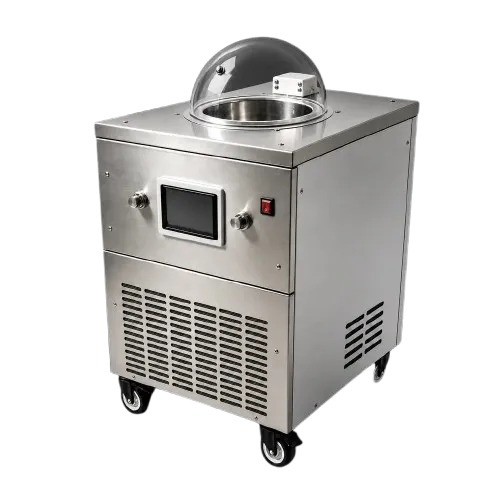
| Hard ice cream machine (1-2 bowls) | $3,500 – $9,000 | 4-8 L per batch; the centre of the business |
| Display cabinet with serving temperature | $1,500 – $6,000 | Do not buy a domestic freezer for this job |
| Freezer storage | $800 – $3,000 | Backup stock and finished product |
| Electrical preparation | $800 – $4,000 | Dedicated circuits; a service upgrade can exceed $10,000 |
| Prep tables, shelving, sinks | $500 – $2,000 | Buy stainless where it touches food |
| Cleaning, sanitiser, brushes, spare gaskets | $200 – $600 | Keep one spare gasket set on site |
| POS, labels, cups, cones, spoons | $300 – $1,500 | Consumables scale with volume, not with the shop |
| Realistic starting total | $7,600 – $26,100 | Before rent, fit-out, and marketing |
Where to spend more, and where not to
Spend more on:
- The freezing system. Compressor headroom and cylinder quality decide whether you can produce at 32 degrees C in August. This is the one place where a cheaper machine costs money every week.
- The display cabinet. Product held at the wrong temperature softens, refreezes, and gets thrown away. Waste is charged at full mix price.
Do not spend more on:
- Extra bowls before you have extra demand. A six-bowl machine producing one flavor is idle capacity you financed.
- Decorative fit-out before the counter works. Customers judge the product and the queue, then the wallpaper.
- Domestic equipment in a commercial role. A home compressor machine that runs four hours a day dies quickly, and it will die during your busiest week.
How many scoops a day covers the equipment
Assume a machine and cabinet package at $10,000 financed over 36 months at 8%, which is roughly $313 per month. If a scoop sells for $3.50 and costs about $0.53 in mix and consumables, the contribution is close to $2.97 per scoop.
| Target | Calculation | Result |
|---|---|---|
| Scoops to cover the equipment payment | $313 / $2.97 | About 106 scoops per month |
| That is, per day | 106 / 30 | About 4 scoops per day |
| Add labor and rent | Multiply the same logic | Most shops need 40-80 scoops a day to be healthy |
The point is not that equipment is expensive. It is that equipment financed at a few hundred dollars a month needs very little volume to justify itself, and a machine that cannot hold texture on a busy Saturday is far more expensive than the payment.
Buying used equipment
Used machines can be a good entry point if you check four things:
- Age and duty history. Ask how many hours per day it ran and in what ambient temperature.
- Compressor condition. Listen at start-up, check the current draw, and look for oil traces around joints.
- Spare parts availability. A working machine with no parts supply is scrap with a plug.
- Voltage. Confirm the nameplate matches your supply before you pay for transport.
Scenario: a shop saved $2,500 on a used two-bowl machine, then spent $1,800 on a compressor repair in month four and lost two weekends of production. The saving was real; the cost of downtime was larger.
FAQ
How much does it cost to equip a small ice cream shop?
For a small shop using a one- or two-bowl hard ice cream machine, a display cabinet, storage, electrical preparation, and basic prep equipment, plan between roughly $7,600 and $26,100 before rent and fit-out.
Should I buy the machine or the display cabinet first?
They are one purchase. A machine with no display cabinet cannot sell product, and a cabinet with no machine has nothing to display. Budget them together and buy them in the same phase.
How many bowls should a new shop start with?
Two bowls is the practical starting point for most shops: one flavor producing while another is sold. Move to four or six bowls when sales data shows you are producing multiple flavors daily.
Is it worth buying a blast freezer in phase one?
Usually not. A blast freezer pays back through waste reduction and labor once volume is stable. Buy it in phase three, funded by proven demand.
Next step
Send us your menu plan, your daily target in liters, and your available power. We will size the machine and the display capacity together so you buy once. Request an equipment budget review, and compare capacity options in the GB series selection guide.
What did you buy first when you opened, and what would you delay now? Tell us in the comments.
Some information may be outdated
Comments
Questions about equipment capacity, voltage, or recipes? Leave a comment.
Loading comments...