




Quick answer: choose an open-bowl ice cream machine when you sell several flavors, change batches often, and want staff to see and manage the product directly. Choose a closed-cylinder machine when you run fewer recipes, need a more enclosed production process, or want a traditional batch freezer with product extracted at the end of each cycle.
The choice is not about which design is automatically better. It is about how your menu, staff, peak hours, cleaning routine, and counter layout work together. For most cafes, gelato bars, bakeries, and small dessert shops, flavor flexibility matters more than brochure output. For a producer running the same base recipe for hours, enclosed cylinders and larger systems can be more efficient.
This guide breaks the decision into the numbers and operating conditions that matter before you pay a deposit.
Reviewed by the GLACIO Machinery equipment team | Updated September 15, 2026 | 9 minute read

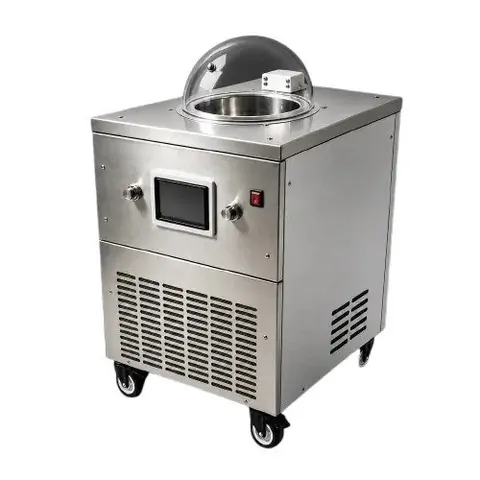
GLACIO open-bowl batch freezer. Product photo: GLACIO Machinery.
What is an open-bowl ice cream machine?
An open-bowl machine, often called a display batch freezer or open-bowl gelato machine, lets the operator work with visible refrigerated bowls or cylinders. The product stays accessible for checking texture, adding inclusions, switching flavors, and serving or transferring the batch.
The useful benefit is operational, not decorative. Staff can see whether a batch is too soft, too hard, or uneven before it reaches the display case. A shop with eight flavors can prepare smaller runs throughout the day instead of committing one large machine to a single recipe.
Open-bowl machines are common in:
- Gelato and hard ice cream shops with rotating flavors.
- Cafes and bakeries adding dessert sales without a full production kitchen.
- Bubble tea shops testing gelato or sorbet as an add-on.
- Small producers that sell cups, cones, pints, and desserts from one menu.
- Businesses that need dairy, vegan, and allergen-sensitive batches separated.
What is a closed-cylinder machine?
A closed-cylinder batch freezer freezes mix inside an enclosed barrel. The operator loads the mix, runs a cycle, and extracts the finished batch through a door or outlet. The freezing process is less visible, but the machine can be designed for consistent cycles and straightforward sanitation.
Closed-cylinder machines can be a strong fit when:
- One or two recipes make up most of production.
- The team follows a fixed formulation and cycle program.
- The machine feeds trays, blast freezing, packaging, or a larger production line.
- Floor space or operator exposure is a concern.
- The business values a more enclosed process over visible bowl-by-bowl control.
Closed cylinders are not the same as soft-serve machines. A hard ice cream batch freezer still produces a firm product that must be hardened, stored, and scooped. The difference is how the mix is frozen and how the operator manages each batch.
Open bowl vs closed cylinder: direct comparison
| Decision factor | Open-bowl machine | Closed-cylinder machine | Which usually wins |
|---|---|---|---|
| Flavor changes | Small visible batches; easier to change recipes | Possible, but often slower between runs | Open bowl |
| Product visibility | Staff can inspect texture and mix-ins | Freezing process is enclosed | Open bowl |
| Allergen separation | Easier to isolate dairy, vegan, or nut batches by bowl or circuit | Depends on cleaning and program control | Open bowl, when circuits are independent |
| Cleaning | More accessible surfaces can be faster to inspect | Barrel cleaning follows a defined procedure | Depends on machine design |
| High-volume consistency | Good when batches are scheduled well | Strong for repeatable, longer production runs | Closed cylinder |
| Peak-hour flexibility | Add a batch when demand appears | Better for planned production | Open bowl |
| Training difficulty | Visual feedback helps new staff | Requires disciplined cycle control | Open bowl for beginners |
| Counter appeal | Can support a visible preparation story | More utilitarian appearance | Open bowl |
| Space use | May need clearance for bowls and domes | Can fit a tighter production footprint | Closed cylinder |
| Best business fit | Multi-flavor shop, cafe, bakery, food hall | Producer with limited recipes and steady volume | Tie, based on menu |
The real cost is changeover time
A machine with a higher liters-per-hour rating can still lose to an open-bowl machine if changeovers, cleaning, and recovery time are poor.
Use a practical production cycle, not just the freezing timer:
- Measure and load the mix.
- Freeze the batch.
- Extract or transfer the product.
- Clean the bowl, dasher, and contact surfaces.
- Allow the refrigeration system to recover before the next batch.
For a small shop, the last two steps often decide whether staff can serve the next flavor during the lunch rush. A 6-liter batch that takes 30 minutes to freeze but 20 minutes to change over is not producing 12 liters per hour in real life. Its usable output may be closer to 7 liters per hour.
Example: a shop selling 80 scoops per hour
Assume a 90-gram scoop and a 65% usable-production factor. The shop needs roughly 7.2 liters of finished product per peak hour. If a machine freezes a 6-liter batch in 30 minutes, the theoretical output looks like 12 liters per hour. After extraction, cleaning, and recovery, the practical output may be 7 to 8 liters per hour.
That is enough for the example, but there is little cushion. If a flavor becomes unexpectedly popular, the machine cannot recover quickly enough. For this reason, calculate peak demand separately from daily demand. A machine can handle 100 liters across a day and still fail during a 90-minute rush.
Read the related guide on batch freezer sizing by daily sales for a fuller capacity calculation.
Six specifications that matter more than the label
1. Independent circuits
A four-bowl machine with one refrigeration circuit cannot run every bowl independently. If the machine has two circuits, one section can keep producing while the other is cleaned or held at serving temperature.
Ask the supplier to identify which bowls share a compressor. This is especially important if you sell dairy and vegan products or need to isolate a major allergen.
2. Bowl or cylinder volume
Batch size should match your smallest commercially useful recipe, not just your biggest bowl. A 10-liter bowl is inefficient if your test flavors sell only 3 liters per day. A 4-liter bowl is limiting if weekend demand requires repeated refills.
For a multi-flavor shop, think in terms of flavor turns rather than total bowl count. Each bowl needs enough demand to justify the labor and ingredient cost of a batch.
3. Compressor and recovery time
The compressor must maintain a stable freezing temperature while the dasher works the mix. A lower number of watts does not always mean a weaker machine, but the refrigeration system must be matched to batch size and cycle time.
Ask for the recovery time after a full batch, not only the initial freeze time. That number shows how quickly the machine can start the next flavor.
4. Contact materials and sanitation access
Stainless steel and food-grade materials should be easy to inspect. Removable parts should not hide mix in seams or sharp corners. Confirm the cleaning procedure and the time it takes one person to complete it.
Where required by your market, look for the applicable electrical and sanitation certifications. Do not assume that a CE mark or UL listing automatically covers every local requirement. Verify the exact model and its documentation.
5. Power and installation fit
Commercial machines may use single-phase or three-phase power depending on model and market. Before ordering, confirm voltage, phase, frequency, circuit breaker size, plug type, and whether the building needs an electrical upgrade.
The commercial ice cream machine installation checklist covers voltage, drainage, ventilation, and service clearance. It is worth reviewing before the quote is finalized.
6. Spare parts and service response
A machine is only productive when it can be repaired. Ask for the parts list, warranty terms, typical response time, and the name of the local or regional service partner. For export orders, confirm whether common wear parts ship with the machine.
How to choose open bowl or closed cylinder in five questions
- How many flavors do you sell each day? More than four active flavors usually points toward open bowls or multiple independent circuits.
- How often do you change a batch? Frequent flavor changes favor a visible, accessible machine.
- What is your peak-hour demand? Calculate scoops and grams per hour, then add a 20% to 30% buffer.
- Do you need allergen separation? If yes, prioritize independent bowls, circuits, and a documented cleaning process.
- Will the machine be a production tool or part of the customer experience? Open bowls can support both; closed cylinders usually prioritize production.
If the answers point in different directions, buy capacity in modules. Two smaller independent machines may be more useful than one oversized machine with a single production chamber.
Best fit by business type
| Business type | Starting choice | Reason |
|---|---|---|
| Neighborhood gelato shop | Open bowl with 2-4 bowls | Flavor variety, visible quality control, flexible batches |
| Cafe or bakery | Compact open-bowl machine | Small footprint, menu testing, easy staff training |
| Food hall or kiosk | One or two independent circuits | Limited space but high visibility and quick flavor changes |
| Bubble tea shop | Open bowl with dairy and vegan separation | Add-on sales and allergen control |
| Pint or tub producer | Closed cylinder or larger batch freezer | Repeatable cycles and packaging workflow |
| Producer above 300-500 L per day | Continuous or hybrid system | Higher throughput and lower labor per liter |
If production is moving beyond one machine, compare continuous freezer vs batch freezer before adding equipment.
Common buying mistakes
- Comparing only the bowl size and ignoring compressor recovery time.
- Counting bowls instead of independent circuits.
- Assuming brochure output is the same as sellable output.
- Forgetting that hardening, storage, and display capacity must match the freezer.
- Buying a production machine before testing real daily demand.
- Choosing a machine without confirming local voltage and service support.
- Ignoring the labor cost of cleaning eight bowls instead of four.
Frequently asked questions
Is an open-bowl ice cream machine better for gelato?
For many small gelato shops, yes. Open bowls make it easier to inspect texture, change flavors, and separate dairy from vegan batches. A closed-cylinder machine can still make excellent gelato when the recipe and cycle are controlled.
Can an open-bowl machine make hard ice cream?
Yes. The distinction is the machine architecture, not the finished product. A hard ice cream batch freezer must still reach the correct draw temperature and the product must be hardened before scooping.
How many bowls do I need?
Start with daily flavor demand and peak-hour output. A practical starting point is one production bowl for every four to six active flavors, then add a second circuit when cleaning or peak-hour refills become the bottleneck. See how many bowls an ice cream shop needs.
Can one machine produce dairy and vegan flavors?
It can when the machine is fully cleaned between recipes and the supplier confirms that the materials and cleaning method are suitable. If cross-contact risk is high, separate bowls, circuits, or machines provide stronger control.
What output do I need for 100 scoops per day?
At 90 grams per scoop, 100 scoops equal about 9 liters of finished product, before waste and sampling. Add a production buffer and calculate peak-hour demand separately. A machine that meets the daily total may still be too slow during peak sales.
Choose the machine around the menu, not the brochure
The best choice is the one that keeps the right flavors available at the right time with a cleaning and recovery routine your team can repeat. Open bowls win on flexibility and visibility. Closed cylinders win on enclosed, repeatable production. Most small food businesses should start by measuring peak demand, counting real flavor changes, and checking independent circuits.
Send GLACIO your peak-hour scoop estimate, flavor count, voltage, and available counter space. Request a specification-based open-bowl machine recommendation and we will help you compare bowl count, output, and installation requirements.
What is harder in your shop right now: changing flavors, keeping up during peak hours, or cleaning between batches? Leave a comment with your current setup.
Some information may be outdated
Comments
Questions about equipment capacity, voltage, or recipes? Leave a comment.
Loading comments...