

Ice Cream Batch Freezer Buying Guide: Output, Power, Price
Short answer: an ice cream batch freezer freezes one bowl of mix at a time, then holds it at scooping temperature. Size it by bowls and cycle time, not by a single “liters per hour” number. A 6-liter bowl produces roughly 7 to 8 liters of finished product at 25 percent overrun, cycles in 15 to 20 minutes, and with handling time gives you about 2.5 to 3 batches an hour, or 14 to 18 liters per bowl per hour once the machine is running. Two bowls covers most cafes and bakeries. Four to six bowls is where a busy gelato or ice cream shop starts.
Buyers usually discover the real constraint in the first busy weekend. The machine freezes beautifully at 10 am and falls behind at 4 pm, because a flavor that sells out in 40 minutes needs a replacement batch that takes 20 minutes to freeze plus handling. A batch freezer is a production tool with a rhythm, and the rhythm is what you are buying.
This guide is written for shop owners, cafe and bakery operators, dessert bars and small producers comparing their first or second batch freezer. Numbers are working ranges from supplier specifications and shop experience; confirm the final figures for the model you are quoted.
What a batch freezer does, step by step
A batch freezer mixes and freezes a fixed volume of prepared mix inside a cylinder or bowl, then stops when the product reaches the target texture and temperature.
- Load. Pour prepared, chilled mix into the bowl or cylinder to the marked level.
- Churn and freeze. A dasher scrapes the cold surface while the refrigerant pulls heat out of the mix.
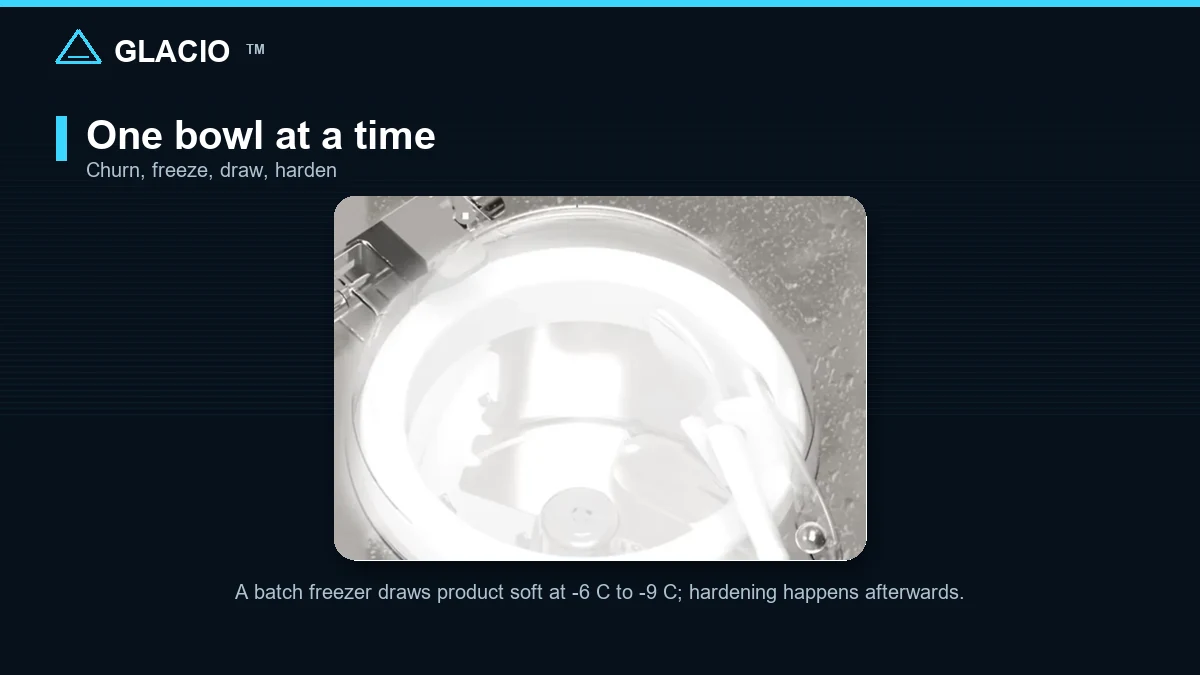
- Draw. The product comes out at -6 C to -9 C as a soft, scoopable mass.
- Harden. Pans or trays go into a blast freezer or a -18 C or colder freezer to set firm.
- Hold. In a display batch freezer the bowl itself holds the product near serving temperature.
Step 3 is where most expectations break. What leaves the machine is not finished ice cream. It still has to harden, and if you skip that or rush it, the texture shows up as ice crystals a day later.
Batch freezer, continuous freezer or soft serve machine
| Machine | How it freezes | Output | Typical buyer |
|---|---|---|---|
| Batch freezer | One fixed bowl or cylinder at a time | 14 to 18 L per bowl per hour | Shops with a flavor menu, cafes, bakeries, small producers. |
| Continuous freezer | Mix is pumped through and frozen in a stream | 100 to 1,000+ L per hour | Factories and packing lines running one flavor for hours. |
| Soft serve machine | Two hoppers feed a gravity or pressurized barrel | Two flavors served straight from the spout | Soft serve counters and quick service outlets. |
If your menu changes through the week and customers buy by the scoop, a batch freezer is the right tool. The trade-off between batch and continuous freezing is covered in more depth in the comparison of a continuous freezer versus a batch freezer.
Capacity math that survives a busy Saturday
Bowl size versus finished liters
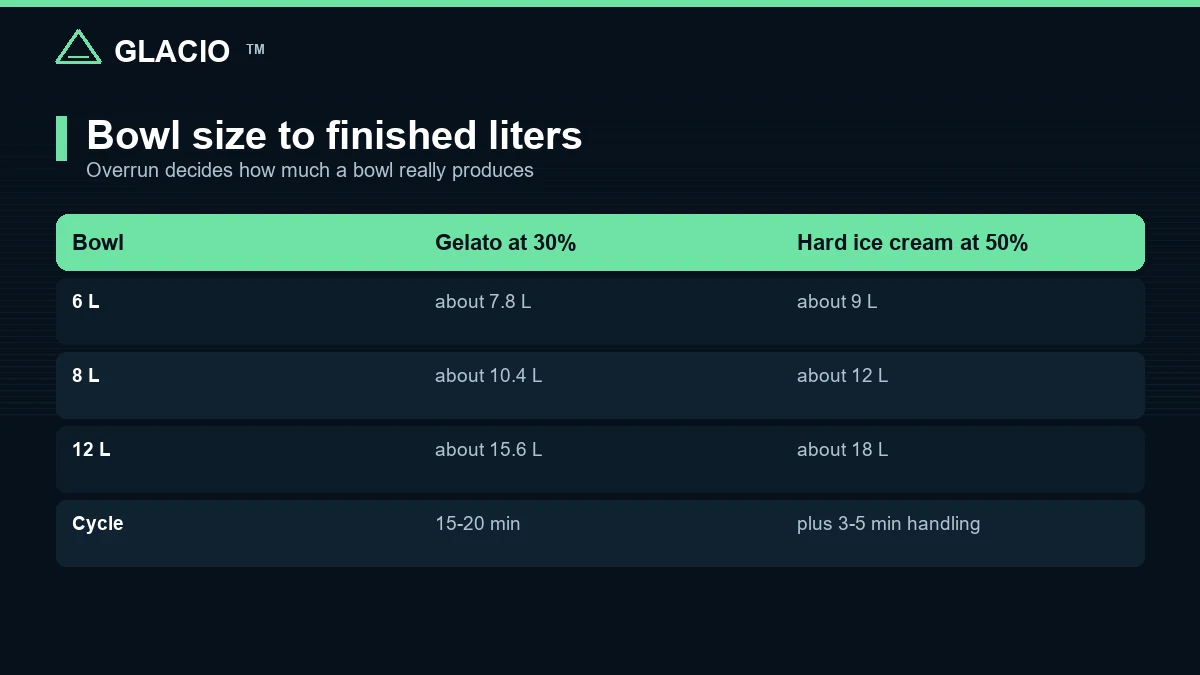
A 6-liter bowl does not produce 6 liters of finished ice cream. Overrun, the air whipped into the mix, adds volume. Gelato typically runs 25 to 35 percent overrun and hard ice cream 50 percent or more, so the same bowl yields different amounts depending on what you make.
| Bowl size | Gelato at 30% overrun | Hard ice cream at 50% overrun | Scoops at 90 ml (gelato) |
|---|---|---|---|
| 6 L | about 7.8 L | about 9 L | roughly 80 |
| 8 L | about 10.4 L | about 12 L | roughly 105 |
| 12 L | about 15.6 L | about 18 L | roughly 160 |
Cycle time is part of capacity
A batch runs 15 to 20 minutes depending on mix temperature, fat content, bowl size and how cold the room is. Then you spend another 3 to 5 minutes drawing product, cleaning the bowl and loading the next mix. Realistically, one bowl delivers 2.5 to 3 finished batches an hour, not the four or five that a headline cycle time suggests.
Worked example: a shop sells 300 scoops on Saturday at 90 ml, which is about 27 liters of gelato. On a two-bowl machine running 6-liter bowls at three batches per bowl per hour, that is roughly 47 liters of capacity per hour of concentrated production time. The machine is not the bottleneck. Staff time, freezer space for hardening and pan rotation are.
| Configuration | Realistic daily output | Fits |
|---|---|---|
| 1 bowl, 6 L | 15 to 25 L per day | Test batches, one-flavor counters, very small shops. |
| 2 bowls, 6 L | 30 to 50 L per day | Cafes, bakeries, dessert bars with a focused menu. |
| 4 bowls, 6 L | 60 to 100 L per day | Gelato shops showing 4 to 6 flavors at once. |
| 6 bowls, 6 L | 90 to 150 L per day | Busy shops, multiple dayparts, wholesale top-ups. |
Treat these as planning numbers with the machine running through a normal service day, not flat out for eight hours. If you are unsure which row matches your sales, the sizing method in batch freezer sizing by daily sales walks through the same arithmetic from the sales side.
Compressor, refrigerant and cooling design
The compressor is the part that decides whether the machine holds texture through a long day. Cheaper machines save money here first.
| Choice | Common in | What it means in practice |
|---|---|---|
| Hermetic compressor | Countertop and light commercial units | Lower cost and quiet, but less repairable and less tolerant of long continuous runs. |
| Semi-hermetic or scroll | Multi-bowl and floor-standing machines | Higher cost, better heat tolerance and serviceability, longer duty cycles. |
| Air-cooled condenser | Most shops | Simple to install. Needs clean airflow and a room that does not sit at 35 C all summer. |
| Water-cooled condenser | Hot climates and tight back rooms | Rejects heat into water instead of air, quieter and more stable, needs a water supply and drainage. |
Ask which refrigerant the machine uses and confirm it is available where you operate. R404A, R452A, R448A and R290 all appear in current equipment, and the choice affects future service cost more than it affects today’s freezing speed.
Electrical supply and installation
Batch freezers are not plug-and-forget appliances in a shop with one spare socket.
- Single phase 220-240 V is common on 1 and 2 bowl countertop machines, typically on a dedicated 16 A to 20 A circuit.
- Three phase 380-415 V appears from around 4 bowls upward and on most floor-standing models.
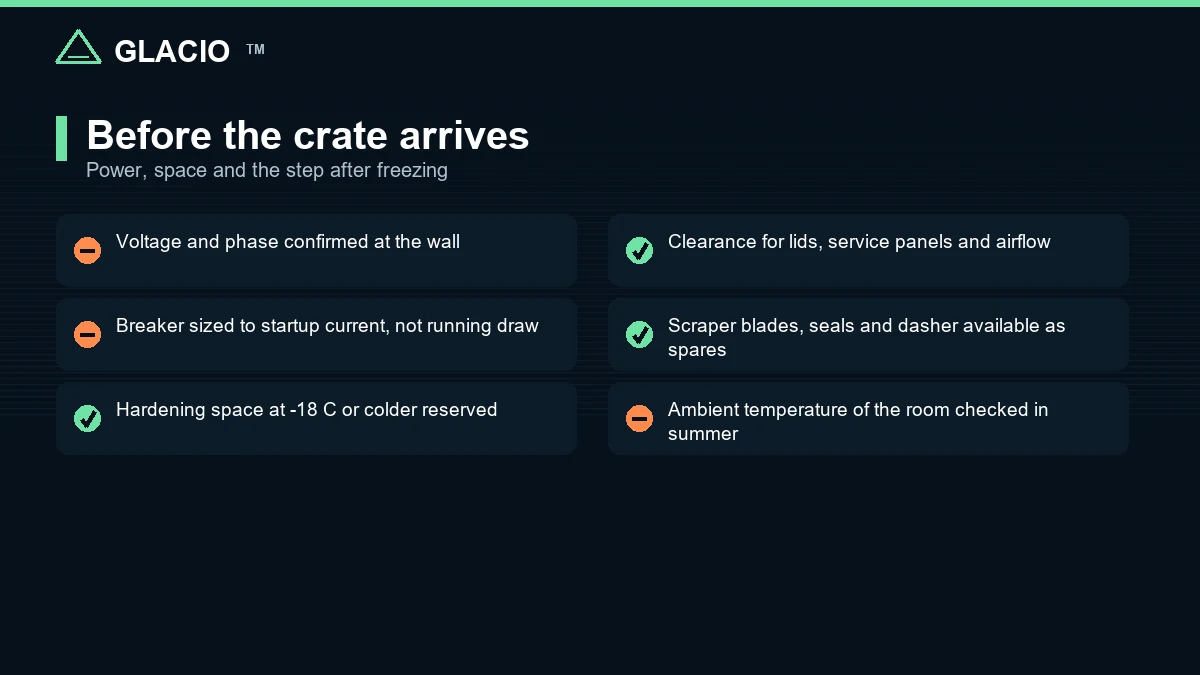
- Startup current is the number to check with your electrician. It is several times the running current, and it is why a machine that “only draws 2 kW” can still trip a shared breaker.
- Clearance matters as much as wiring: 10 to 15 cm behind and above, plus access for service panels.
Two things to settle before the machine ships: the voltage and phase at the wall, and the ambient temperature of the room it will live in. Both are cheaper to fix on paper than in a finished shop. The full site list is in the commercial ice cream machine installation checklist.
Hardening after the batch freezer
The batch freezer draws product soft. What happens next decides texture.
- Blast freezer. Fastest and most consistent, at -30 C or colder with moving air. Best for shops that want repeatable texture and quick turnaround.
- Deep freezer at -18 C or colder. Works for low volume if pans are shallow, spaced and not stacked warm.
- Display case. For serving, around -12 C to -14 C for gelato. It is not a hardening tool.
If you are pairing a batch freezer with a display, the case has to be sized to the pans you produce. The gelato display case buying guide covers pan count, holding temperature and glass options.
What an ice cream batch freezer costs
Bands below reflect new equipment quotes in 2026, before freight, duty, VAT and installation. Factory-direct pricing sits at the lower end; branded European machines sit well above these ranges.
| Machine | Typical price band (USD) | Notes |
|---|---|---|
| 1 bowl, 6 L, countertop | $1,200 – $3,000 | Usually single phase, often with a display dome. |
| 2 bowls, 6 L | $2,500 – $6,000 | The usual step up for a cafe or bakery counter. |
| 4 bowls, 6 L | $5,000 – $12,000 | Floor-standing or large countertop, often three phase. |
| 6 bowls, 6 L | $8,000 – $18,000 | Busy shops; check power, weight and floor loading. |
| Continuous freezer | $25,000 and up | Industrial output, different service and spare-parts model. |
A used batch freezer typically asks 30 to 50 percent of new. That can be good value, but only with an inspection: run it for a full cycle and watch the draw temperature, listen to the compressor under load, look for rust at the bowl welds, and confirm the refrigerant and the availability of scraper blades.
Maintenance rhythm
Batch freezers fail in predictable ways. Most of them are cleaning and wear issues rather than electronics.
- Every service day: rinse and sanitise the bowl, dasher, seals and draw spout. Follow the contact times in the batch freezer cleaning and sanitising protocol.
- Weekly: lift and inspect the seals, check the scraper blades, and clean the condenser coil or filter.
- Monthly: probe the draw temperature against the display, check the door and bowl gaskets, and look at the compressor mounts.
- Seasonally: have the refrigerant charge and the electrical connections checked before your peak season, not during it.
If a machine suddenly stops freezing or cycles too long, the usual causes and their fixes are covered in batch freezer not freezing troubleshooting.
Five buying mistakes
- Buying on cycle time alone. A 12-minute cycle with 6 minutes of cleaning and loading is slower than a 17-minute cycle with good bowl design.
- Sizing for the best day, not the average peak. Size for a normal Saturday, then add a bowl for growth.
- Ignoring the hardening step. No machine fixes a shop with nowhere cold to set the product.
- Skipping the electrical survey. Phase, breaker and cable runs are expensive after the fact.
- Choosing the cheapest bowl material. Thin bowls and soft dashers wear out within a season or two of daily production.
Frequently asked questions
How many liters per hour does an ice cream batch freezer produce?
One 6-liter bowl typically delivers 14 to 18 liters of finished product per hour once you include cycle time and handling. Two bowls double that, four bowls quadruple it. Treat any single number in a brochure as a maximum under ideal conditions, and plan with the 2.5 to 3 batches per hour figure instead.
What is the difference between a batch freezer and a gelato machine?
In most shops they are the same machine type. A gelato batch freezer runs colder and slower with lower overrun, and often holds product in the bowl behind a display dome. A machine sold as an ice cream batch freezer will make both, as long as you adjust the mix, the overrun target and the draw temperature.
Do I need three-phase power for a batch freezer?
Not for one or two bowl countertop machines, which usually run on single phase 220-240 V with a dedicated 16 A to 20 A circuit. From around four bowls, and on most floor-standing machines, three phase 380-415 V is common. Have an electrician confirm the startup current before you order.
Can a batch freezer harden the ice cream as well?
It hardens the product only to scooping consistency, around -6 C to -9 C at draw. Proper hardening happens afterwards in a blast freezer or a freezer at -18 C or colder. Skipping that step is the most common reason for icy texture in the days that follow.
New or used batch freezer?
A used machine at 30 to 50 percent of new can be excellent value if it is inspected properly. Run a full cycle, check the draw temperature, listen to the compressor under load, look for corrosion around the bowl welds, and confirm that scraper blades and seals are still available for that model.
Match the machine to your daily liters
Send us your busiest-day scoop count, the number of flavors you want on the counter, your available power and how much space you have for hardening. We will come back with a bowl count, a configuration and the accessories that go with it.
Tell us the shop. We size the machine and price it.
Two numbers decide the model: how much you sell on a busy day, and how much you need in your busiest hour. Send those with your voltage and you get a model recommendation and an FOB quote within 24 hours.
- ✓ Sized to your peak hour
- ✓ FOB quote and lead time
- ✓ No obligation
Some information may be outdated
Comments
Questions about equipment capacity, voltage, or recipes? Leave a comment.
Loading comments...