




Short answer: A lease or buy commercial ice cream machine decision should be made on cash flow and total cost, not the monthly payment alone. Compare four numbers: cash due at signing, payment during your slowest month, known 48- or 60-month cost, and what you own or owe at the end. In the small-shop example below, an equipment lease has the lowest monthly payment, a cash purchase has the lowest known cost, and a loan costs more in interest but leaves you owning the machine.
Ice cream demand is seasonal in many shops. A machine can sit idle during a wet January and then run hard through a warm July weekend. A payment that feels comfortable during peak sales can become a fixed burden when production is down to a few troubleshooting batches and staff training sessions. The cost of getting this wrong is not just interest. It can consume the cash reserve that would have covered mix, payroll, repairs, or a slower-than-expected opening.
This guide is for bakery owners, cafe and bubble tea operators, gelato shop founders, and home bakers moving into wholesale or retail production. The numbers below use an illustrative small-shop scenario, not a universal quote. Your tax position, lender requirements, local regulations, and machine configuration can change the answer. The method does not change: model the full obligation against the shape of your sales.
Lease or Buy Commercial Ice Cream Machine: Compare Total Cost, Not Payment
Start with the same machine, the same installation scope, and the same maintenance assumption in every quote. If one seller includes freight, electrical work, startup spares, and a service visit while another quotes only the machine, the cheaper monthly payment may be comparing two different projects. Build a simple comparison sheet before you discuss ice cream machine financing with anyone.
- Cash due at signing: include deposit, first payment, sales tax, delivery, electrical work, and the first spare parts order.
- Cash flow by month: show peak-season payments and off-season payments separately, not as one annual average.
- Known total cost: add the down payment, every monthly payment, fees, service contracts, and any end-of-term obligation.
- End state: note whether you own the machine, must return it, or face a buyout that is still unknown.
That fourth line is where many deals separate. A cash purchase creates a large day-one outflow but no payment risk. A loan creates a known payment schedule and ownership after the final payment. A lease can preserve cash, but the machine may return to the lessor when the term ends. Use a proper ROI and payback calculation alongside the financing quote, because a payment structure cannot rescue an ice cream program that does not cover its own cost.
A Small-Shop Cash Flow Scenario
Assume a shop needs $20,000 for the machine, delivery, electrical work, and startup spares. For the loan, assume $2,000 down, $18,000 financed at 8 percent APR for 48 months, and a $500 fee. The payment is about $439. For the lease, assume $425 per month for 48 months, a $500 administration fee, the first payment at signing, and a $1,500 refundable deposit. The deposit is left out of net cost because it should return if the machine passes inspection.
| Payment structure | Cash due at start | Monthly outflow | Known 48-month cash cost | End state |
|---|---|---|---|---|
| Cash purchase | $20,000 | $0 | $20,000 | You own the machine and carry no equipment debt. |
| Equipment loan | $2,500 | About $439 | About $23,600 | You own the machine after payment 48. |
| Equipment lease | $1,925 | $425 | About $20,900 | You return it unless you pay the fair-market buyout. |
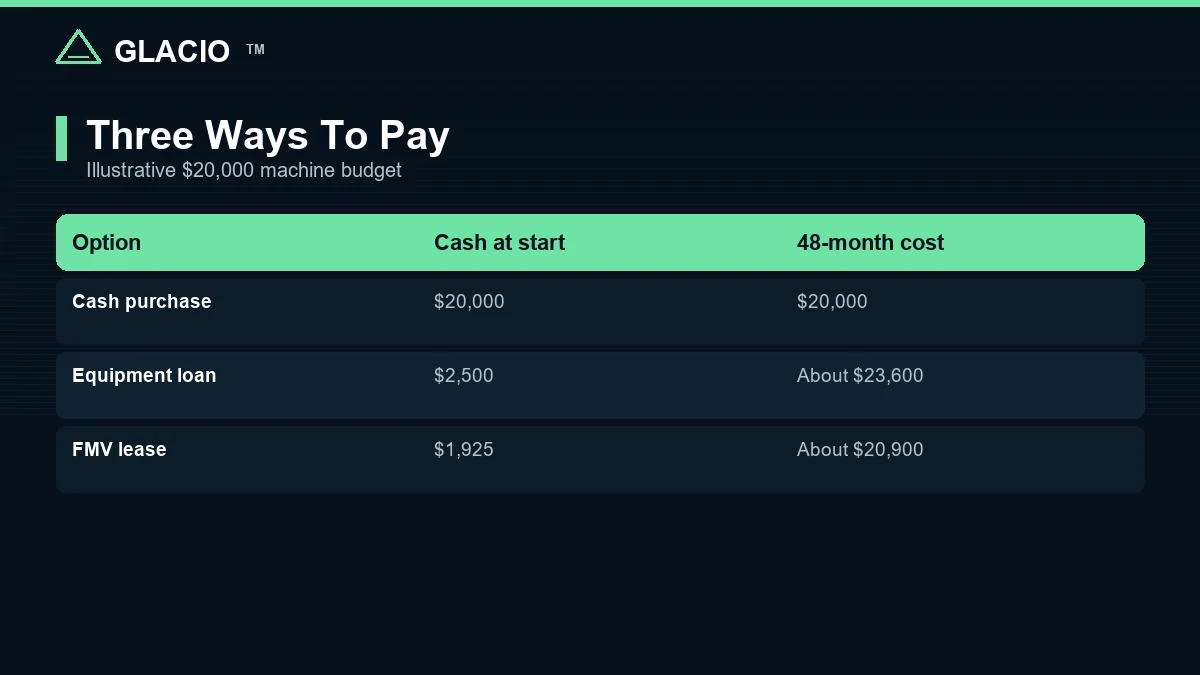
Those assumptions make the trade-off visible. The lease saves about $5,900 at signing compared with cash and about $575 at signing compared with the loan. Its monthly payment is $14 lower than the loan. Over 48 months, that difference is only $672. Yet the lease does not leave you with a machine unless the buyout price is acceptable. The loan costs roughly $2,700 more than the lease over four years, but the final payment produces an owned asset. That may be a bargain or a waste, depending on how long you keep producing and what a used machine is worth at that point.
Keep installation in the financing amount. A machine that arrives before the circuit, drain, and ventilation work is ready can sit wrapped in a corridor while the first finance payment starts. The installation checklist should be part of the quote, not an embarrassing surprise after delivery.
Why the Monthly Payment Is the Most Expensive Number to Trust
Monthly payment answers one question: how much cash leaves the account each month. It does not answer total cost, ownership, renewal, service, or exit risk. A $425 lease payment and a $439 loan payment look almost identical, but one may end with a return inspection and one ends with an asset. A cash purchase has no monthly payment at all, yet tying up $20,000 can create a real cash problem if the same money was needed for ingredients and payroll during the first winter.
Translate the payment into production cost. If your shop makes 3,000 liters per year, a $425 monthly lease payment equals $5,100 annually, or $1.70 per liter in financing cost before mix, labor, and energy. The same first-year pressure applies to a loan payment of $5,268, or $1.76 per liter over 3,000 liters. Those figures do not prove either option is wrong. They show how little room remains if your retail price and batch volume are already thin. A running cost per liter model should include the payment, not treat it as a separate business expense.
Ask for the payment schedule in writing. If the quote includes a six-month deferral, find out whether interest still accrues and whether the missed principal is added to later payments. If the answer is vague, assume the obligation continues to grow. A deferred payment is not a discount. It is a cash-flow tool with a cost.
How Seasonality Changes the Lease or Buy Decision
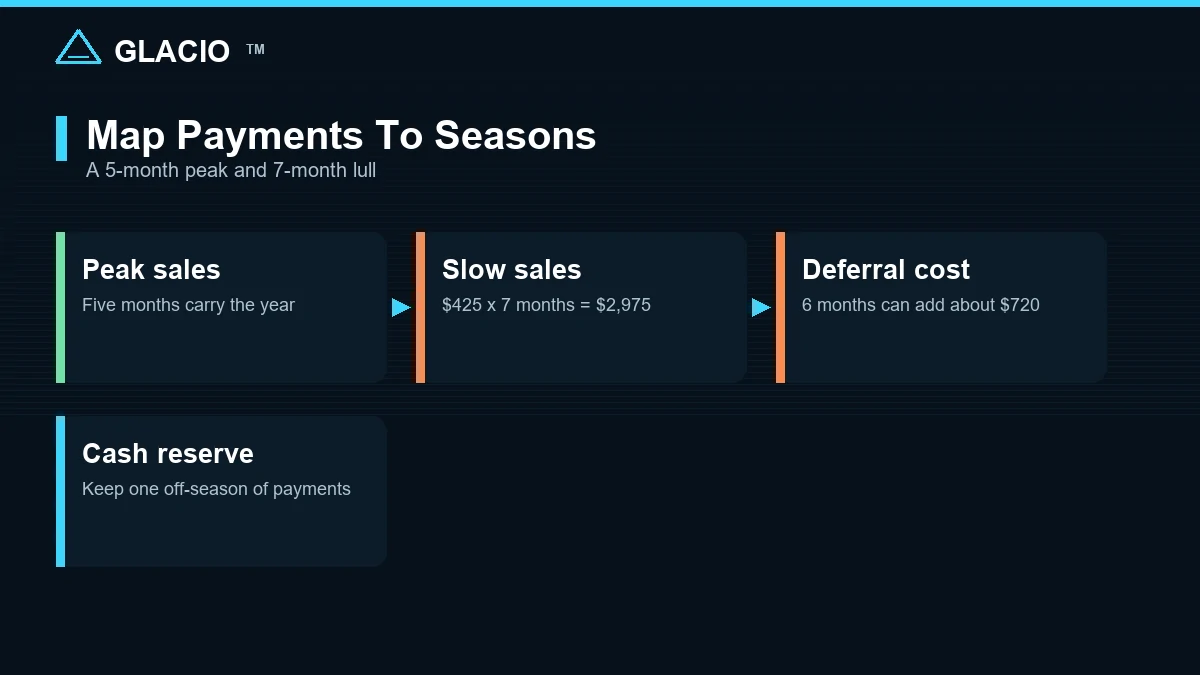
Use a 12-month cash calendar. Imagine five strong production months and seven softer months. The machine still needs space, insurance, cleaning, and possibly a payment during all 12 months. That seasonal shape changes which structure fits.
- Cash purchase: strongest when the reserve can absorb $20,000 and the coming peak season will replenish working capital.
- Equipment loan: predictable, but $439 per month means $3,073 in payments during the seven softer months.
- Equipment lease: useful only when the contract explicitly lowers or skips payments in slow months without unreasonable catch-up terms.
- Hybrid approach: use cash for the base machine and finance only an additional bowl or installation upgrade if peak demand justifies it.
A six-month deferral on an $18,000 balance at 8 percent adds roughly $720 in interest if principal does not fall during those months. That may be worth paying to protect January cash flow. It is not worth paying if the lease already charges a higher implicit rate than the loan. Compare the deferral cost with the interest and fees in the loan quote.
Do Not Finance More Capacity Than Your Slow Month Can Support
Capacity decisions belong before financing decisions. A larger machine can make the lease or loan look more impressive, but every extra bowl adds capital, weight, cleaning work, and production planning. A GB-1 has 1 bowl and weighs about 96 kg. A GB-2 has 2 bowls and weighs about 140 kg. The difference is about 44 kg before mix is added. If those two bowls sit empty for most of the year, you are financing flexibility you do not use.
GLACIO GB-Series machines have 1 to 6 bowls, each with a 6-liter capacity. Typical cycle time is 15-20 minutes per bowl, with typical output of roughly 14 liters per hour per bowl. Draw temperature, cycle time, and output depend on mix, starting temperature, ambient conditions, and the operating cycle. A shop that needs 12 liters for a focused Saturday menu may handle production with one bowl if it plans ahead. A cafe that needs four flavors ready at the same time may value two bowls even when total daily volume is modest.
Size the demand first with a daily sales sizing model, then compare models in the GB-Series selection guide. The goal is not to buy the smallest machine. It is to buy the smallest configuration that protects peak service and still earns its keep during ordinary weeks.
The Lease Clauses That Make a Cheap Payment Expensive
A gelato machine lease can be a sensible way to preserve cash and avoid a large purchase. The payment alone will not tell you whether it is cheap. The clauses decide what happens when sales miss the plan, the machine needs service, or you want to end the agreement. Read every line with the same skepticism you would apply to a supplier contract.
What to Circle Before You Sign
- Evergreen renewal: if the notice window is 90 days and you miss it, another 12 months at $425 costs $5,100.
- Return and restocking fees: a 10 percent restocking fee on a $20,000 machine adds $2,000 before freight or repair deductions.
- Mandatory supplies or service: a $125 monthly package across 48 months costs $6,000, even if you rarely use it.
- Percentage-of-sales or minimum-use payments: a clause charging the greater of $425 or 4 percent of sales costs $600 in a $15,000 month.
- Fair-market buyout: an uncapped buyout can turn a lease into an expensive way to buy the machine. Ask for the formula or a written range.
- Hell-or-high-water language: payment may continue when the machine is down. Require response times, parts coverage, and a remedy in writing.
- Transfer and personal guarantee: moving, selling, or closing the shop may trigger approval requirements and fees while the personal guarantee survives.
An equipment loan for a small food business should disclose the APR, origination fee, term, collateral, prepayment penalty, and personal guarantee. A $500 origination fee on an $18,000 loan is real money. A missing quote line does not make it disappear. Compare the loan's total cost with the lease's known cost and its end-state value, not just the advertised rate.
When Does Waiting a Season Beat Financing?
Waiting beats financing when the machine is still a hypothesis. If you cannot show reasonable evidence of demand, a peak-season test can be cheaper than four years of payments. The decision is not about fear or optimism. It is about whether one more season of information is worth more than the cost of buying now.
- Your shop has never sold hard ice cream or gelato through a full seasonal cycle.
- Demand depends on a short holiday period that has not been tested with your own menu.
- You cannot keep a reserve large enough to cover one full off-season and an unexpected repair.
- The lease includes renewal, return, or percentage-of-sales terms you cannot safely control.
- A borrowed, rented, shared, or smaller existing setup can cover peak demand long enough to collect real sales data.
Run the arithmetic on the delay. If one more season lets you add $8,000 to the down payment and reduce the financed amount from $18,000 to $10,000, the same 8 percent, 48-month loan payment falls from about $439 to about $244. That is a material reduction in fixed risk. Waiting is expensive when demand is already proven. If the skipped season would have produced $12,000 in contribution margin, delaying the machine to avoid a few thousand dollars in financing cost is poor math.
Frequently asked questions
How much cash should I keep after buying an ice cream machine?
Keep enough cash to cover one full slow period, including payroll, rent, mix, and the equipment payment. In the $20,000 example, spending every available dollar on day one leaves nothing for a compressor repair or a weak opening month. A reserve is part of the machine plan, not a separate emergency fund.
Is an equipment loan always cheaper than a lease?
No. In the sample scenario, the 48-month loan costs about $23,600 and ends with ownership, while the lease costs about $20,900 if returned clean and ends without the machine. The loan can still be the better deal because you keep the asset and control the exit. Compare total cost, buyout terms, tax treatment, and the machine's value after the term.
Can a new ice cream shop get machine financing?
It can be possible, but a new shop usually faces more scrutiny than an established operator. Lenders and lessors may ask for a business plan, sales projections, personal guarantees, and a deposit. Start with a quote that shows the APR or lease factor, total cost, and every fee before comparing approvals.
Does leasing solve summer-only cash flow?
Only when the contract explicitly moves payments away from the slow months. A six-month deferral on an $18,000 balance at 8 percent adds roughly $720 in interest if principal does not fall. Without that clause, seven off-season months at $425 still create $2,975 of fixed payments.
Is a $1 buyout lease the same as a loan?
No. A $1 buyout may lead to ownership, but the lease still has its own payment factor, fees, insurance requirements, and end-of-term conditions. A fair-market lease may have no ownership promise at all. Put both offers side by side and compare their total cost over the same term.
What should I ask for in writing before signing?
Ask for the payment schedule, APR or lease factor, fees, deposit treatment, service obligations, renewal notice, return standards, buyout formula, and early-termination cost. Also request permission to move or sell the equipment and a clear statement of any personal guarantee. A written quote that leaves out the exit terms is not a complete quote.
Pick the Payment That Fits Your Slowest Month
For most small shops, a fixed-rate equipment loan makes sense when the machine is central to production and you can absorb the higher monthly payment. A cash purchase wins when you have the reserve and the first season will replace the cash. A lease wins only when it preserves working capital, includes service you value, and puts seasonal payment flexibility in writing. Do not choose a structure because the first number looks small. Choose it because the 12th payment, the 48th payment, and the exit still fit your business.
The GLACIO GB-Series spans 1 to 6 bowls, each with a 6-liter capacity. Typical cycle time is 15-20 minutes per bowl, and typical output is roughly 14 liters per hour per bowl under the stated operating conditions. If you are still deciding between cash, a loan, and a lease, Request a machine recommendation and quote. What does your slowest month look like after the equipment payment is included?
Some information may be outdated
Comments
Questions about equipment capacity, voltage, or recipes? Leave a comment.
Loading comments...