




Short answer: A commercial ice cream machine warranty is a repair contract, not a service plan. It may cover a failed compressor or control board within a stated period, but it rarely covers wear parts, labor, freight, water damage, or lost production. Before you pay, confirm which parts are covered, where replacements ship from, how quickly they arrive, and who pays for the technician.
A bakery owner adding gelato, a bubble tea operator planning six flavors, and a home baker moving into wholesale all face the same trap. The quote with the lowest price often looks complete until a scraper blade, seal, or control board fails during a busy weekend. Then the real cost appears as downtime, expedited freight, and a technician who has never opened that machine before.
Warranty language is only one part of serviceability. You also need to know whether the machine has documented parts, whether those parts remain available after the sales promotion ends, and whether your market has anyone qualified to fit them. A strong quote answers those questions before money changes hands.
The goal is not to demand an unlimited guarantee. It is to compare two machines on the support system behind them. A clearly limited warranty with fast parts and a named technician is often safer than a broad promise with no parts diagram and no local response path.
Commercial ice cream machine warranty: what it does and does not cover
A warranty usually promises to repair or replace a defective component during a defined period. It does not promise that the machine will never stop, that maintenance is free, or that every failed part is included. Those details live in the warranty schedule, the exclusions, and the service terms.
The first question is whether coverage is parts only, parts and labor, depot, or onsite. Parts-only coverage can still leave you paying a technician, travel, diagnosis, return freight, and customs. A depot warranty may require you to remove and ship a heavy machine, which is difficult for a front-counter unit and expensive for a multi-bowl freezer.
Read the exclusions against your actual working conditions. A machine installed beside a hot bakery oven, connected to unstable voltage, or cleaned with the wrong chemical can lose coverage under an abuse or improper-installation clause. Keep commissioning records, voltage readings, service reports, and cleaning logs together. If a compressor fails in month 10, those records help show that the machine was operated within the supplier's instructions.
The warranty promises buyers should separate
- Parts-only: the supplier sends a component, while you arrange and pay for diagnosis, labor, and freight.
- Parts and labor: stronger coverage, but confirm the hourly rate, travel charge, after-hours rate, and who authorizes the repair.
- Depot warranty: the machine or assembly must be returned, so ask who crates it and who pays both directions.
- Onsite warranty: the best commercial option when available, but it depends on a service partner who actually covers your postcode.
- Goodwill support: a supplier may help after the warranty ends, but an informal promise is not a spare-parts plan.
How do you compare warranty terms without getting lost in legalese?
Put the warranty promises into a table before you compare price. Ask the supplier to complete it in writing, then compare that document with the final invoice. If one quote covers a gearbox but excludes labor, and another covers labor but offers no gearbox lead time, the price difference is not the whole story.
| Warranty promise | Usually covered | Common exclusion | What to confirm |
|---|---|---|---|
| Compressor and condensing unit | Mechanical failure inside the stated term | Low voltage, blocked ventilation, or impact damage | Part number, labor rate, diagnostic fee, and shipment responsibility |
| Control board and sensors | Defective board or sensor after testing | Moisture, power surge, or incorrect wiring | Who tests it, return shipping, and compatible revision |
| Gearbox and drive assembly | Defect under normal operating conditions | Overload, missing lubrication, or unauthorized repair | New or rebuilt part, turnaround, and technician requirement |
| Wear parts | Sometimes a very short defect period only | Scraper blades, seals, gaskets, belts, and couplings | Replacement interval, list price, and recommended stock quantity |
| Transit and cosmetic damage | Damage reported within the stated claim window | Marks found after acceptance or installation | Photo evidence, delivery signature, and claim deadline |
A 12-month promise sounds simple until you test the sequence. Suppose the drive assembly fails in month 8. Who diagnoses it, who removes it, who pays freight, and who confirms the replacement is compatible with your serial number? Get those answers in the same email as the warranty period. The useful warranty is the one you can execute, not the one with the most generous headline.
Which spare parts decide whether a machine is serviceable for ten years?
Batch freezer parts availability depends on more than a supplier saying that parts exist. The machine needs an exploded parts diagram, stable part numbers, revision records, and a supply path for both routine wear and less common repairs. A parts catalog that lists only the motor and compressor is not enough for a working shop.
Start with the parts touched during normal production. These are the components that determine whether a machine can finish a busy Saturday, not whether it can survive a showroom inspection. Ask the supplier to mark each item on the diagram and state whether it is consumable, wear-prone, or repairable.
Consumable and wear parts list
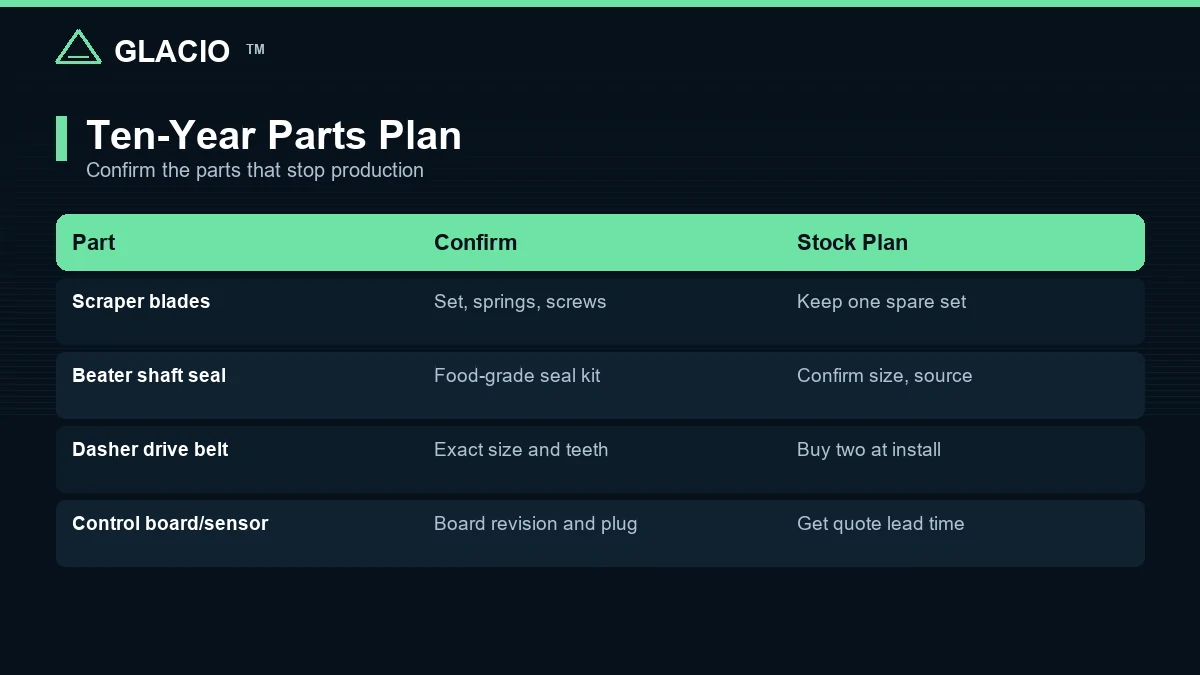
- Scraper blades or beater blades: inspect at every cleaning cycle for chips, bends, or uneven wear; a damaged blade can score the cylinder and reduce freezing performance.
- Blade springs, screws, and retainers: small fasteners disappear during cleaning and must be available as a complete set, not as an uncertain special order.
- Beater shaft seals and O-rings: replace according to the maintenance schedule or at the first sign of mix seepage, hardening, or cracking.
- Door gaskets and drain plugs: confirm these are food-grade and sized to the exact door assembly; a poor seal can leak mix and create a cleaning problem.
- Food-grade lubricant: use only the specified product and keep enough for the next scheduled service, because the wrong grease can damage seals.
- Drive belts and couplings: record the exact size, tooth count, or coupling type before the original wears out.
- Bearings and bushings: ask whether they are standard industrial parts or proprietary components, because that choice affects local availability.
- Temperature sensors and thermistors: keep the correct probe type and connector revision in the parts list, since a visually similar sensor may not calibrate correctly.
- Control board and display: confirm board revision compatibility, plug layout, and whether replacement requires parameter reprogramming.
- Relay, contactor, and protection devices: these are inexpensive until they stop production, so identify them by number rather than by appearance.
A ten-year machine is not one with zero failures. It is one whose common failures can be diagnosed, sourced, and repaired without redesigning the machine.
Lead time versus local stock: which risk can your shop carry?
Local stock and factory supply solve different problems. A local distributor may get a seal kit to you before the next production day, but may not carry a rare control board or a gearbox. Factory supply may offer the exact revision, yet freight, customs, and distance can turn a minor repair into lost production.
The trade-off is not only price. It is the number of production cycles you can miss. If you sell frozen desserts daily, a stocked wear part is worth more than a discount on a machine that needs a week to source the same part. If you run a seasonal or home-based business, you may accept a slower factory shipment in exchange for lower inventory cost.
Where each supply option fits
| Supply source | Main advantage | Main risk | Best use |
|---|---|---|---|
| Local distributor stock | Quick collection or delivery when the part is on the shelf | Limited range and possible price premium | Scraper blades, seals, gaskets, and belts |
| Regional warehouse | Shorter shipping path and fewer customs steps | Stock may not match your exact serial number | Planned maintenance and common electrical parts |
| Factory direct | Correct revision and access to less common assemblies | Freight, customs, and longer lead time | Major repairs and obsolete or proprietary components |
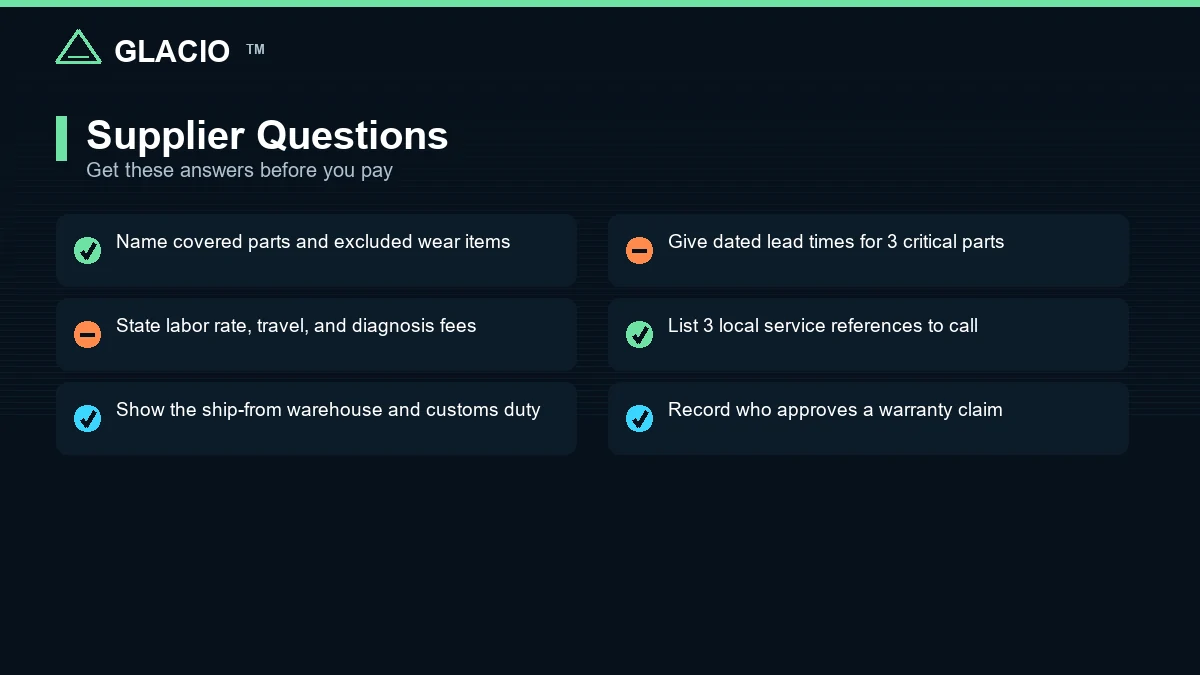
Ask the supplier to name the warehouse, not just the country. "Available from our factory" can mean production scheduling, export packing, and an international shipment. A dated lead time for three critical parts tells you more than a generic promise of fast service.
Keep a small critical-spares kit based on failure impact. If a blade set stops a flavor launch, stock it. If a cosmetic panel scratches, order it when convenient. The right inventory is the list of parts that can stop production before a replacement arrives.
What questions expose a weak support channel?
A support channel is weak when every question returns to a sales representative who cannot identify the part. Test the channel before purchase. Call the number a customer would call, ask for a technician, and describe a real fault without providing the model history first.
Support should be able to ask for the serial number, find the part on a diagram, and explain the diagnosis step. If the answer is only "send us a video" or "our engineer will check", ask when the engineer will reply, who owns the case, and what happens outside business hours.
Signals that deserve scrutiny
- No named service contact: you receive a general chat address and no case owner, so follow-up depends on whoever answers next.
- No component-level part numbers: the supplier can name a blade or board but cannot quote the exact revision.
- No local coverage map: the supplier claims global support but cannot name a technician or partner near your shop.
- Return freight falls on you: a defective part must be shipped back before replacement, leaving your machine idle.
- Different answers on different calls: one representative says labor is covered while another says only the part is covered.
Ask the supplier to identify one critical part by number, confirm whether it is stocked, and give a dated lead time. If that request takes several days before you have paid, expect worse when the machine is down and the pressure is higher.
What should you get in writing before you pay?
Verbal assurances disappear when a machine fails. Put the service terms in the quotation, a signed annex, or an email that clearly references the order. Ask the supplier to answer each question below in plain language, then keep the reply with the invoice and serial number.
- When does the warranty start: delivery, installation, commissioning, or invoice date?
- Which assemblies and components are covered, and which are explicitly excluded?
- Is labor covered, and what are the hourly, travel, diagnostic, and after-hours rates?
- Who pays for outbound and return freight, customs duties, packing, and insurance?
- What are the lead times for three named critical spare parts from your actual location?
- Can the supplier guarantee the same revision, or may it substitute a compatible part?
- Which local partners cover your area, and what response time do they commit to?
- What remote support is available, including hours, language, and escalation contact?
- Which consumables ship with the machine, and what replacement intervals are recommended?
- What records prove installation, voltage, ventilation, and initial operation comply with the manual?
- What annual maintenance is required to preserve coverage, and who is allowed to perform it?
- Will you receive a parts manual, wiring diagram, serial-number record, and commissioning report?
These questions also improve the quote. A supplier that maintains revision records, trains local partners, and stocks wear parts can answer them quickly. A supplier that sells machines as one-off imports often cannot. That difference is more valuable than a small discount on the purchase price.
How should GLACIO GB-Series buyers assess serviceability?
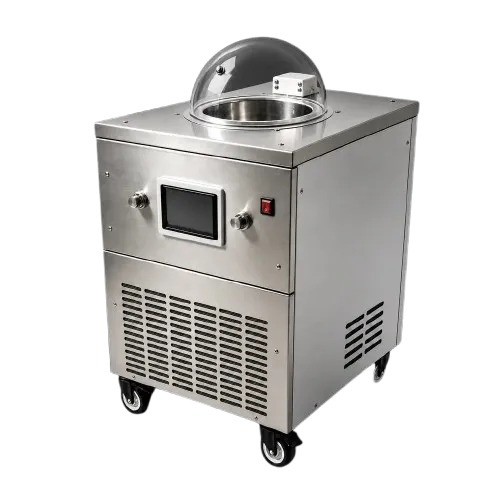
The GLACIO GB-Series is available with one to six 6-liter bowls, so the right service plan depends on how many production positions you rely on each day. Typical cycle time is 15-20 minutes per bowl, with typical output of roughly 14 liters per hour per bowl. Draw temperature, cycle time, and output depend on mix, starting temperature, ambient conditions, and the operating cycle.
Machine weight matters during installation, moving, and repair. GB-1 is about 96 kg, GB-2 about 140 kg, GB-4 about 230 kg, and GB-6 about 330 kg. A heavier multi-bowl unit can justify an onsite service agreement because removing it from a counter is disruptive. A smaller unit may be easier to access, but it still needs a documented parts path.
For a bakery testing a small gelato range, a GB-1 may offer a focused starting point. For a cafe or bubble tea operator running several flavors, a GB-2 or GB-4 may match the counter layout better. A GB-6 gives six production positions, but it also concentrates more revenue in one machine, so the supplier's support terms deserve more scrutiny.
Do not treat bowl count as the only buying decision. Ask how a failed bowl affects the rest of the machine, whether the drive and control system are shared, and which components can be isolated without stopping every flavor. Review the GB-1 vs GB-2 vs GB-4 vs GB-6 Hard Ice Cream Machine Guide alongside the warranty and parts schedule. For daily care, use the Commercial Ice Cream Machine Maintenance Checklist for Gelato Shops to connect cleaning records with warranty compliance. Before finalizing a quote, also review the Hard Ice Cream Machine Reliability Checklist for Shop Owners.
Keep dairy mix at 2-4 degrees C before loading. If mix is warm, a normal 15-20 minute cycle can run long and draw soft, which encourages the operator to restart or overload the machine. That kind of repeated abuse can turn a legitimate warranty claim into an excluded repair. Temperature control is part of serviceability because it protects both food quality and machine components.
Frequently asked questions
Does a commercial ice cream machine warranty cover the compressor?
Many commercial machine warranties cover a defective compressor for a stated period, but the details matter. Check whether labor, diagnosis, refrigerant recovery, freight, and a replacement dryer are included. A compressor failure after incorrect voltage or blocked ventilation may be excluded even when the compressor itself is listed as covered.
Are ice cream machine spare parts covered by warranty?
Wear parts are usually excluded or covered only for a short defect period. Scraper blades, seals, gaskets, belts, lubricants, and door parts are normal operating costs. Ask for the consumable list and replacement intervals before purchase, then budget for those parts as part of running costs.
How long should batch freezer parts availability last?
There is no universal legal duration, so judge the supplier's plan rather than the slogan. A machine intended to run for ten years should have documented part numbers, revision records, and a stated source for critical assemblies. Ask what happens if a board or drive component becomes obsolete, because "we will help" is not a stock plan.
Can I use aftermarket ice cream machine spare parts?
Aftermarket parts can work when they match the specification exactly, but they can also create warranty disputes. A cheaper seal with the wrong compound may fail early, while a non-original control board may need different programming. If you use a substitute, keep the supplier's written approval and the part documentation.
What voids a commercial ice cream machine warranty?
Common exclusions include unauthorized repair, incorrect voltage, poor ventilation, water or chemical damage, missing maintenance, and operation beyond the manual. Keep commissioning records, service invoices, cleaning logs, and voltage checks. When a fault appears, report it before attempting a repair that the warranty does not permit.
Is direct factory purchase better for gelato machine warranty terms?
Direct purchase can give you better access to original parts and technical knowledge, but it may leave you managing freight, customs, and local labor. A regional distributor may cost more yet respond faster. Compare the written lead time, stocked parts, and named service partner rather than assuming one channel is always better.
Pick the quote that can still repair the machine in year seven
Choose the supplier that can identify the part, name the warehouse, quote a dated lead time, and explain who will perform the repair. That support system is worth more than a vague promise of complete coverage, especially when the machine sits on your front counter and your production schedule depends on it.
Use the comparison table, the consumable list, and the written question list as your buying checklist. A clear warranty with realistic exclusions and fast parts access is a better business decision than a broad warranty with no service path. If you want help matching GB-Series capacity, voltage, and support requirements to your shop, Request a machine recommendation and quote.
What single spare part would stop your production tomorrow, and can your supplier name it today?
Some information may be outdated
Comments
Questions about equipment capacity, voltage, or recipes? Leave a comment.
Loading comments...