




A pasteurizer and an aging tank are the two machines that turn “mix” into a safe, consistent base. They are also the two purchases new gelato shops most often get wrong — either skipped entirely, or bought too big because a catalogue looked impressive.
The honest answer starts with one question: are you making your own base from raw ingredients, or buying a pre-made mix? That decides everything else.
What pasteurization actually does
Pasteurization is the biological control point in ice cream and gelato production: the mix is heated to a defined temperature for a defined time to destroy pathogenic bacteria, then cooled quickly. University dairy-science teaching material describes it as the step that makes the mix safe before freezing — not a flavour step, a safety step.
Two methods dominate:
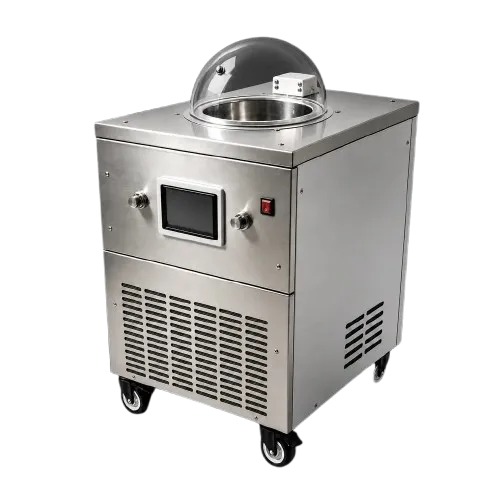
- Batch pasteurization. Heat the whole batch in a vat to temperature, hold, then cool. Simple, flexible for small volumes and recipe testing.
- HTST (high temperature, short time). Continuous flow through a heat exchanger with a holding tube. Faster, more uniform, higher throughput, higher capital cost and more complex cleaning.
What the aging tank does
Aging (maturation) is the cold rest after pasteurization: the mix is held just above freezing, typically below 5 °C for at least four hours, so stabilisers hydrate, fat recrystallises and proteins reorient. The Tetra Pak Dairy Processing Handbook is explicit that inadequate aging causes processing defects — poor churning, failure to develop overrun, weak structure and faster melting.
An aging tank is therefore not a spare fridge. It is a controlled hold at a specific temperature with gentle agitation — and its capacity should match your daily production, not your freezer’s bowl count.
Do you need them?
| Your situation | Pasteurizer | Aging tank |
|---|---|---|
| Buying pre-made liquid mix from a dairy | Usually no — the supplier pasteurized it | Not necessarily; store per supplier instructions |
| Making base from milk, cream, sugar, powders | Yes, required for safety and consistency | Strongly recommended |
| Small shop testing recipes | Small batch pasteurizer | Small tank or timed cold hold |
| Scaling to multi-flavour daily production | HTST or larger batch | Yes, sized to daily litres |
| Adding a second freezer | Check capacity first | Check capacity first |
The common mistake is buying a pasteurizer without the aging capacity to feed it, or buying an aging tank bigger than the freezer can draw. Match the chain: pasteurizer throughput, aging volume, batch freezer draw, display.
Sizing the line
Work backwards from what you sell: litres per day by flavour, batches per day, and the hold time you need. If you run 60 litres a day across four flavours, you need aging capacity for the day’s production plus a buffer — not a 500-litre tank that sits half empty and cycles badly.
Pasteurizer sizing follows the same logic: a batch vat that matches one day’s base is easier to run than an oversized HTST that forces you to make more base than you sell.
Compliance and cleaning
Compliance is local: pasteurization temperatures and holding times are set by dairy regulations in your market, and the equipment must be able to prove it reached them. Ask for temperature records, not just a thermostat. Cleaning and sanitising between batches is part of the same system — a pasteurizer that is hard to clean is a food-safety risk, not a labour saving.
What it costs, and where to spend
Budget the pasteurizer and aging tank as one line, not two. Spend on: temperature control and records, cleanability (welds, drains, access), and service support. Save on: automation you will not use, and capacity you cannot fill.
If you are not ready for a full line, the alternative is buying pre-made mix and using your batch freezer only. That is a legitimate starting model — the gelato shop equipment checklist and the commercial gelato machine buying guide show where the line fits, and the cleaning protocol covers daily hygiene.
FAQ
Can I pasteurize in the batch freezer?
No. A batch freezer freezes; it does not heat mix to pasteurization temperature with a validated hold. Some machines offer a heat cycle for specific recipes, but that is not a substitute for a pasteurizer where dairy regulations require one.
Is aging really necessary?
For consistent texture and overrun, yes. The handbook evidence is clear that insufficient aging causes processing defects. If you skip it, expect variable batches and a machine that seems inconsistent.
Batch or HTST pasteurizer?
Batch for small volumes, recipe development and simpler maintenance. HTST when daily volume and consistency justify the capital and cleaning complexity. Match it to the freezer’s appetite, not to the catalogue.
What size aging tank should I buy?
Daily production plus a buffer, sized so the tank runs full rather than half empty. Undersizing forces stops; oversizing wastes energy and produces stale base.
If you are planning a production line, tell us your daily litres and flavours — an export engineer replies within 24 hours with a pasteurizer and aging sizing proposal alongside the freezer quote. Request a line-sizing quote.
Sources: University of Guelph Ice Cream Technology e-Book (pasteurization as the biological control point); Tetra Pak Dairy Processing Handbook Chapter 21 (aging requirements and defects from insufficient aging). Local dairy rules set exact temperatures and records — confirm before purchase.
Some information may be outdated
Comments
Questions about equipment capacity, voltage, or recipes? Leave a comment.
Loading comments...