

Commercial Gelato Machine Buying Guide: Bowls, Output, Display and Cost
Short answer: a commercial gelato machine is a batch freezer built for business use. Size it by peak flavor demand, not by total daily liters: for most cafes, bakeries, bubble tea counters and small gelato shops, a countertop gelato machine with two to four six-liter bowls covers roughly 8 to 20 liters of finished gelato per hour, displays the product behind anti-fog domes, and removes the need for a separate gelato display case on opening day. If you sell more than around 60 liters a day or run more than six flavors at once, price a floor-standing or multi-bowl machine instead of stacking countertop units.
Most buyers start with the wrong question. They ask what a machine costs, or how many liters the bowl holds, and only later discover that the answer depends on how fast they must refill a flavor during the Saturday rush. A machine that looks cheap per liter can still leave you scraping an empty pan at 6 pm, and a machine with too many bowls quietly ties up capital in compressors you never run.
This guide is written for shop owners, cafe and bakery operators, dessert-bar founders and small producers who are buying their first or second commercial gelato machine. You do not need refrigeration engineering. You need to match bowls, cycle time, holding temperature and display format to the way you actually sell.
What “commercial gelato machine” actually covers
The phrase covers three different machines, and sellers rarely say which one they mean.
| Machine type | How it works | Best for | Typical buyer |
|---|---|---|---|
| Batch freezer | Freezes one bowl of mix at a time, then holds it at serving temperature for scooping. | Shops that serve scoops, cones, cups and desserts from a fixed menu of flavors. | Gelato shops, cafes, bakeries, hotels, small producers. |
| Display batch freezer | Same freezing cycle, but the bowls sit behind clear domes on the counter so the product is sold where it is made. | Counters where space is tight and customers buy what they can see. | Bubble tea shops, dessert bars, bakery counters, food halls. |
| Continuous freezer | Mix is pumped through and frozen in a continuous stream; output is measured in liters per hour, not per batch. | Packing lines and factories running one flavor for hours at a time. | Industrial producers, private-label plants. |
If your menu changes daily and you serve from a counter, you are shopping for a batch freezer. Everything below assumes that machine.
The four numbers that decide the machine
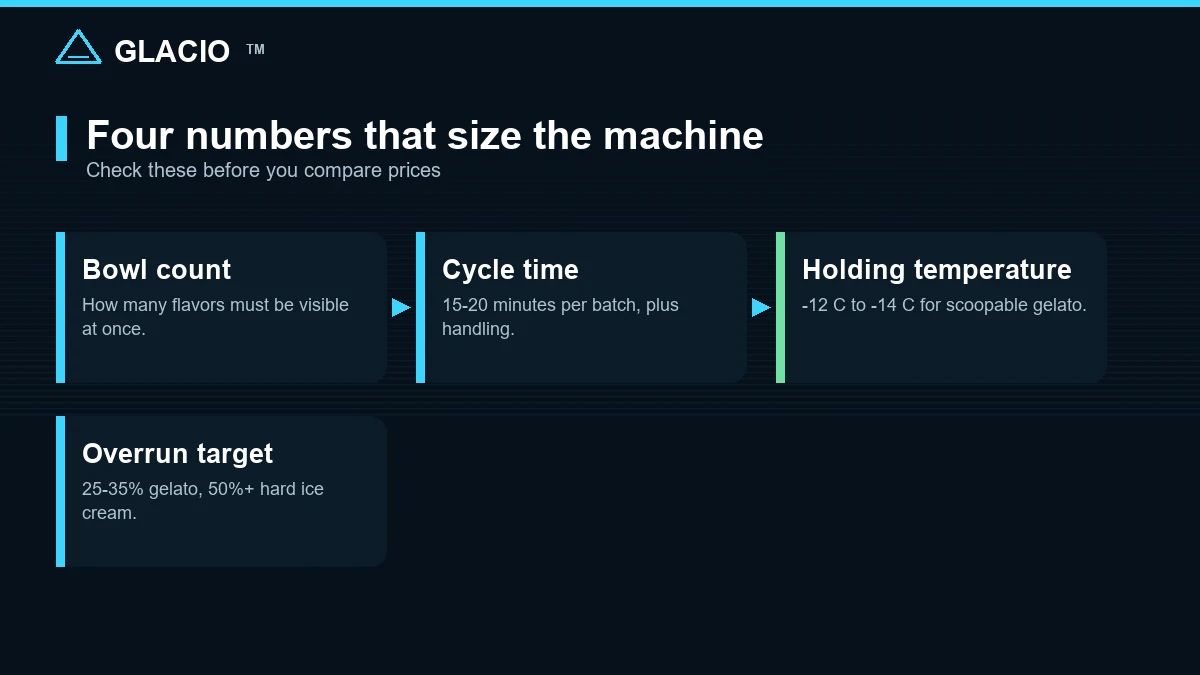
1. Bowl count and usable batch size
A “6-liter bowl” describes the mix capacity of one cylinder, not the amount of gelato you can sell from it. At 25 to 30 percent overrun, that bowl yields roughly 7 to 8 liters of finished product. A two-bowl machine therefore holds two flavors at once; a four-bowl machine holds four. Bowl count is a menu decision before it is a capacity decision: if you want six flavors visible at all times, five bowls will always leave one pan empty.
2. Cycle time and hourly output
Batch freezers typically run a 15 to 20 minute cycle, then need a few minutes for drawing, cleaning and refilling. Plan on 12 to 15 minutes of usable production per bowl per hour in real service, not the marketing number. A four-bowl machine that cycles in 18 minutes can refill four flavors per cycle, which is far more useful during a rush than a single-bowl machine with a faster cycle.
3. Holding and draw temperature
Gelato is served warmer than American hard ice cream, usually around -12 C to -14 C, so the texture stays soft enough to scoop cleanly. Ask what temperature the machine holds between batches, and whether it can hold two different temperatures at once. A machine that only freezes but cannot hold forces you into a display case within the first month.
4. Overrun target
Overrun is the air whipped into the mix. Gelato usually sits at 25 to 35 percent, hard ice cream at 50 percent or more. Some machines are tuned for one target. If you plan to sell both gelato and American-style hard ice cream from the same counter, confirm that the dasher speed and freezing profile can be adjusted rather than assuming the machine covers both.
Countertop versus floor-standing commercial gelato machine
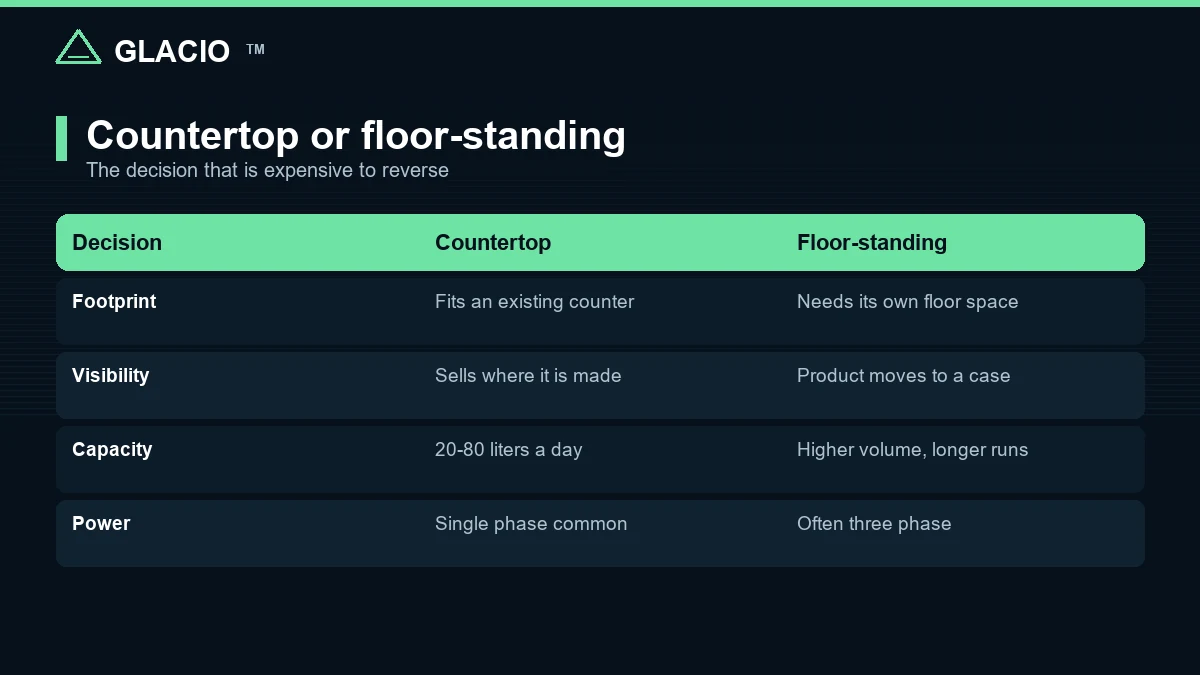
Most first-time buyers compare models by price. The more useful comparison is where the machine will physically live, because that decision is expensive to reverse.
| Decision | Countertop gelato machine | Floor-standing machine |
|---|---|---|
| Footprint | Fits on an existing service counter; usually 1 to 6 bowls in one row. | Needs its own floor space plus working clearance on both sides. |
| Visibility | Product is displayed where customers order, which is why many shops skip a display case. | Production happens away from the counter; product is usually moved into a display cabinet. |
| Capacity | Practical for shops selling roughly 20 to 80 liters a day. | Built for higher volume, more flavors, or longer production runs. |
| Staff workflow | One person can churn, serve and clean at the same station. | Often splits production and service between two stations and two people. |
| Power and drainage | Single-phase options are common; confirm breaker size and drainage before delivery. | Frequently three-phase with dedicated circuits and a floor drain. |
A countertop machine is not a compromise for a small shop. It is the format that lets a bakery, bubble tea counter or cafe sell gelato without giving up seating or building a back-of-house production room.
Do you need a gelato display case as well?
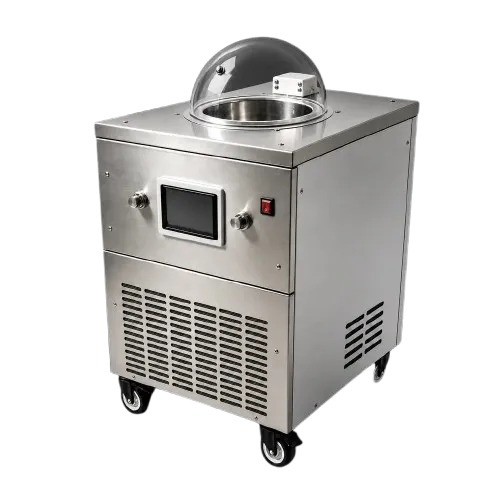
Usually not at the start. A display batch freezer already shows the product: the bowls sit behind clear domes, the batch is visible while it churns, and the machine holds it at serving temperature. Adding a gelato display case on day one doubles the cold equipment in the customer area, doubles the cleaning routine and puts a second compressor on the electricity bill.
Add a case when at least one of these is true:
- Menu range: customers need to browse 8 to 12 flavors at once, more than your machine bowls can hold.
- Hold time: finished pans must sit stable at around -14 C for hours while the machine starts the next batch.
- Service style: you plate desserts or fill takeaway tubs away from the counter, so product has to travel.
Compare the two formats in detail in the gelato display case versus machine display guide, and plan the rest of the counter with the gelato shop equipment checklist.
What a commercial gelato machine costs
Prices move with bowl count, compressor quality, controller features, certification and freight, not with brand alone. These bands reflect 2026 quotes for machines shipped from Asia to the United States and Europe, excluding duty and local installation.
| Segment | Typical price (USD) | What you get | What to watch |
|---|---|---|---|
| Single-bowl countertop | 3,500 – 6,000 | One 6-liter bowl, basic controls, one flavor at a time. | No holding mode, slow refill during peak hours. |
| Two to three bowls | 6,000 – 12,000 | Two or three flavors on the counter, independent circuits on better models. | Confirm each bowl freezes independently rather than sharing one compressor cycle. |
| Four to six bowls | 12,000 – 22,000 | Full display counter for busy shops, higher output, heavier frame. | Weight, floor loading, breaker size, delivery access. |
| Industrial continuous freezer | 25,000 and above | Continuous output for packing and wholesale. | Utilities, spare-parts lead time, service contract. |
Budget for the machine to be about 60 to 70 percent of the frozen-equipment cost. Power work, drainage, spare bowls, scoops, storage and the first month of mix make up the rest. The commercial ice cream machine cost guide breaks those extras down line by line.
GLACIO GB-Series: models and output
GLACIO builds front-counter display batch freezers, so the display format and the production machine are the same unit. Every model uses 6-liter bowls, runs a typical cycle in 15 to 20 minutes and produces roughly 14 liters per hour per bowl.
| Model | Bowls | Machine weight | Fits |
|---|---|---|---|
| GB-1 | 1 x 6 L | about 96 kg | Takeaway windows, pop-ups, market stalls, test menus. |
| GB-2 | 2 x 6 L | about 140 kg | Cafes, bakeries and bubble tea counters with two core flavors. |
| GB-4 | 4 x 6 L | about 230 kg | Gelato shops and dessert bars running four flavors at once. |
| GB-6 | 6 x 6 L | about 330 kg | Busy counters that need a full six-flavor display. |
Draw temperature, cycle time and output depend on the mix, starting temperature, ambient conditions and the operating cycle. Compare the four models in the GB-1 to GB-6 selection guide.
Sizing example: 300 scoops a day
Assume 85 gram scoops, which is a normal single serving in a cup or cone.
- 300 scoops x 85 g = 25.5 kg of finished gelato per day.
- At roughly 0.8 kg per liter, that is about 32 liters of finished product.
- A 6-liter bowl yields roughly 7 to 8 liters after overrun, so you need about four to five batches per day.
- At 15 to 20 minutes per cycle plus handling, that is under two hours of production, spread across the morning and the afternoon rush.
The volume is easy. The real constraint is variety: if those 300 scoops cover eight flavors, a four-bowl machine cannot keep eight pans fresh on its own. In that case, plan a four-bowl machine plus a small case, or accept a rotating menu of four flavors with two made ahead. The batch freezer sizing guide works through the same math for higher daily volumes.
Installation, power and site preparation
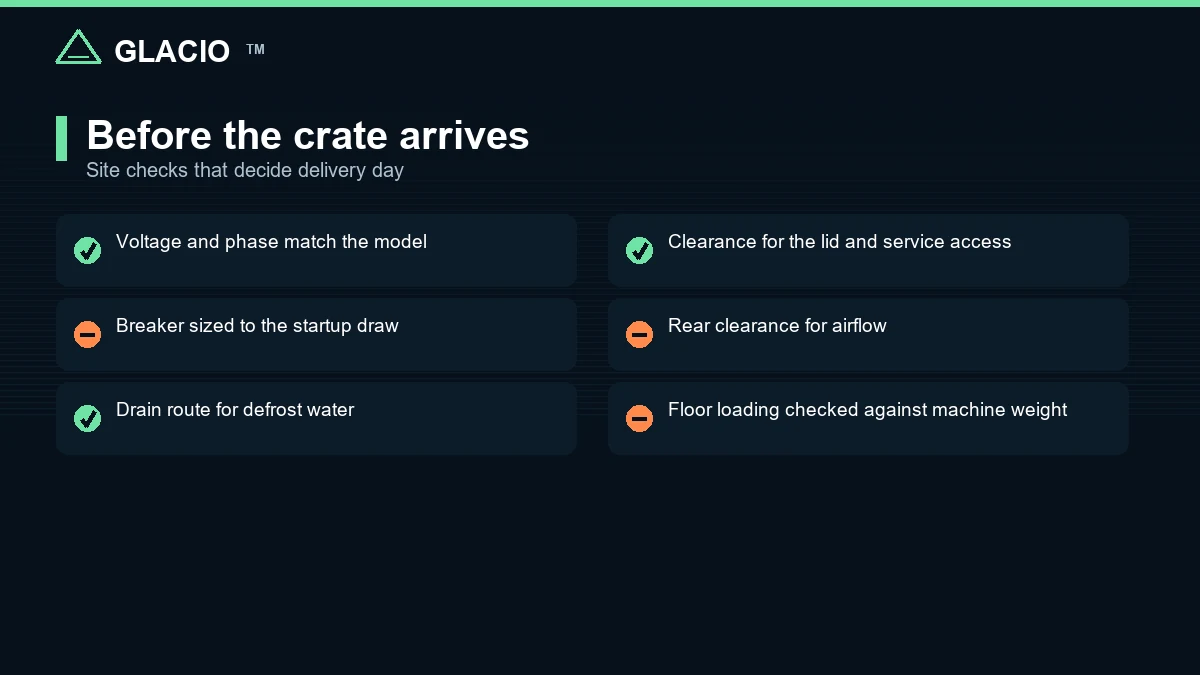
Order the machine after you know the electrical reality of the building, not after it arrives. Three points decide whether the delivery day goes smoothly: voltage and phase, circuit capacity, and drainage.
- Voltage and phase: confirm what the building supplies and what the model needs. A machine quoted for 220 V single phase will not run on a 380 V three-phase supply without the right configuration.
- Breaker and cable: the startup draw of a compressor is higher than the running draw. Size the breaker and cable to the startup figure.
- Drainage and clearance: plan a route for defrost water and cleaning, plus clearance for the lid to open fully and for staff to work on both sides.
The power requirements guide covers breaker sizing, and the installation checklist lists what to prepare before the crate is opened.
Cleaning and maintenance rhythm
Daily cleaning is the difference between a machine that lasts a decade and one that develops off-flavors in a season. Rinse and sanitise the product-contact parts at the end of service, lift the seals weekly, and check the scraper blades for wear every month. A written routine beats good intentions, especially with rotating staff.
Follow the batch freezer cleaning and sanitising protocol for contact times and the parts that are usually missed.
Five buying mistakes
- Buying by liters per hour alone. Peak-hour refill speed depends on bowl count and cycle time together.
- Assuming a display case is mandatory. A display batch freezer already sells what it makes.
- Choosing on price without checking the compressor. A cheap machine that cannot hold temperature costs more in wasted batches.
- Ignoring the electrical supply. Reworking a distribution board after delivery is expensive and slow.
- Buying for the busiest day only. Size for a normal peak, then add one spare bowl for growth.
Frequently asked questions
Is a commercial gelato machine the same as a hard ice cream machine?
Mechanically they are the same category: a batch freezer that churns and freezes mix to a scoopable texture. The difference is the recipe and settings. Gelato uses less fat, less air and a warmer serving temperature; hard ice cream uses more cream and higher overrun. Many machines, including the GLACIO GB-Series, cover both by adjusting the mix and the cycle.
How many bowls do I need for a small gelato shop?
Match bowl count to the number of flavors you want visible at once, not to your total daily liters. Two bowls cover a cafe or bakery menu. Four bowls is the usual starting point for a gelato shop that wants a proper display. Six bowls suits busy counters where customers expect a full range.
Can a commercial gelato machine make sorbet and frozen custard?
Yes. Sorbet uses a water and fruit base, frozen custard uses egg yolk, and both run on the same freezing cylinder. You change the mix, the overrun target and the serving temperature rather than the machine.
Do I need a gelato display case if the machine displays the product?
Only when the menu outgrows the machine. Add a case when you must show 8 to 12 flavors for several hours, or when finished pans need to stay near -14 C while the machine starts the next batch.
How long does one batch take on a commercial gelato machine?
A typical cycle runs 15 to 20 minutes depending on the mix, the starting temperature and the ambient conditions. Add a few minutes for drawing the product, cleaning the bowl and refilling the mix before the next batch.
Match the machine to your counter
Tell us how many flavors you want on display, how many scoops you sell on your busiest day and what power the building supplies. We will come back with a bowl count, a model and the accessories that go with it, without pushing a display case you do not need yet.
Tell us the shop. We size the machine and price it.
Two numbers decide the model: how much you sell on a busy day, and how much you need in your busiest hour. Send those with your voltage and you get a model recommendation and an FOB quote within 24 hours.
- ✓ Sized to your peak hour
- ✓ FOB quote and lead time
- ✓ No obligation
Some information may be outdated
Comments
Questions about equipment capacity, voltage, or recipes? Leave a comment.
Loading comments...