




Private label sounds like a branding exercise: put your logo on a machine and sell it as yours. In practice it is a manufacturing project with a minimum order quantity, a tooling and artwork budget, a compliance owner, and a service commitment you inherit the moment your first unit ships.
Here is what a 30-unit MOQ really includes, and what it does not.
What 30 units buys
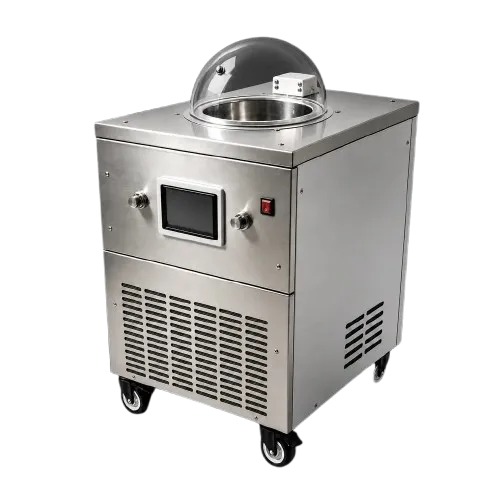
At GLACIO, OEM/ODM starts at 30 units. In that range you are typically buying configuration changes rather than new tooling: panel colour, silkscreen or badge, localized UI strings, localized manuals, and packaging with your brand. It is enough to build a coherent product line for a distributor or a growing chain without funding injection molds.
Above that, the options widen: different bowl configurations, control-panel layouts, accessory kits, and eventually incremental tooling. The honest rule is that tooling changes move the MOQ up, and the further you move from the standard build, the longer the engineering and certification path.
What is usually included
- Your logo on panel, badge and packaging
- A colour and finish selection from a standard palette
- Localized control-panel language and manual
- Standard machine configuration, with your model naming
- Documentation package: manual, wiring diagram, fault codes
- The base compliance documents for the machine platform
What is not included (and gets discovered later)
- New tooling. A new shell or a different bowl geometry is an engineering project, not an artwork change.
- New certifications. A re-badged machine does not automatically carry new-market certification. If the destination market needs a different listing or declaration, that is a separate scope with its own cost and timeline.
- Service network. Private label does not create technicians. You either build service capability or contract it — and your customers will call you, not the factory.
- Spare-parts stock. You will need to hold or arrange parts for the models you sell.
- Regulatory ownership. In many markets the entity placing the product on the market is responsible for compliance. Confirm who that is before the first shipment.
The process, step by step
1. Specify. Model, voltage, market, certification scope, branding, packaging, manuals. 2. Quote and sample. Confirm the base unit, the customization list and the per-unit delta. 3. Artwork and approval. Panel artwork, badge, label content, manual translation. 4. Pilot build. A small run or a single unit for photography, testing and approval. 5. Production. 30-unit MOQ, with QC and burn-in per the factory process. 6. Documentation. Certificates, declarations, manuals, spare-parts list. 7. Shipment. FOB or delivered, with the document set agreed in the purchase order. 8. After-sales. Parts, warranty process and escalation path written down.
Commercial terms to negotiate
- Exclusivity. Territory and category exclusivity is a separate commercial agreement, not a feature of the MOQ.
- Price tiers. Ask for the price at 30, 60 and 100 units so you can see the curve before you commit.
- Warranty split. Who pays labour and who pays parts, and how claims are proven.
- Spare-parts commitment. What is stocked, dispatch time, and the price list at signature.
- Brand ownership. Your artwork stays yours; the factory’s platform stays theirs.
- Change control. What happens if you want a running change after the pilot.
Is 30 units right for you?
30 units suits a distributor testing a brand, a chain standardizing equipment across locations, or a company building a product line on a proven platform. It is too many for a single shop and probably too few if you need deep hardware differentiation.
If you are earlier than that, start with a standard machine under the factory brand and revisit private label once volume is predictable. The factory-direct verification guide covers how to check the supplier before committing, and the Carpigiani and Taylor guides show how established brands position their platforms.
FAQ
Is 30 units enough for custom branding?
For panel colour, badge, silkscreen, localized UI and packaging, yes. For new tooling or a new chassis, no — that is a different project with a higher MOQ.
Who owns the certification?
The entity placing the product on the market. If you resell under your brand in a regulated market, confirm in writing who holds the technical file and declaration, and what the factory will supply.
Can I get exclusivity at 30 units?
Rarely. Exclusivity is usually tied to annual volume commitments. Negotiate it as a separate agreement with targets, not as a line item on the first order.
How long does a private-label run take?
Artwork and approvals, pilot build, production and documents — plan in months, not weeks, and add time if certification scope changes.
If you are evaluating private label, tell us your market, target volume and branding scope — an export engineer replies within 24 hours with a 30-unit configuration and cost breakdown. Request an OEM quote.
Sources: GLACIO OEM/ODM terms (30-unit MOQ, panel and badge customization, localized UI and manuals); general private-label practice. Certification scope and regulatory ownership vary by market — confirm in writing.
Some information may be outdated
Comments
Questions about equipment capacity, voltage, or recipes? Leave a comment.
Loading comments...