




Quick answer: A factory-direct gelato machine can reduce configuration risk and improve support only when the buyer verifies that the seller controls production. Match the legal entity, factory address, assembly video, serial-numbered test report, electrical documents and spare-parts list before you compare quotes. These checks protect uptime, which is where equipment cost meets revenue.
A lower quote is not automatically a lower-cost machine. If the equipment arrives with the wrong voltage, an untraceable controller, unclear refrigerant documentation or no practical spare-parts route, the saving can disappear during installation or the first busy weekend.
This guide is written from the manufacturing side. It explains what a serious factory can show you, what a trading company may struggle to prove, and how to turn those checks into a commercial decision without pretending that a video call replaces a formal audit.
By the GLACIO Machinery Team | Updated October 27, 2026 | 8 minute read
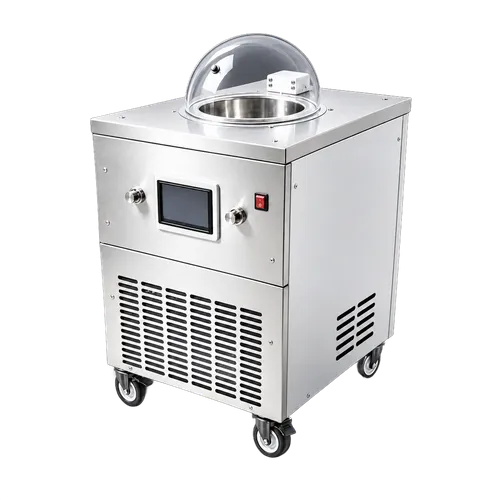
What does “factory-direct” actually mean?
Factory-direct means the company quoting the machine has direct responsibility for the agreed production scope. It does not mean every component is made in one building. Compressors, controllers, pumps or refrigeration parts may come from specialist suppliers.
The useful question is therefore narrower: who controls final assembly, testing, configuration, serialization and after-sales support? Ask that question before discussing machine colour or freight.
A real factory can usually explain the production route from incoming parts to final run test. A reseller may still provide good service, but the buyer should know which company is accountable when a technical problem crosses departmental lines.
The 7 checks that separate a factory from a sales office
1. Match the legal entity, bank beneficiary and quotation
Request the company’s current legal name, registered address and business-registration document. The name on the quotation, proforma invoice, bank account and export documents should be consistent, unless a documented group or sales arrangement explains the difference.
Verify the registration through the relevant official company registry and ask who signs the contract. Do not use a copied certificate alone as proof: certificates are easy to reuse and may not show the exact production site.
2. Confirm the production address
A showroom, warehouse and factory can be three different addresses. Ask where final assembly and testing take place, then compare that address with the inspection report, shipping documents and the route shown in a live video.
For a GLACIO order, the production base is in Jinhua, Zhejiang. Buyers can request a live production walk-through before placing a deposit and a pre-shipment video tied to the machine’s serial number.
3. Ask for an unedited production walk-through
A rendered promotional clip does not prove production capability. Ask for a live call or a continuous video that shows the site sign, assembly area, component storage, wiring bench, testing station and packing area in one route.
Useful details appear in the background: cable routing, pressure-test equipment, work instructions, labelled parts and machines waiting for test. The goal is not a perfect-looking film set. The goal is evidence that the claimed process exists.
4. Require a serial-numbered test record
The machine’s nameplate should connect the exact unit to the order. Ask for photographs of the nameplate and test record before packing, including voltage, frequency, current, compressor start-up, freezing-cycle behaviour, controls, alarms and final cleaning.
| Evidence | What it proves | What it does not prove |
|---|---|---|
| Business registration | The legal entity exists and can be checked | That the production line is at the same address |
| Live factory walk-through | Assembly and test areas exist | Long-term reliability or compliance in your market |
| Serial-numbered test report | The exact unit was tested to a recorded procedure | Independent laboratory certification |
| Wiring diagram | The electrical architecture can be reviewed locally | That a local installer has approved the installation |
| Spare-parts list | Critical parts can be identified and sourced | Instant delivery or low lifetime cost |
5. Review the final electrical specification
“220 V” is not a complete electrical specification. Confirm phase, frequency, rated current, starting current, plug type, breaker guidance, cable size and whether any accessories change the load. The final approved drawing should match the destination and the local electrician’s plan.
This matters because a factory can build a capable machine and still create a costly site problem if the configuration is discussed only through abbreviated chat messages. Use one specification sheet with revision numbers and signed approval.
6. Audit the component and compliance file
Ask for the bill of materials for critical systems, the compressor and refrigerant details, controller model, safety devices and the documents required by the destination market. Confirm which certifications apply to the exact model and configuration, rather than assuming that a logo on a brochure covers every version.
For imported food equipment, also confirm cleaning access, food-contact materials, drainage and ventilation requirements with local authorities and your installer. A supplier declaration supports the review; it does not replace local law.
7. Test the spare-parts and service route before things fail
Request the recommended spare-parts list, lead times, prices, seal and gasket schedules, controller support and the escalation contact for technical issues. Ask whether manuals and wiring diagrams will be supplied in English and whether remote diagnostics are available.
Do not accept “all parts available” as an answer. Name the compressor, controller, door seal and key sensors. A supplier that can identify them precisely is easier to hold to a service promise.
Why factory-direct can create more revenue than a cheap handoff
Gelato revenue depends on serving the right product during demand peaks. Configuration mistakes reduce that opportunity three ways: the shop opens later, batches take longer, or downtime removes a visible menu item.
Direct factory contact helps when the buyer needs a documented voltage configuration, a custom panel, recipe-specific operating guidance or a replacement part matched to a serial number. The value is not simply a wholesale price. It is a shorter line between the operating problem and the person who can resolve it.
That difference matters most for a multi-bowl shop. If a two-circuit GB-4 is selected because the shop needs four visible flavours and partial service flexibility, the buyer should verify that the final controller, circuit layout and operating instructions match that plan. Otherwise the shop may pay for a cabinet that behaves like a simpler machine.
Compare models by peak-hour demand and flavour count, not catalogue size. The GB-1, GB-2, GB-4 and GB-6 selection guide explains the capacity steps and operating trade-offs.
A practical factory-audit checklist
- Verify the legal entity and registered address.
- Map the actual assembly and testing site.
- Watch a live or continuous production walk-through.
- Approve a revision-controlled specification sheet.
- Review the electrical diagram and site requirements.
- Confirm the compliance documents for the destination.
- Record critical component brands and models.
- Agree the serial-numbered run-test evidence.
- Set packing, loading and shipment inspection points.
- Approve the spare-parts, manuals and service route.
The warranty and spare-parts guide helps turn those last two points into a purchase-term checklist.
Red flags that deserve a slower decision
- The company cannot name the party responsible for final assembly and testing.
- The factory address changes when you ask for a live walk-through.
- The quotation has no model, serial range, voltage, frequency or revision number.
- Photos are offered as proof, but the seller refuses a live or serialized test.
- Certification documents do not identify the product family or configuration.
- Spare parts are described only as “available” with no part numbers or lead times.
- The bank beneficiary belongs to a different, unexplained company.
- You are pressured to pay before technical clarifications are written down.
One red flag may have a reasonable explanation. A pattern of vague answers is the problem.
How to compare factory-direct offers fairly
Use total landed and operational cost, not the machine price alone. The U.S. Small Business Administration’s startup-cost guidance supports the same planning principle: list one-time and ongoing costs before deciding whether the investment works.
| Quote line | Question to ask |
|---|---|
| Machine and accessories | Which model, bowls, controllers and options are included? |
| Electrical configuration | What exact voltage, frequency, current and breaker guidance applies? |
| Packaging and freight | Which Incoterm, ports, insurance and unloading responsibilities apply? |
| Import and local work | What duty, tax, installation and ventilation costs remain outside the quote? |
| Commissioning | Who approves the installation and first production run? |
| Spares and support | Which parts are stocked, priced and guaranteed to have a lead time? |
For a broader landed-cost framework, read the commercial ice cream machine cost guide. For site preparation, use the installation checklist.
Frequently asked questions
Does factory-direct always mean the lowest price?
No. A direct manufacturer may offer fewer intermediary costs, but the final value depends on configuration, freight, import charges, support and uptime. Compare total installed cost and the supplier’s ability to resolve problems.
Is a live video inspection enough to verify a factory?
A live walk-through is useful evidence, but it is not a full audit. Match the address, legal entity, production process and serialized test report. For a large order, use an independent inspection company.
What documents should be attached to the contract?
Attach the approved specification, electrical drawing, component schedule, test procedure, packing standard, warranty, spare-parts list and acceptance criteria. The exact commercial and import documents depend on the destination and Incoterm.
Can custom panels or manuals be produced?
GLACIO offers panel colour, print, control graphics and manual customisation from 30 units, subject to artwork approval and order review. Confirm the final scope and schedule in the quotation.
Request a factory verification call
Send GLACIO your planned menu, expected peak-hour servings, flavour count, available counter dimensions and destination voltage. We will recommend a GB configuration and arrange a factory discussion covering the production site, test record, electrical documents and spare-parts route.
Request a factory verification and sizing review. Review the GB-series machine specifications before the call so the discussion starts with your operating plan rather than a catalogue number.
Some information may be outdated
Comments
Questions about equipment capacity, voltage, or recipes? Leave a comment.
Loading comments...