

Carpigiani Gelato Machine: What You Pay For and When It Pays Off
Most gelato shop owners meet Carpigiani the same way: they walk into a good shop in Italy, ask what is behind the counter, and hear the same name. Then they look up the price of a new machine and start hunting used listings instead. The brand is not marketing hype – it earned its place – but the gap between a well-kept used unit and a tired one is wide enough to swallow the savings. This guide covers what the money actually buys, the checks that decide whether a used machine is a bargain, and the cases where a new batch freezer at the same capacity is the smarter purchase.
Quick answer
A Carpigiani gelato machine is worth its price when you are buying consistency, parts availability and resale value, and when the machine will run several batches a day for years. It is usually the wrong first purchase when your peak demand is under about 30 litres a day, when you have no local refrigeration technician, or when a used unit has no service history. In those cases a new factory-direct batch freezer at the same capacity often costs less over four years, even though its sticker price looks less impressive.
What you are actually paying for
The cylinder is the machine
On any batch freezer, the freezing cylinder and the beater that scrapes it decide texture, cycle time and service life. Italian machines in this class are built around a hardened cylinder with a close-tolerance beater, and the scraper blades are a consumable that keeps the cylinder clean rather than a fixed part. When you buy used, you are really buying the condition of that pair. A machine with a scored cylinder freezes slowly, runs longer per batch and never quite reaches the texture the brand is known for.
Consistency controls
Newer units manage the freeze automatically and stop on viscosity rather than on a timer. That matters when staff change between shifts: a timer machine produces one texture at 9am and another at 9pm, while a viscosity-controlled machine produces the same tub all day. If you are buying used and the shop runs different people on different shifts, this single feature is usually worth more than a slightly bigger bowl.
Parts, technicians and resale
The brand is supported in most of Europe, North America and Australia, with dealers who stock blades, seals, gaskets and boards. That network is the real premium. It also protects resale: a working Carpigiani with paperwork is easy to sell, while an unknown import often is not.
Price bands in 2026
The numbers below are market observations from quotes and listings we see, not an official price list. Treat them as a starting point for your own budget and always confirm with the seller.
| Machine class | Typical new quote | Typical used asking price | What changes the number most |
|---|---|---|---|
| Countertop or lab unit, 2 to 6 litres per cycle | USD 8,000 to 18,000 | USD 3,500 to 8,000 | Single-phase power, low hours, complete accessories |
| Small shop unit, 6 to 12 litres per cycle | USD 18,000 to 35,000 | USD 7,000 to 15,000 | Cylinder condition, automatic controls, service history |
| Mid-size unit, 12 to 25 litres per cycle | USD 35,000 to 70,000 | USD 12,000 to 30,000 | Three-phase power, water cooling, refurbishment records |
Two patterns show up again and again. First, asking prices on used listings are usually 15 to 30 percent above what the machine actually sells for. Second, machines sold as part of a shop closure are often the best value, because the seller needs the unit gone rather than maximising the price.
The checks that decide a used deal
Work through these before you transfer money. Each one has a cost attached if it fails.
- Hours and age. Ask for the production counter reading, not just the year of manufacture. A 2009 machine with 4,000 hours is often healthier than a 2018 machine that ran two shifts a day.
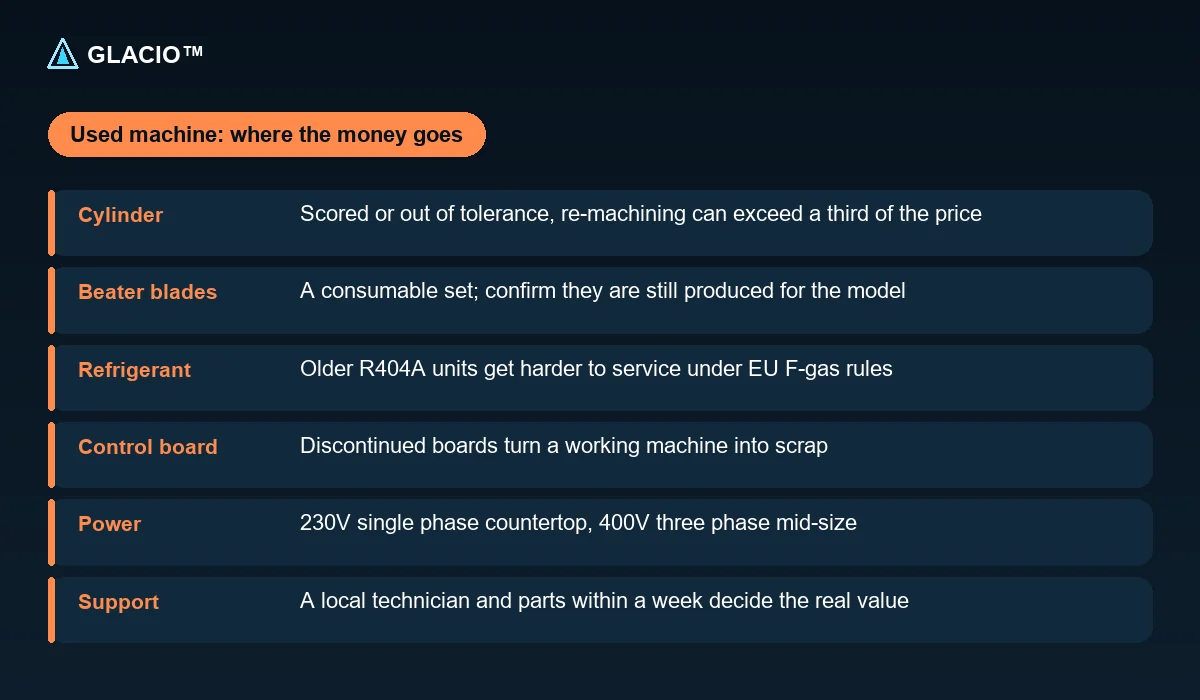
- Cylinder and beater. Look for scoring, deep grooves and uneven blade wear. A cylinder that needs re-machining can cost as much as a third of the purchase price.
- Refrigerant type. Older R404A machines are cheap to buy and increasingly awkward to service in Europe, where fluorinated gas rules push technicians toward R448A and R452A. Confirm the gas and that a local technician will still work on it.
- Cooling method. Water-cooled units freeze faster and are less sensitive to a hot kitchen, but they need a drain and a water supply. Air-cooled units are simpler to install and slower in a 35 degree room.
- Power supply. Small units run on 230V single phase. Mid-size machines usually need 400V three phase. Check your board before you check the machine, and budget for cable, breaker and a dedicated circuit.
- Seals, gaskets and blades. Price a full consumable set before you buy. Availability and cost of these parts is a good proxy for how well the rest of the machine will be supported.
- Controller and board. Ask whether the board is still produced. A discontinued board turns a working machine into a paperweight.
- Test run, under load. Freeze a real mix, not water, and time a full cycle. Note the room temperature. A machine sold in a cold warehouse can behave very differently in a warm shop.
The costs that follow the machine
- Commissioning: allow USD 400 to 1,200 for transport, unloading and a technician visit.
- Refurbishment: budget USD 800 to 2,500 for seals, blades, gas and a board check on a used unit.
- Service contract: roughly USD 300 to 700 a year if you keep up with maintenance.
- Downtime: a week without production costs far more than the parts. This is the line most buyers forget when comparing a cheap used machine with a new one that carries a warranty.
Four situations, four answers
| Your situation | Is a Carpigiani the right buy? | What to do instead |
|---|---|---|
| First shop, roughly 30 litres a day, tight budget | Rarely. A used mid-size unit leaves little room for refurbishment surprises. | Start with a new small batch freezer sized to your real peak hour. See the commercial gelato machine buying guide. |
| Cafe adding gelato, 10 to 20 litres a day | Only if a well-documented countertop unit is available locally. | Size the machine honestly first: a countertop gelato machine covers this range. |
| Established shop replacing one of two machines | Yes, if the brand is already in your kitchen and your staff know it. | Keep the spare-parts shelf compatible and buy the same control family. |
| Wholesale producer at 300 litres a week | Yes, but buy on service terms, not on brand alone. | Compare against a new machine with a written service agreement and spare cylinder. |
Used European machine against a new batch freezer
Here is the comparison that actually decides it. Both machines freeze 12 litres per cycle. The example assumes a shop producing 60 litres a day, five days a week.
| Cost line over four years | Used European machine | New factory-direct batch freezer |
|---|---|---|
| Purchase price | USD 14,000 | USD 9,500 |
| Freight and commissioning | USD 1,200 | USD 1,600 |
| Refurbishment in year one | USD 2,000 | USD 0, covered by warranty |
| Planned service, four years | USD 1,800 | USD 900 |
| Unplanned downtime, one week at USD 600 a day of lost margin | USD 3,000 | USD 0 in this example |
| Total | USD 22,000 | USD 12,000 |
The example is deliberately simple, and a used premium machine can win easily when it comes with recent refurbishment records, a spare-parts shelf and a technician who already knows it. The point is that brand alone does not decide the cheaper machine. Condition and support do. If you want the arithmetic behind daily production, the running cost per litre breakdown works through mix, power and labour.
What to do before you pay
- Ask for the service history and the last refrigerant service date in writing.
- Confirm parts availability for the specific model, including the control board.
- Get a refrigeration technician to see the test run, not just the seller.
- Check your electrical supply and drainage before agreeing on delivery.
- Compare against a new machine of the same capacity, then compare four-year totals, not sticker prices.
If the used unit is being replaced inside a closed shop, ask what else is available. Display cases and gelato display cases sold in the same lot often cost less than they would on their own, and they are the other half of a working gelato counter. Buyers who are still weighing a first machine against a hobby unit should read home versus commercial gelato machines first, and anyone shopping on price alone should start with the budget machine checklist.
Frequently asked questions
Is a Carpigiani gelato machine worth the price?
It is worth it when the machine will run daily for years, when a local technician supports it, and when resale matters to you. It is rarely worth it as a first machine for a shop producing under 30 litres a day on a tight budget.
What does a used Carpigiani gelato machine cost?
Used countertop and lab units typically ask USD 3,500 to 8,000, small shop machines USD 7,000 to 15,000, and mid-size units USD 12,000 to 30,000. Expect to spend another USD 800 to 2,500 on refurbishment and a full consumable set.
Can one machine make both gelato and hard ice cream?
Yes. A batch freezer freezes mix to a firm, scoopable state, and the difference between gelato and hard ice cream comes mostly from the recipe, the overrun you aim for and the serving temperature – not from a different machine. What changes is how you harden and display the product afterwards.
Which model families should I look at?
For small volumes, look at countertop and lab-class machines from the LABO and Ready families. For a working shop counter, mid-size Master-class machines appear most often on the used market. Match the class to your peak-hour litres first, then compare condition and support.
How long do these machines last?
Fifteen to twenty years is realistic with regular blade and seal changes and a clean cylinder. Age matters less than hours, refrigerant history and whether the cylinder has been kept in tolerance.
Do I need three-phase power?
Countertop units usually run on 230V single phase. Mid-size machines generally need 400V three phase with a dedicated breaker. Confirm the supply in your unit before you commit to a machine, because electrical work adds cost and delay.
Choosing between a used European machine and a new batch freezer is really a question about how much certainty you want to buy. If you send us your peak-hour litres, the product you sell and your power supply, we will tell you which capacity fits – and whether the machine you are looking at is worth the asking price. Tell us in the comments which model you are considering and what you have been quoted.
Tell us the shop. We size the machine and price it.
Two numbers decide the model: how much you sell on a busy day, and how much you need in your busiest hour. Send those with your voltage and you get a model recommendation and an FOB quote within 24 hours.
- ✓ Sized to your peak hour
- ✓ FOB quote and lead time
- ✓ No obligation
Some information may be outdated
Comments
Questions about equipment capacity, voltage, or recipes? Leave a comment.
Loading comments...