




Short answer: A used commercial ice cream machine can be a good buy when the compressor, freezing bowl, controls, and parts channel are verifiable. Walk away when the compressor has been replaced without paperwork, the bowl is deeply scored or leaking, the controller is hot or intermittent, or the seller refuses a loaded test run.
A used batch freezer can cut the entry cost of a gelato shop, bakery, cafe, or small food business. It can also turn a $6,000 saving into a $12,000 repair if you buy the wrong machine. The difference is not the age on a listing. It is the condition of the parts that make cold and the availability of the parts that keep it running.
This checklist is written for a used commercial ice cream machine, gelato machine, or hard-serve batch freezer. Use it before you send a deposit. If the seller will not allow an inspection or a controlled test run, price the machine as a repair project rather than working equipment.
Why used machines can still be a smart purchase
A commercial batch freezer is a stainless cabinet with a refrigeration system, a freezing bowl, a dasher drive, and a controller. Those systems can be rebuilt. A used machine becomes worth buying when the structure and bowl are sound, the compressor is serviceable, parts are still available, and the seller can document how the machine was used.
For reference, the GLACIO GB-Series uses one to six 6-liter bowls. Each bowl is rated for a typical 15-20 minute batch and roughly 14 liters per hour, depending on mix, starting temperature, ambient conditions, and operating cycle. A GB-1 weighs about 96 kg, while a GB-6 reaches about 330 kg. Those numbers matter because a used machine must match both your production plan and the path into your building.
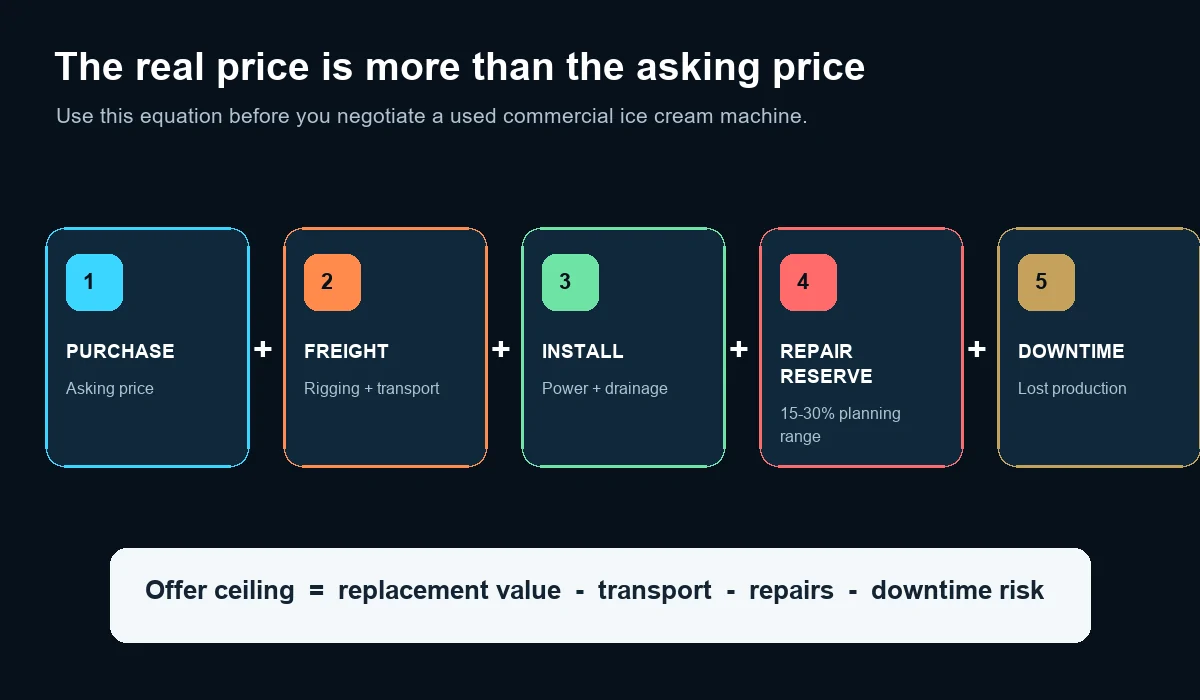
Do not start with the asking price. Start with the replacement value of a machine that meets the same production requirement. Then subtract transport, installation, likely repairs, and the cost of downtime. The offer ceiling comes from that calculation.
The 35-point used machine inspection checklist
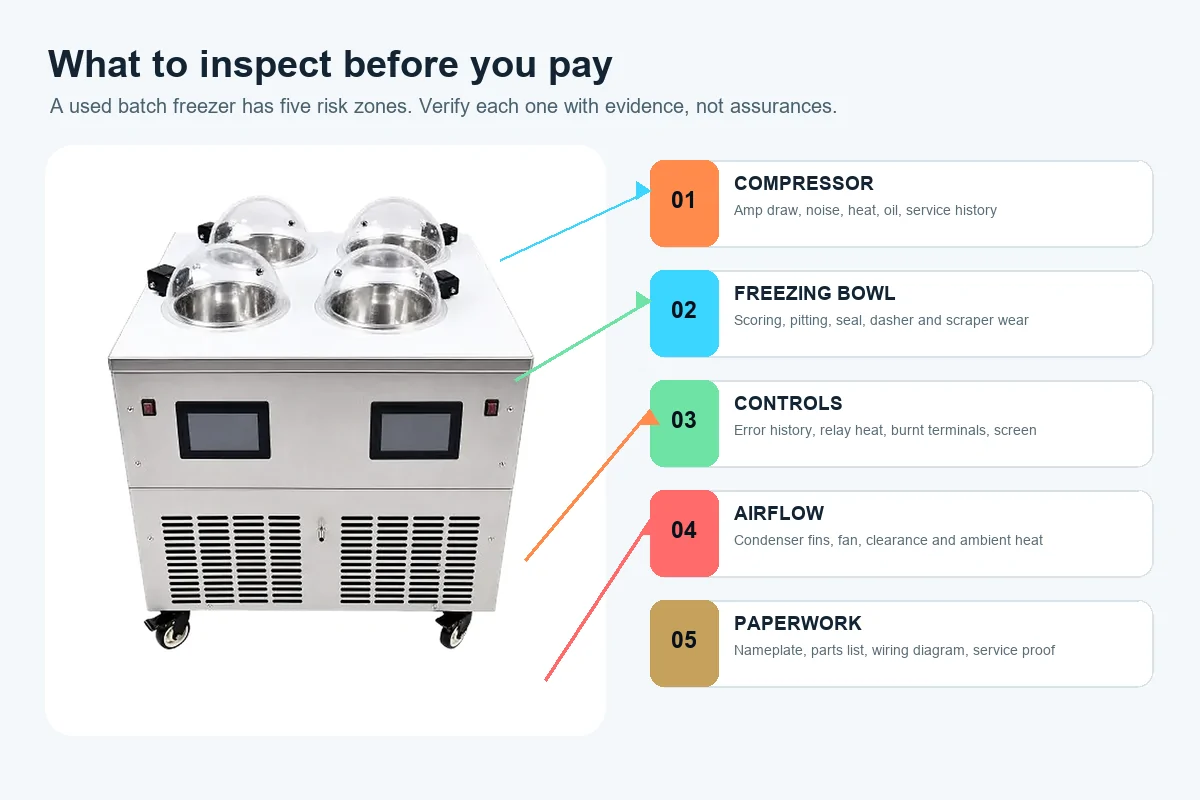
Print this section or copy it into your inspection notes. Record a photo, measurement, or document for every answer. A verbal statement from the seller is not evidence.
Zone 1: Paperwork and machine identity – 5 points
- Nameplate: Model, serial number, voltage, phase, frequency, refrigerant type, and rated current are readable.
- Ownership: The seller’s name matches the invoice, company record, or asset release document.
- Service history: Compressor, controller, fan motor, relay, and refrigerant repairs have dates and invoices.
- Manuals: The operation manual, wiring diagram, parts list, and controller guide are available or downloadable.
- Parts channel: You can identify a supplier for the bowl seal, scraper blades, fan, controller, contactor, and compressor start components.
Zone 2: Refrigeration system – 10 points
- Compressor identity: The compressor model matches the original nameplate or the documented replacement.
- Startup behavior: The compressor starts without a loud knock, repeated clicking, or immediate breaker trip.
- Running current: A clamp meter reading is compared with the nameplate rated or full-load current by a qualified person.
- Compressor temperature: The shell is warm, not scorching, and the area has no burnt smell.
- Oil condition: If a sight glass exists, oil level and color are within the manufacturer guidance.
- Refrigerant lines: There is no oily residue, fresh dye, frost pattern that changes during the test, or evidence of repeated charging.
- Service valves: Caps are present, ports are not damaged, and the seller can explain every recent refrigerant service.
- Condenser coil: Fins are straight, clean, and not packed with grease or flour.
- Condenser fan: Blades turn freely, the motor runs quietly, and airflow is strong.
- Safety controls: High-pressure, thermal, and overload protections are connected, not bypassed.
Zone 3: Freezing bowl, dasher, and drive – 8 points
- Bowl surface: The stainless freezing surface has no deep scoring, pitting, cracks, or repairs with non-food-grade material.
- Bowl seams: Welds and seals are intact with no evidence of refrigerant or water leakage.
- Dasher condition: The dasher is straight, clean, and free from broken welds.
- Scraper blades: Blades are complete, flexible, and available as a replacement part.
- Shaft and coupling: Splines, keys, or couplings are not rounded, cracked, or heavily worn.
- Drive noise: The motor runs without grinding, rhythmic knocking, or excessive vibration.
- Lid and seal: The cover closes correctly and the gasket or seal can still keep product contained.
- Drain and plug: The drain plug seals, the outlet is clear, and no product residue is trapped in inaccessible areas.
Zone 4: Controls and electrical – 7 points
- Supply match: The machine voltage and phase match your building supply or a documented transformer or converter plan.
- Controller display: The screen, buttons, and indicators work without flickering or dead areas.
- Error history: Stored faults are recorded before the seller clears or resets the controller.
- Board condition: There is no burnt smell, scorched connector, bulging capacitor, or corrosion.
- Relays and contactors: Contacts are not heavily pitted and the terminals are tight.
- Wiring: Cable insulation, strain reliefs, grounding, and terminal covers are intact.
- Thermal protection: The cabinet fan, vents, and thermal controls are working and not defeated.
Zone 5: Test run and commercial terms – 5 points
- Controlled test: The seller agrees to a supervised run long enough to reach stable operation.
- Temperature evidence: You record starting ambient, bowl or product temperature, and temperature change over time.
- Electrical evidence: You record voltage and current at startup and after the machine has run for several minutes.
- Leak and noise check: You inspect for drips, unusual frost, vibration, and changes in sound during the run.
- Written terms: Price, included accessories, loading, warranty, return conditions, and payment milestones are written down before payment.
How to run a useful 20-minute test
A short power-on test proves almost nothing. The machine can start cold and still fail after the compressor, condenser, and controller heat up. Ask for a supervised run that is long enough to observe stable operation and at least one change in load or temperature.
- Before starting: Photograph the nameplate, serial number, bowls, compressor compartment, controller, wiring, and any existing damage.
- Record baseline: Note room temperature, voltage, and whether the machine arrived cold or at room temperature.
- Start normally: Use the manufacturer sequence. Do not allow anyone to bypass a safety switch to make the test work.
- Watch for the first minute: Listen for compressor start, fan operation, relay chatter, unusual vibration, or a breaker trip.
- Measure during the run: Record current, compressor shell temperature, condenser airflow, and controller or cabinet temperature when safe.
- Check the product zone: Confirm the dasher turns, the bowl surface changes temperature, and there are no leaks around seals or the drain.
- Shut down normally: Confirm the controller completes its stop sequence and the machine can be restarted after a short pause.
- Review faults: Read the error history again after the test. A new fault is more important than the seller’s explanation.
Testing with clean water is useful for drive operation, leaks, noise, and controller behavior. It is not a complete freezing-performance test because water does not behave like an ice cream or gelato mix. For a meaningful performance test, agree in advance on the mix, starting temperature, bowl volume, cycle setting, and pass criteria.
Calculate the real price before you negotiate
The asking price is only one part of the purchase. A used machine that needs a compressor, controller, and installation upgrade can cost more than a smaller new machine that matches your actual production plan.
Real cost = purchase price + freight + rigging + electrical work + cleaning and service + repair reserve + downtime risk.
A practical planning range for the repair reserve is 15-30% of the purchase price for an older machine with incomplete service records. This is not a prediction of the final repair bill. It is money you should be prepared to spend without delaying opening day. If the reserve pushes the project above your budget, reduce the machine size, not the safety checks.
Use this comparison:
| Decision factor | Used machine with records | Used machine with no records |
|---|---|---|
| Purchase price | Lower than new | Often lowest on the listing |
| Inspection | Test run and service history | Cannot verify hidden failures |
| Repair reserve | Lower, but still required | Plan for the high end |
| Parts availability | Known and quoted | Unknown |
| Downtime risk | Manageable with spare parts | Can stop production without warning |
| Best use | Planned expansion or backup capacity | Only if your offer reflects the risk |
Nine red flags that should change the deal
- No test run: A seller who will not run the machine is selling uncertainty, not working equipment.
- Bypassed safety controls: A jumper around a thermal, pressure, or door switch is an immediate stop signal.
- Fresh oil around refrigerant fittings: Oil residue can indicate a leak or recent repair that was not documented.
- Burnt wiring or board smell: Heat damage usually has a cause that returns after the machine is loaded.
- Deep bowl scoring: A damaged freezing surface can affect release, cleaning, and food safety.
- No replacement scrapers or seals: A good machine with no consumable parts is a future paperweight.
- Compressor replacement with no invoice: You cannot confirm capacity, refrigerant, or work quality.
- Breaker trips during the test: Stop. Do not keep resetting the breaker to force the machine through a cycle.
- Pressure to pay quickly: A fair seller can wait for inspection and written terms.
Which used model fits your business?
Match the bowl count to the number of flavors you need at the same time, not simply the total liters you make in a day. A cafe or bakery may only need one or two bowls. A busy gelato counter often needs enough independent bowls to keep several flavors available while staff clean and reload others.
| Model | Bowls | Typical output | Best used-machine fit |
|---|---|---|---|
| GB-1 | 1 x 6 L | About 14 L/h | Small cafe, bakery, test kitchen, backup production |
| GB-2 | 2 x 6 L | About 28 L/h | Small shop with two active flavors |
| GB-4 | 4 x 6 L | About 56 L/h | Busy gelato or ice cream counter with flavor rotation |
| GB-6 | 6 x 6 L | About 84 L/h | High variety, peak-hour production, multi-bowl menu |
The output figures assume the standard 15-20 minute cycle and a suitable mix. Always compare the used machine against your own peak-hour requirement. Our batch freezer sizing guide shows how to convert daily scoops and peak demand into liters per hour.
If you are comparing new GLACIO models, start with the GB-1, GB-2, GB-4 and GB-6 selection guide. It explains the bowl, circuit, power, and space differences in one table.
What to ask the seller in writing
- What is the exact model, serial number, voltage, phase, and refrigerant type?
- What was produced in the machine, how often, and at what batch size?
- What repairs were completed, by whom, and when?
- What parts were replaced, and are invoices available?
- What faults are stored in the controller?
- What accessories and spare parts are included?
- What test run will be allowed before payment?
- What warranty applies after the machine leaves the seller’s site?
- Who loads the machine, and who pays for freight and insurance?
- What is the return or dispute process if the machine does not match the description?
Frequently asked questions
Is a used commercial ice cream machine worth it?
It can be worth it when the freezing bowl and cabinet are sound, the compressor can be tested, control faults are visible, parts are available, and the seller allows a documented run. A low price without those conditions is a repair project, not a bargain.
How many hours should a used batch freezer have?
Many commercial batch freezers do not have reliable hour meters. Compressor condition, service history, operating current, condenser condition, bowl wear, and the availability of parts matter more than a displayed number. Treat an hour figure as one data point, not proof.
Can I test a used gelato machine with water?
Yes for a basic function, leak, noise, and drive test. Water cannot confirm the final texture, overrun, or gelato recipe performance. Agree on a mix-based test if freezing performance is the reason for the purchase.
Should I repair an old machine before reselling it?
Only when the repair is documented, the food-contact surfaces are safe, and the final price still beats a comparable working machine. Hidden repairs reduce buyer trust and can make the machine harder to sell.
What is the biggest reason used machine deals fail?
The most common failure is buying without a loaded test or parts quotation. A machine can start and still fail when the compressor heats up, the condenser cannot reject heat, or the controller has an intermittent fault.
Use the inspection to protect the business, not just the budget
A used commercial ice cream machine is a production asset. The inspection is not about finding every cosmetic mark. It is about deciding whether the machine can make safe product, repeat the same cycle, and be repaired without stopping your business for weeks. Verify the cold chain, the food-contact surfaces, the controls, and the parts channel before you pay.
If you are planning a new installation instead, tell GLACIO your daily cups, peak-hour demand, flavor count, voltage, and available floor space. We will help you match a GB-1, GB-2, GB-4, or GB-6 to the workload. Request a machine recommendation and quote.
Have you inspected a used batch freezer before? Share the one check that saved you from a bad purchase, or the warning sign you wish you had seen sooner.
Some information may be outdated
Comments
Questions about equipment capacity, voltage, or recipes? Leave a comment.
Loading comments...