




Short answer: A batch freezer that will not freeze is usually losing cooling at one of five places: power, controls, airflow, refrigerant circuit, or product load. Check the panel, error code, condenser airflow, room heat, and current draw first. Do not bypass thermal protection or open the refrigerant circuit unless you are certified.
The machine may be running without cooling, cooling too slowly, stopping after a few minutes, or showing a high-temperature or overload fault. Those are different failures. Before you call a technician, collect the evidence that separates them. That short diagnostic record can cut hours of guesswork and stop a small fault from becoming a compressor replacement.
Start with the safe checks, not the panel screws
A hard ice cream batch freezer moves a dasher through a freezing bowl while the refrigeration system removes heat from the mix. The controller commands the process. It does not create cold by itself. If any link in the cooling chain fails, the machine can appear to run normally while the product stays soft.
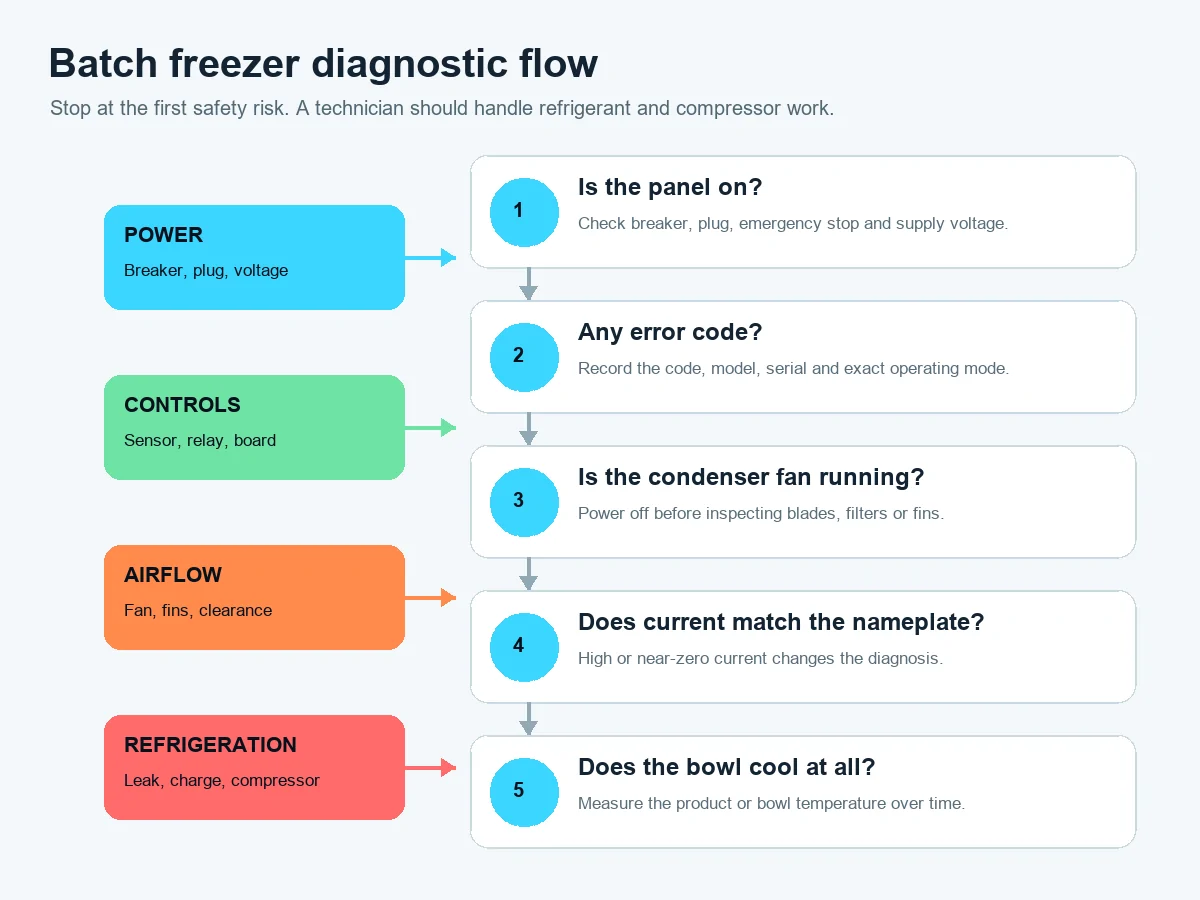
Use this sequence:
- Stop production. Remove product if food safety or mix quality is at risk.
- Record the fault. Photograph the screen, error code, mode, timer, and temperature reading before resetting anything.
- Disconnect power before touching the condenser area, covers, blades, or electrical terminals. Follow your lockout/tagout procedure. OSHA explains the basic requirements in 29 CFR 1910.147.
- Check the building supply. Confirm the breaker, plug, phase, voltage, and emergency stop are correct for the nameplate.
- Check airflow. The condenser needs clean fins, a working fan, and enough clearance to reject heat.
- Document the condition. Record ambient temperature, supply voltage, current, compressor behavior, fan behavior, noise, and whether the bowl cools at all.
Do not keep resetting a breaker or thermal cutout. A protection device that trips is reporting a real electrical or thermal condition. Repeated resets can damage the compressor, controller, wiring, or start components.
10 causes of a batch freezer that will not freeze
1. Power supply or breaker problem
What you see: The controller does not start, the compressor never attempts to run, or the breaker trips as soon as the cycle begins.
Check whether the machine is receiving the voltage, phase, and frequency shown on its nameplate. Loose plugs, damaged cables, an undersized breaker, a shared circuit, or a voltage drop during compressor startup can all prevent a normal cycle. A commercial machine is not a household appliance. The circuit must be sized for startup current and the actual installation.
Owner check: Confirm the breaker is on, the plug is fully seated, the emergency stop is released, and no other major equipment is starting on the same supply. Measure voltage at the machine only if you are qualified to do so.
Stop point: Repeated breaker trips, burning insulation, exposed conductors, or voltage outside the nameplate range require an electrician. Do not raise the breaker size to make the machine run.
2. Thermal protection, overload, or high cabinet temperature
What you see: The machine starts, runs for several minutes, then stops. The screen may go dark, reset, or show an overload or high-temperature message. After a rest, it starts again and repeats the cycle.
Commercial machines use overloads, thermal switches, and controller protections to stop operation before damage occurs. That protection may be doing its job. The underlying cause could be a hot electrical cabinet, a failing relay, a condenser problem, a fan that has stopped, or a compressor drawing too much current.
If the control-board area is unusually hot, do not treat the board as the entire problem. Heat is a symptom. Check the cabinet vents, enclosure fan, ambient temperature, compressor current, contactor terminals, and the condition of the relay. A board that keeps resetting may be protecting the machine from a fault elsewhere.
Owner check: Record how long the machine runs before stopping, what the display shows, and whether the condenser fan continues running. Power off before inspecting a cover or vent.
Stop point: A burning smell, discolored terminal, hot wiring, or repeated thermal shutdown requires electrical diagnosis.
3. Blocked or dirty condenser coil
What you see: The machine freezes slowly and gets worse as the room warms. The compressor becomes hot, the cabinet feels hot, and the condenser air is weak or warm.
The condenser releases heat taken from the mix. In a bakery, cafe, or gelato shop, flour, dust, grease, syrup, and packaging debris can coat the fins. A restricted condenser raises compressor temperature and pressure, reduces cooling capacity, and can trigger an overload.
Owner check: With power isolated, inspect the accessible filter and condenser face. Clean according to the manufacturer manual. Do not bend the fins or spray water into electrical components.
4. Condenser fan failure or wrong air direction
What you see: The compressor tries to run but the machine cools poorly. The fan may be stopped, noisy, slow, or pushing air in the wrong direction after a repair.
The fan must move enough air across the condenser. A failing motor, damaged blade, blocked guard, loose connector, or incorrect replacement can make the refrigeration system run outside its design condition. If the machine was recently repaired, compare the fan, airflow direction, and electrical connection with the service manual.
Owner check: Power off first. Confirm the blade turns freely and the guard is clear. A fan that requires a push to start is not a working fan.
5. High ambient temperature or hot-air recirculation
What you see: The machine works in the morning but struggles during a hot kitchen service. It may freeze one batch and fail on the next.
A commercial freezer removes heat from the product and transfers it into the surrounding air. If the machine sits in a small alcove, next to an oven, under a hot shelf, or where its discharge air returns straight into the intake, the condenser cannot reject heat efficiently. The room may be within the human comfort range while the machine is operating outside its specified ambient condition.
Owner check: Keep the specified clearances. Move heat-producing equipment where possible. Add ventilation only after checking the machine’s installation requirements and local building rules.
6. Warm mix, an overfilled bowl, or the wrong batch size
What you see: The machine runs a full cycle, the dasher turns normally, but the product leaves soft, sticky, or half-set. On the next batch the same recipe freezes correctly.
A batch freezer is sized to remove a certain amount of heat in a certain amount of time. If the mix enters the bowl warm, or the bowl holds more mix than the design fill, the machine simply has more heat to pull out than the cycle allows.
Two numbers decide this. The first is mix temperature. A mix loaded at 2-4°C (36-39°F) freezes predictably. The same mix loaded at 20°C carries roughly five times the heat that must be removed before the product can set. The second is fill level. A 6-liter bowl is not designed to be filled to the rim with dense gelato mix. Going 20 percent past the working fill adds about 20 percent more heat load and can also push mix into the lid or the air path.
Owner check: Measure the mix temperature with a calibrated probe before loading the bowl. Cool mix overnight in a walk-in or blast chiller rather than pouring it in warm. Stay at or below the working fill line marked in the manual.
Stop point: If the mix is cold, the fill level is correct, and the machine still produces soft product every cycle, stop adjusting recipes. Move to the controls and refrigeration sections below.
7. Mode, timer, or lid and safety sensor problem
What you see: The dasher runs but the compressor never engages. Or the compressor runs, then stops early while the product is still soft. The display may look completely normal.
A batch freezer only refrigerates when the controller believes every condition is satisfied. That usually means the lid or handle switch is closed, the bowl is seated, the mix level sensor is satisfied, the correct program is selected, and the timer has not expired. Machines with multiple programs often separate a gelato-style cycle, a hard-serve cycle, and a hold cycle. Selecting the softest program, or a hold program, will stop the batch at a temperature that is correct for that program and wrong for a firm, scoopable hard ice cream.
There is a real temperature difference behind those programs. Gelato is typically served around -12 to -14°C, while a firmer hard-serve ice cream is drawn closer to -16 to -20°C. A machine set to a soft serving window will look like it “will not freeze” when it is actually doing exactly what it was told to do.
Owner check: Confirm the selected program, the timer setting, and the consistency setting. Reseat the lid or handle and clean the sensor window or magnet area. Never tape, wedge, or bypass a safety switch to force a cycle.
Stop point: A bypassed switch, a sensor that reads differently at room temperature and in the cold, or a controller that changes program on its own needs an electrical diagnosis.
8. Control board, relay, contactor, or loose terminal
What you see: The controller is powered and the display responds, but the compressor never starts. Or the compressor chatters, starts for a second, and drops out. There may be a warm or burnt smell near the electrical cabinet.
On most commercial batch freezers the control board does not switch the compressor directly. It sends a low-voltage signal to a relay or contactor, and that device carries the compressor and fan load. Heat, dust, vibration, and time build resistance at the terminals. A loose lug at a high-current terminal can reach a temperature that oxidizes the connection and eventually burns it open, and the board is blamed because the display still works.
Overheated electronics have a second layer to the story. Heat inside the cabinet comes from somewhere: a failing contactor, a worn capacitor, a fan that has stopped, a condenser coil that cannot reject heat, or a compressor drawing more current than it should. A board that keeps resetting when the cabinet is hot is often a symptom, not the fault.
Owner check, with power isolated: Look for discolored or darkened terminals, melted insulation, a swollen capacitor, or corrosion. Confirm the cabinet vents are clear and any enclosure fan still runs. Record the fault code and the exact moment the machine stops.
Stop point: Measuring coil voltage, replacing a contactor, or re-terminating high-current wiring is an electrician or refrigeration technician job. Do not hold a contactor closed by hand or with a tool.
9. Low refrigerant charge or a leak in the sealed system
What you see: The compressor runs continuously and never seems to hold temperature. The condenser coil stays cooler than usual, the suction line does not get properly cold, and the freezing bowl may show only a light film of frost or none at all.
Refrigerant does not wear out or disappear on its own. If a machine needs a top-up once, it has a leak, and the same leak will return. Common locations are flare and brazed joints, Schrader ports, a corroded evaporator, and a rubbing vibration line. Adding refrigerant without finding the leak is a temporary repair that also hides the evidence of the real problem.
This part of the machine is regulated work. Under EPA Section 608 of the Clean Air Act, refrigerant in the covered classes must be handled by a certified technician, and knowingly venting refrigerant to the atmosphere is prohibited. Details are published in EPA’s Section 608 program.
Owner check: Photograph any oil traces, dark residue, or corrosion on the coil and piping. Note whether the condenser coil is hot, warm, or cool after ten minutes of running. Record the ambient temperature and the run time before the product stays liquid.
Stop point: Sealed-system work is technician only. Ask for leak detection and repair before charging, and ask for the pressures and superheat readings in the service report.
10. Compressor, start components, or a refrigerant valve
What you see: The compressor hums for a few seconds and trips. Or it is silent with no current draw at all. Or it runs, the machine draws normal current, but the bowl never gets cold.
This group covers the start capacitor, start relay, run capacitor, thermal overload, internal compressor valves, and the solenoid or expansion devices that control the refrigerant flow. Their symptoms overlap, which is why the sequence matters. A compressor that cannot start and a compressor that starts but cannot build pressure call for different repairs, and a replacement compressor quote should always be compared against the value of the whole machine.
The fastest way to sort these is current. Every compressor has running and locked-rotor current values on its label. A compressor pulling well above the rated running current while failing to cool is a very different situation from one pulling nothing at all, and the measured number tells a technician where to look before the first part is ordered.
Owner check: Record whether the compressor is silent, humming, or running. Record how long it runs before a trip and whether the condenser coil and the bowl cool at all by hand, with the machine off.
Stop point: Any compressor or sealed-system repair is technician work. Get the repair quote in writing, including the parts, the labour, and the warranty on the repair, before authorising the job.
Where the cold can be lost in the circuit
It helps to picture the machine as a chain of hand-offs. Product heat moves into the freezing bowl, the refrigerant carries it to the condenser, and the condenser passes it into the air of your room. A single weak link slows every step downstream of it.
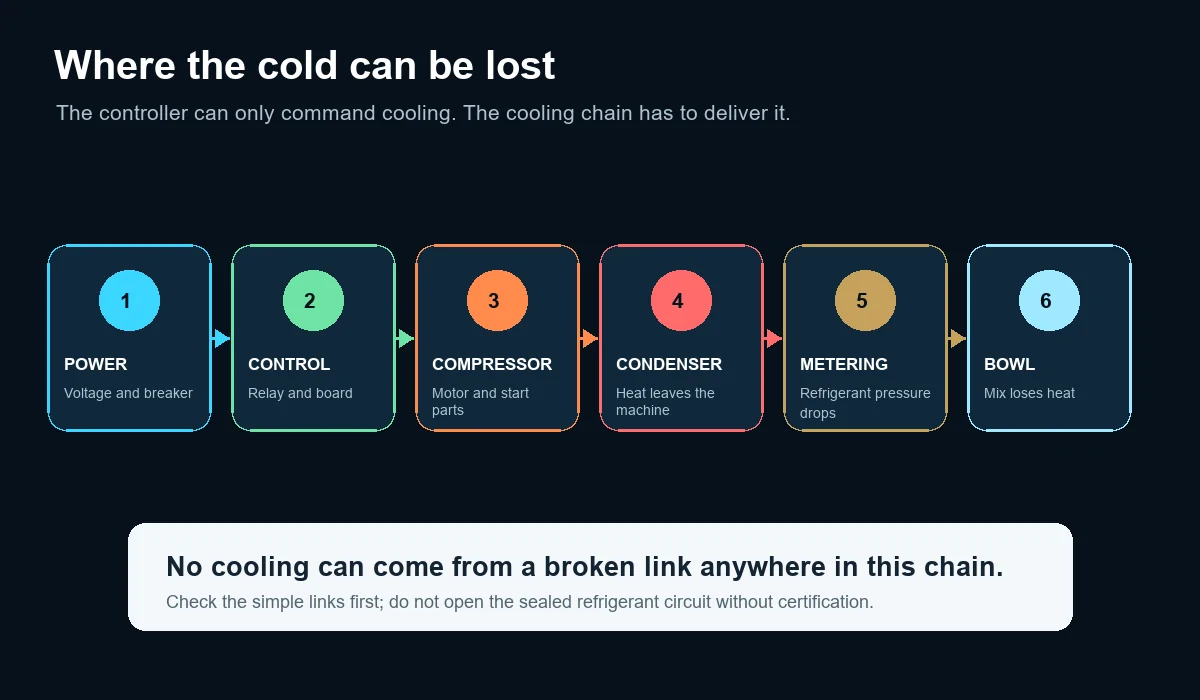
- Product side. Mix temperature, batch size, and fill level decide how much heat enters the bowl in the first place.
- Evaporator or freezing bowl. Scored surfaces, poor contact between the barrel and the refrigerant circuit, or a partially blocked passage reduce heat pickup.
- Refrigerant charge and flow. A leak, a restricted drier, or a stuck valve moves too little refrigerant to carry the heat away.
- Compressor. It has to raise the refrigerant to a pressure the condenser can work with. Worn valves lose capacity without any obvious noise.
- Condenser. Dirty fins, a stopped fan, or hot recirculated air leave the heat in the machine instead of rejecting it.
- Air and room. Clearance, ambient temperature, and ventilation decide whether the whole chain can finish its work.
The 10-minute owner triage table
Use this table before you call anyone. It will not repair the machine, but it will turn “it does not freeze” into a specific complaint that saves the technician an hour of searching, and it will tell you when the machine should be switched off and left alone.
| What you observe | Most likely area | Owner action | Stop and call a technician when |
|---|---|---|---|
| Breaker trips at startup | Supply, wiring, compressor start components | Confirm plug, phase, voltage, and that no other heavy load shares the circuit | It trips a second time, or you smell or see burnt insulation |
| Runs 5-15 minutes, then stops and restarts later | Thermal protection, hot cabinet, condenser, compressor current | Record run time, fault code, and whether the condenser fan keeps running | Shutdown repeats, or terminals look discoloured |
| Cools slowly and gets worse through the day | Condenser airflow, ambient temperature, clearance | Clean the accessible filter and condenser face, restore clearances | No improvement after cleaning and ventilation |
| Freezes one batch, fails on the next | Heat build-up, high ambient, recovery time, mix temperature | Space batches, cool mix correctly, log room temperature | Batch times keep stretching with the room inside spec |
| Compressor never starts, display normal | Program setting, sensor, relay or contactor, board output | Confirm program mode, timer, lid and bowl seating | A safety switch has been bypassed or the contactor chatters |
| Compressor runs continuously, bowl stays liquid | Refrigerant charge, leak, restriction, compressor capacity | Record coil temperature by hand and any oil traces near joints | Immediately. This is sealed-system work |
| Product is soft every cycle, machine behaviour normal | Mix temperature, fill level, program, recipe | Measure mix temperature, reduce fill, check the hard-serve program | Correct mix and settings still give soft product |
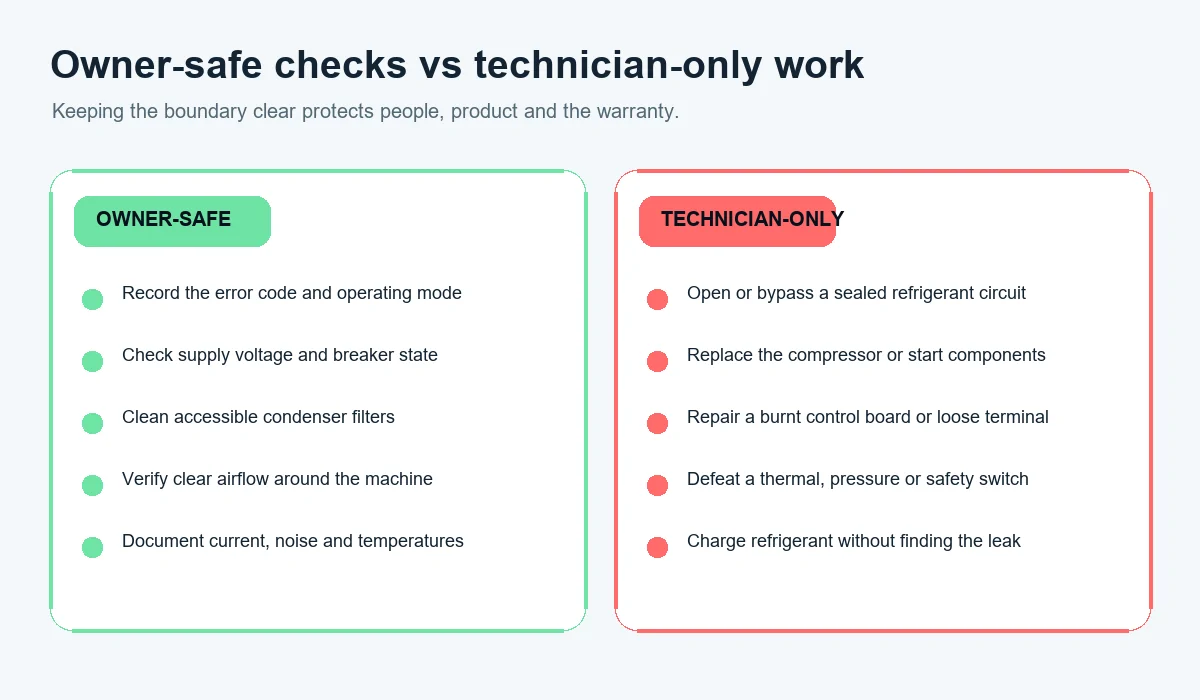
Owner-safe checks and technician-only work
| Task | Owner | Technician | Why |
|---|---|---|---|
| Recording fault codes, run time, and ambient temperature | Yes | – | No tools, no risk, and it shortens diagnosis |
| Measuring mix temperature with a probe | Yes | – | Rules in or out the most common product-side cause |
| Cleaning the accessible condenser filter and face | Yes, power isolated | – | Restores airflow without touching the refrigeration circuit |
| Confirming clearances and room ventilation | Yes | – | Often the difference between a summer and a winter batch time |
| Measuring supply voltage and compressor current | Qualified staff only | Yes | Live electrical measurement |
| Replacing relays, contactors, capacitors, or control boards | No | Yes | High-current wiring and warranty implications |
| Leak detection, recovery, evacuation, charging | No | Yes, certified | Regulated refrigerant handling under EPA Section 608 |
| Compressor replacement or valve repair | No | Yes | Sealed-system work plus system-specific charge and settings |
When the control board or electrical cabinet overheats
If the area around the board or the electrical cabinet is hot enough that you would not rest your hand on it, treat that as a finding in itself. Electronics in a commercial freezer are rated for an enclosure temperature, not for a cabinet full of trapped heat from a compressor and a struggling condenser.
Work through the sources of heat in this order:
- Cabinet ventilation. Check that the vents, filters, and any enclosure fan are clear and working. Flour, sugar dust, and grease are common blockers in bakeries and cafes.
- Ambient and clearance. Confirm the machine has its specified rear and side clearance. A machine pushed tight into an alcove recirculates its own hot discharge air.
- Condenser condition. A dirty or damaged coil raises compressor discharge temperature and cabinet temperature together.
- Fan operation. A condenser fan that has stopped or slowed shows up first as heat, then as a tripping overload.
- High-current connections. Discoloured terminals, hardened insulation, and a warm cabinet door are signs of resistance in the circuit.
- Compressor current. Compare measured current against the nameplate values. This separates an overheating cabinet from a compressor that is failing.
- Board condition. Only after the items above are excluded does the board itself become the primary suspect.
Replacing a board without working through this list usually ends the same way: the machine runs for a while, the cabinet heats up again, and the second board fails the same way. Heat is a symptom. Find what is producing it.
What a normal batch should look like
It is hard to spot a fault if you never recorded what normal looks like. On a GLACIO GB-Series machine, each 6-liter bowl is rated for a typical 15-20 minute batch and roughly 14 liters per hour, depending on mix, starting temperature, ambient conditions, and the operating cycle. Use those figures as a reference point and then build your own baseline from your own kitchen.
| Reading | Healthy baseline | What a deviation suggests |
|---|---|---|
| Mix temperature at loading | 2-4°C (36-39°F) | Warm mix lengthens the batch and softens the draw |
| Ambient room temperature | Within the machine’s specified range | Hot rooms reduce capacity before anything actually breaks |
| Batch time | Roughly 15-20 minutes per bowl | Steady increases point to condenser, charge, or compressor |
| Draw temperature | Firm and scoopable on the hard-serve program | Soft draws point to program, mix, fill, or refrigerant |
| Condenser coil by hand after 10 minutes | Warm to hot, with strong airflow | A cool coil with a running compressor suggests low charge |
| Cabinet temperature | Warm, never uncomfortable to touch | A hot cabinet points to airflow, fan, or high current |
| Compressor sound and vibration | Steady, even, no chatter | Chatter, hums, or repeated dropouts point to start components |
Write the first two weeks of readings on a card taped inside the cabinet door. When a machine does stop freezing, a five-minute comparison with that card is worth more than any description given over the phone.
Maintenance that prevents most no-freeze calls
Almost every batch freezer that loses freezing capacity does so gradually. The product gets slightly softer, the batch runs two minutes longer, and the machine still produces. By the time someone calls it a breakdown, the cause has usually been present for weeks. This routine is deliberately short so that it actually gets done.
| Interval | Task | What you are preventing |
|---|---|---|
| Daily | Check condenser airflow by hand, log ambient room temperature, clean up mix spills | Blocked airflow and slipping mix quality |
| Daily | Rinse and sanitise the bowl per the manual, and re-lubricate the dasher seal as specified | Bowl wear, leakage, and drive strain |
| Weekly | Clean the condenser filter or accessible coil face; inspect the cabinet vents | Slowly rising compressor temperature and current draw |
| Weekly | Listen to the machine for unusual noise and check for vibration at the panel | Failing fans, loose fasteners, and worn bearings |
| Monthly | Inspect terminals, cables, and plugs for discolouration or heat marks with the power isolated | Resistance at high-current connections |
| Monthly | Verify the lid, handle, and bowl safety switches work as designed | An unsafe or intermittent start condition |
| Quarterly | Have a technician measure compressor current, pressures, and cabinet temperature rise | Early refrigerant loss and compressor wear |
| Annually | Full service: condenser clean, electrical torque check, seal and gasket review | Unplanned peak-season failures |
If your shop runs double shifts in summer, halve these intervals for the condenser and electrical checks. Those are the two areas that degrade fastest in a hot, dusty kitchen. A fuller version of this routine is in our commercial ice cream machine maintenance checklist.
What to send a technician before the visit
A technician who arrives with the fault history, the machine model, and the electrical details often finishes the diagnosis on the first visit. Send this list when you book the appointment:
- Machine brand, model, serial number, and voltage or phase on the nameplate
- A photo of the nameplate and of the controller showing the fault code
- Exact fault description: what you did, what the machine did, and the run time before it stopped
- Whether the compressor is silent, humming, or running when the fault happens
- Ambient room temperature and clearances around the machine
- Mix temperature at loading and the batch size you used
- Program or mode selected, timer value, and consistency setting
- Supply voltage at the panel if it has already been measured by a qualified person
- Recent service history, refrigerant work, and parts replaced
- Two preferred time windows when the machine can be run empty without stopping service
If you bought the machine used, send the inspection notes too. Our 35-point used machine inspection guide lists exactly what to record, and that history tells the technician whether the fault is new or something inherited with the purchase.
Never do these things
- Never bypass a safety switch. The lid, handle, and bowl switches protect hands, blades, and the motor. A bypassed switch turns a repair into an injury.
- Never increase the breaker size to stop nuisance trips. The breaker is sized for the wiring and the machine, not for the inconvenience.
- Never reset a thermal cutout repeatedly. Each reset pushes current through a fault that is already generating heat.
- Never add refrigerant without leak detection. Topping up a leaking system hides the fault and repeats the cost.
- Never open the refrigerant circuit unless you hold the certification the law requires and the equipment to do the job properly.
- Never keep running a machine that smells burnt, sparks, or shows discoloured terminals or melted insulation.
- Never pour warm mix into a struggling machine to “test” it. You will be testing the problem, not the machine.
- Never assume the control board is the fault because the display is the part you can see. Confirm airflow, current, and the low-voltage signal first.
Related reading
- Hard ice cream machine reliability checklist for the checks that keep a machine out of the repair queue
- Ice cream texture troubleshooting when the machine freezes but the product is icy, greasy, or crumbly
- Batch freezer sizing by daily sales if soft batches appear whenever you push volume
- Commercial ice cream machine power requirements before you change a circuit or add equipment
Frequently asked questions
Why is my batch freezer not freezing but still running?
A machine that runs without freezing is usually not moving heat rather than not running. Check the program mode, the lid and bowl sensors, condenser airflow, ambient temperature, and mix temperature first. If the compressor runs continuously, the condenser coil stays cool, and nothing gets cold, suspect a refrigerant leak or a loss of compressor capacity, which requires a certified technician.
Can a batch freezer stop freezing because the room is too hot?
Yes. A commercial freezer rejects heat into the room air. Above the specified ambient range, capacity falls and batch times stretch, and the compressor runs hotter and longer. A machine that performs in the morning and fails during a hot afternoon service is often describing a room or airflow problem rather than an electrical fault.
Does soft ice cream mean the machine needs refrigerant?
Not necessarily. Soft product is more often caused by warm mix, an overfilled bowl, the wrong program, or a recipe with too much water, sugar, or alcohol. Measure mix temperature and fill level before assuming a refrigerant fault, and only let a certified technician make the sealed-system call.
How long should a batch freezer take to freeze one batch?
On a GLACIO GB-Series machine, each 6-liter bowl is typically rated for a 15-20 minute batch and roughly 14 liters per hour, depending on mix, starting temperature, ambient conditions, and the operating cycle. Consistent increases beyond your own recorded baseline are the warning sign, not the number on its own.
Is a hot electrical cabinet a control board problem?
Usually not. Cabinet heat commonly comes from a dirty condenser, a stopped fan, blocked ventilation, a failing contactor, or a compressor drawing excess current. Replacing the board without finding the heat source often leads to a second board failure. Measure compressor current and inspect the high-current connections before ordering electronics.
When should I repair a batch freezer instead of replacing it?
Compare the repair quote against the value of a working machine that meets the same production requirement. A condenser clean, fan, contactor, or capacitor is normally worth repairing. A compressor replacement on an old machine with an unknown history or unavailable parts is where replacement often makes more sense.
Turn the fault into a checklist, then turn it back into cold
Most “batch freezer not freezing” calls are decided in the first ten minutes by four questions: is the mix cold, is the fill level right, is the correct program running, and is the condenser moving air. Answer those honestly and you either fix the problem yourself or arrive at the technician’s visit with a fault the machine cannot hide.
If your machine is drawing soft product while the model is correct and clean, or if you are sizing a new hard ice cream or gelato machine for a shop that is about to grow, tell GLACIO your daily cups, peak-hour demand, flavor count, voltage, and available floor space. We will match a GB-1, GB-2, GB-4, or GB-6 to the workload. Request a machine recommendation and quote.
Which of these ten causes turned out to be your problem? Tell us what the machine did, what the display said, and what fixed it. The next shop reading this will thank you.
Some information may be outdated
Comments
Questions about equipment capacity, voltage, or recipes? Leave a comment.
Loading comments...