




You already have the customers, the counter and the footfall. An ice cream or gelato machine adds a second sale to the same visit — often the highest-margin item on the menu. The question is not whether it fits, but which machine fits a shop that is not an ice cream shop.
This guide is for cafés, milk tea shops and bakeries adding frozen desserts as an add-on: small footprint, low volume, existing staff.
Why add ice cream to an existing shop
- Incremental revenue per visit. A customer already buying a coffee can add a scoop or an affogato for a few dollars.
- No new location. The machine fits on or behind the existing counter.
- Higher margin than drinks. Frozen dessert typically carries a better gross margin than a latte.
- Seasonal hedge. Hot drinks dip in summer; ice cream fills the gap.
- Menu differentiation. A signature gelato flavour is harder for a competitor to copy than a coffee blend.
The risk is the opposite: a machine bought for “someday” traffic, run at 20% capacity, becomes a cleaning chore. The numbers below are how you avoid that.
Which machine fits which shop
| Shop type | Best fit | Capacity | Footprint |
|---|---|---|---|
| Coffee shop | Countertop batch freezer (1 bowl) or small soft-serve | 5–15 L/day | 0.4–0.6 m² |
| Milk tea shop | Countertop batch freezer or soft-serve | 10–25 L/day | 0.4–0.7 m² |
| Bakery | Countertop batch freezer, gelato cart, or display freezer + batch freezer | 10–30 L/day | 0.6–1.5 m² |
| Dessert café | Two-bowl countertop or small floor model | 25–50 L/day | 0.8–1.2 m² |
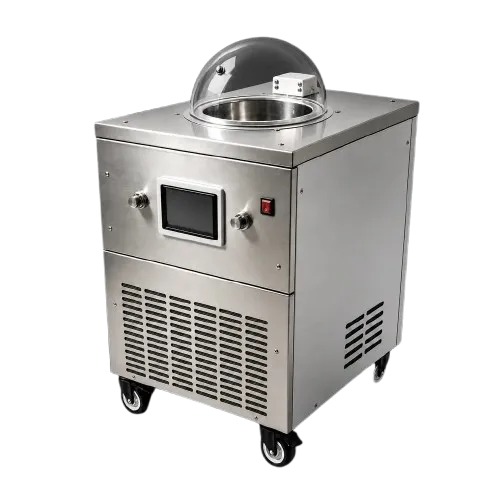
A single-bowl countertop batch freezer is usually the safest first purchase: it makes gelato and sorbet from a mix, needs one circuit, and produces 6-litre batches — enough for 60–100 scoops a day.
What you need beyond the machine
- Freezer or display case to hold finished product at serving temperature.
- A small prep area for mix, inclusions and toppings.
- A menu slot — three flavours is enough to start.
- Cleaning routine — daily, and it must fit your closing shift.
- Staff training — one person responsible for batches and records.
If you make base from raw ingredients you also need a pasteurizer; if you buy pre-made mix, you do not. Most cafés start with pre-made mix to keep the process simple.
The revenue maths
Work from units, not litres:
| Item | Example |
|---|---|
| Scoops per day | 40 |
| Price per scoop | $3.50 |
| Daily revenue | $140 |
| Ingredient and packaging cost (30%) | $42 |
| Daily gross margin | $98 |
| Monthly gross margin (26 days) | $2,548 |
| Machine cost (countertop) | $3,500–6,000 |
| Payback at this volume | 2–3 months |
That is the case for a busy café. At 15 scoops a day the margin is roughly $37/day — still positive, but payback stretches to 8–12 months. The machine is not the risk; the traffic is.
Menu ideas that sell without a new brand
- Affogato — espresso poured over a scoop; the highest-margin coffee add-on.
- Ice cream float — soda or cold brew plus a scoop.
- Gelato shake — blend a scoop into a milkshake; uses the same machine.
- Croissant gelato sandwich — bakery-specific, photogenic, high margin.
- Milk tea float — a scoop in milk tea; the drink stays, the price rises.
- Seasonal flavour of the week — one batch, one poster, repeat customers.
Start with three: one classic (vanilla or chocolate), one signature (matcha, pistachio, or your house flavour), one sorbet.
Space, power and operations
- Counter space: a countertop machine needs 0.4–0.7 m² plus working room in front.
- Power: most single-bowl machines run on a standard single-phase circuit; check the nameplate.
- Heat: the machine rejects heat — do not box it into a closed cabinet.
- Noise: compressors cycle; place the machine away from seating if possible.
- Cleaning: 15–25 minutes at close, or it becomes tomorrow’s problem.
- Staffing: one trained person per shift; a second person as backup.
Three mistakes cafés make
1. Buying capacity for a future shop. Buy for today’s traffic plus 30%, not for a second location you have not opened. 2. No menu plan. A machine without three named menu items sells nothing; the menu is the product. 3. Skipping the display. Customers buy what they can see; a small display case lifts attachment rate far more than a discount.
A worked example: the café with 120 cups a day
Take a coffee shop selling 120 drinks a day, adding a countertop batch freezer.
| Metric | Number |
|---|---|
| Drinks per day | 120 |
| Attachment rate (target) | 12% |
| Ice cream orders per day | 14 |
| Average ice cream ticket | $5.50 |
| Daily ice cream revenue | $77 |
| Gross margin (65%) | $50/day |
| Monthly margin | $1,300 |
| Machine + display cost | $6,500 |
| Payback | ~5 months |
At 5% attachment the monthly margin falls to about $540 and payback stretches to a year. The machine is the same; the difference is menu visibility and staff asking.
Which mix to start with
Three routes, in order of simplicity:
- Pre-made liquid mix. Pasteurized by the supplier, consistent, no pasteurizer needed. Highest cost per litre, lowest labour.
- Powder base plus milk or water. Cheap and shelf-stable; quality depends on the powder. Good for high-volume, simple flavours.
- Scratch base from milk, cream and sugar. Best quality and differentiation; needs a pasteurizer and recipe discipline.
Most cafés should start with pre-made mix and move to scratch only when ice cream becomes a meaningful part of the menu. The pasteurizer guide covers what changes when you make your own base.
Training a barista to make gelato
A one-page SOP is enough for a café:
1. Morning: check mix stock, clean the machine, run the first batch. 2. Midday: scoop and refill the display; start the second batch before the afternoon peak. 3. Close: empty and clean the bowl, wash the beater, log the batch. 4. Weekly: deep clean the seals, check blade wear, review waste. 5. Monthly: review sales by flavour and cut the weakest one.
The person who owns the machine should also own the waste log. Waste is the fastest signal that batch size or menu is wrong.
The first four weeks
| Week | Focus |
|---|---|
| 1 | One flavour, one menu item, staff training, cleaning routine |
| 2 | Add a second flavour and a drink pairing; start sampling |
| 3 | Track attachment rate and waste; adjust batch size |
| 4 | Add a signature flavour and a poster; review payback |
Do not launch with six flavours. Launch with one that works and add only when it sells out consistently.
If you already have a soft-serve machine
A soft-serve machine and a batch freezer are not competitors; they answer different needs.
| Soft serve | Batch freezer (gelato/hard) | |
|---|---|---|
| Product | Soft, airy, immediate | Dense, scooped, display |
| Menu fit | Cones, sundaes | Affogato, tubs, floats |
| Capacity | Continuous, high peak | Batch, 15–20 min cycles |
| Cleaning | Daily, more parts | Daily, simpler |
| Differentiation | Low — same as everyone | High — your recipe |
If you already run soft serve, adding a small batch freezer gives you a signature product without replacing the workhorse. If you are choosing one, choose by menu: cones and sundaes point to soft serve; scoops and display point to a batch freezer.
Chains and multi-site shops
If you run more than one site, standardise the machine model across locations. Reasons:
- Staff can move between sites without retraining.
- Spare parts and service contracts are simpler.
- Recipes transfer and quality stays consistent.
- Purchasing leverage improves at volume.
The exception is a flagship site where the machine is part of the experience — there, a larger or visible model can be justified separately.
Quick checklist before you buy
- Counter space measured, including working room in front
- Power point and breaker confirmed for the model voltage
- Ventilation clearance available
- Display case selected (same order as the machine)
- Three menu items named and priced
- Cleaning routine written into the closing shift
- One trained owner and one backup
- Waste log started on day one
If any line is missing, the machine will arrive before the plan does — and that is how add-on ice cream fails.
One last sanity check
Before you order, stand where a customer stands and look at the counter for thirty seconds. If you cannot see where ice cream would be made, neither can they — and the add-on will stay invisible no matter how good the machine is.
FAQ
Can I add ice cream to a coffee shop without a kitchen?
Yes. A countertop batch freezer plus a small display case needs a power point and about a metre of counter; no full kitchen is required.
How much space does an ice cream machine need?
A single-bowl countertop machine needs roughly 0.4–0.7 m² of counter, plus clearance for ventilation and access.
How many scoops a day to justify the machine?
At 40 scoops a day, a US$5,000 machine pays back in about three months on margin. Below 15 scoops a day, it is a convenience rather than an investment.
Do I need a pasteurizer?
Only if you make base from raw ingredients. With pre-made mix, pasteurization is done by the supplier.
Next step
Tell us your shop type, counter space and daily cups — we will recommend a countertop model and a three-item menu that fits. Request a countertop recommendation.
Sources: GLACIO factory data (countertop output, footprint, power); general food-service margin ranges. Revenue examples are illustrative, not guarantees — test with your own traffic.
Some information may be outdated
Related reading
Comments
Questions about equipment capacity, voltage, or recipes? Leave a comment.
Loading comments...