




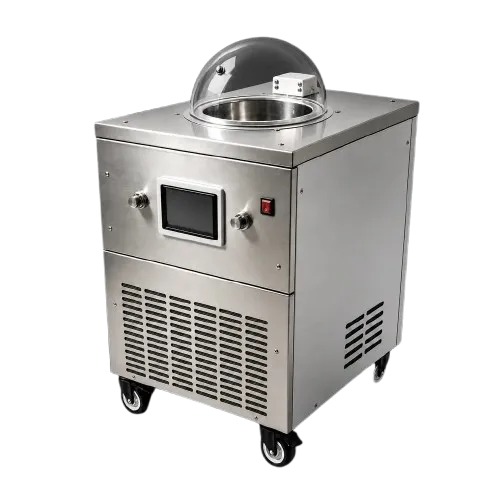
Two gelato shops can sell the same product at the same price. The one where customers can watch the machine work usually sells more — because the machine is not just production equipment, it is the shop’s best marketing asset.
This is a guide to making visible production work: placement, timing, menu, pricing and the layout that turns a batch freezer into foot traffic.
Why visible production sells
- Freshness becomes evidence. A customer who sees mix go in and gelato come out does not need to trust a label.
- The wait becomes entertainment. A 15–20 minute batch gives people a reason to linger and order a drink.
- It is shareable. A short video of a machine working is the kind of content customers post without being asked.
- It justifies a price premium. “Made here, in front of you” supports a higher price than a tub from a wholesaler.
- It creates ritual. Regulars come at the same time to watch the same flavour being made.
The cost is that your production is now a performance, and the shop layout, staffing and timing have to support it.
What customers actually watch
1. Loading the mix. The start of the process reads as “real ingredients”. 2. The bowl turning. Visible movement signals work in progress. 3. The moment it thickens. The texture change is the payoff. 4. Scooping into the display. From machine to case in one view. 5. Your staff’s hands. Gloves, clean tools and a visible cleaning routine build trust.
Design the counter so at least steps 2–4 are visible from the queue, not just from one seat.
Placement: the five rules
- Height: the bowl at chest height is watchable; at floor level it is invisible.
- Angle: 30–45 degrees to the queue line, not square-on, so people see the inside of the bowl.
- Lighting: a small spot on the machine does more for sales than a poster.
- Distance: 1–1.5 m from the customer side — close enough to see, far enough to keep the service lane clear.
- Background: put the display case behind or beside the machine so the eye moves from production to product.
If the machine is hidden in a back kitchen, you have paid for production and given up the marketing.
Timing batches to peak traffic
Visible production is a schedule, not an accident:
| Time | Action |
|---|---|
| 30 min before peak | Load the first batch so it thickens as the queue forms |
| Peak | Scoop from the finished batch; start the next one for the second wave |
| Lull | Clean the machine visibly; it signals hygiene |
| Evening | Run a signature flavour as a “made now” offer |
A batch takes 15–20 minutes. Starting one when the queue is already long means customers wait for the machine; starting it 30 minutes earlier means they watch it finish.
Menu and pricing around “made here”
- Name the process, not just the flavour. “Churned at 2pm” beats “vanilla”.
- Price with a visible story. A made-here scoop can carry a 10–20% premium over a comparable wholesale product.
- Bundle with a drink. Affogato or float turns a drink sale into a higher ticket.
- Limit the menu to three to five flavours. Visible production favours depth over breadth.
- Sell the wait. Offer a smaller “fresh scoop” while the next batch finishes.
Layout and hygiene
- Keep a clear sightline from door to machine; do not put shelving in between.
- Put the sink and cleaning supplies within reach so cleaning is easy to do visibly.
- Use closed containers for mix and toppings; visible mess reads as risk, not craft.
- Keep a small sample tray at the counter: sampling converts more than any sign.
- Separate the queue lane from the pick-up point so watchers do not block service.
Staff choreography
The performance is mostly habits:
1. Greet, then narrate the batch in one sentence (“this one has 10 minutes left”). 2. Offer a sample while the customer waits. 3. Scoop in view; hand over with a recommendation for next visit. 4. Clean tools in view at the end of each batch.
Train the whole team on the same three lines. Consistency reads as professionalism.
What to measure
- Attachment rate: percentage of drink orders that add ice cream.
- Conversion at the counter: samples handed out versus scoops sold.
- Dwell time: longer is fine while watching, as long as the queue moves.
- Photo/video mentions: a proxy for shareability; search social tags weekly.
- Batch sell-through: batches finished versus batches wasted.
A shop that tracks these five knows within a month whether the visible machine is paying for itself.
Mistakes that kill the effect
1. Hiding the machine to keep the counter clean. The trade-off is visibility for tidiness; visibility wins. 2. Running batches only when someone orders. The queue watches nothing and buys less. 3. No sample policy. Sampling is the cheapest conversion tool you have. 4. Overcomplicated menu. More flavours mean smaller batches and more waste. 5. Cleaning out of sight, mess in sight. Customers read hygiene from what they can see.
Three counter layouts that work
| Layout | Description | Best for |
|---|---|---|
| Front-row | Machine at the counter, display case beside it, queue passes both | Narrow shops, high foot traffic |
| Corner theatre | Machine on a 90-degree corner, visible from seating and door | Corner sites, dessert cafés |
| Island | Machine on a low island, customers on three sides | Open-plan shops, malls |
All three share one rule: the bowl is visible from the queue and the machine does not block the service lane.
A theatre calendar
Visible production works best when it has rhythm:
- Daily: first batch 30 minutes before the afternoon peak; cleaning visible after the rush.
- Weekly: one “flavour of the week” batch at a fixed time, announced on the menu board.
- Monthly: a collaboration or seasonal flavour with a short video of the batch.
- Seasonal: holiday flavours with a countdown; the machine becomes the calendar.
A fixed time creates habit. Customers who know the 3pm batch exists plan their visit around it.
Capturing content without a content team
- Phone on a small tripod at the counter, recording 30 seconds of the bowl turning.
- One weekly clip is enough; post it with the flavour name and time.
- Staff take the clip as part of the batch routine; no separate content session.
- Ask permission when customers appear on camera, and keep faces out of frame.
The clip is not advertising — it is proof. “Made at 2pm today” with a timestamp outperforms a studio photo.
When visible production does not fit
Visible production is not right for every site. It does not fit when:
- The counter is too narrow to keep the service lane clear.
- The shop is takeaway-only and customers never linger.
- The lease forbids equipment on the sales floor or the landlord requires a back-of-house kitchen.
- Heat or noise would hurt the seating experience.
- Staff turnover is high and no one owns the routine.
In those cases, produce in the back and use the display case as the theatre: a well-lit case with fresh scoops still communicates “made here” without the machine on the floor.
Handling hygiene questions
Customers watching production will ask hygiene questions. Have answers ready:
- “How often do you clean it?” — after every batch, with a visible cleaning log.
- “Is it pasteurized?” — yes, and here is the supplier’s certificate or our record.
- “How long does it keep?” — serving temperature, code date, and how long the batch lasts.
- “Why is it softer than the shop down the street?” — serving temperature and overrun, explained in one sentence.
A shop that answers confidently turns a hygiene question into a trust signal.
Measuring the effect honestly
Compare four weeks before and after making production visible:
- Ice cream attachment rate
- Average ticket
- Number of samples handed out
- Social mentions or tagged videos
If attachment does not move within a month, the problem is usually the menu or the placement, not the machine.
A one-page layout brief for your fitter
Give the shopfitter these five lines:
1. Machine model, dimensions and required clearance, drawn on the counter plan. 2. Bowl height from finished floor (chest height, 1.0–1.2 m). 3. Sightline: machine visible from the door and the first three queue positions. 4. Power: circuit, socket type and isolation point. 5. Cleaning: sink distance and a surface for the cleaning kit.
A single drawing with these five items prevents the most common retrofit cost: moving the machine after the counter is built.
FAQ
Do customers really watch the machine?
Yes — visible production is a proven draw in dessert retail. The key is placement: machine visible from the queue, bowl at chest height, with lighting.
Does visible production slow service?
It changes service: the batch cycle runs in the background while staff serve. Peak-hour throughput depends on having finished product ready, not on batch speed.
Can a small shop do this?
A countertop or single-bowl machine plus a 1.2–1.8 m counter section is enough. The constraint is layout, not floor area.
Is it worth the extra space?
At a 10–20% price premium and higher attachment rate, visible production usually pays for the counter space within a season.
Next step
Send us your counter dimensions and daily foot traffic — we will propose a front-counter layout with machine placement and batch timing. Request a front-counter layout.
Sources: GLACIO factory data (machine footprint, batch cycle); dessert-retail practice. Layout and premium figures are planning guidance — test in your own shop.
Some information may be outdated
Related reading
Comments
Questions about equipment capacity, voltage, or recipes? Leave a comment.
Loading comments...