




Opening an ice cream shop needs about 12–18 pieces of equipment, but only five of them decide whether you can serve at all. The rest can wait. This list puts everything in purchase order, with realistic 2026 cost ranges, so the first money you spend is the money that opens the door.
The five must-buys
Without these, there is no product:
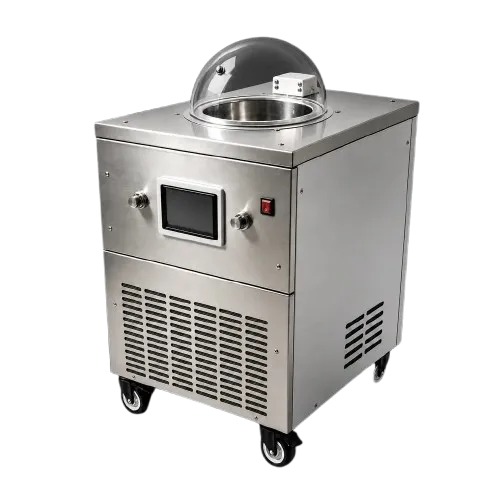
1. Freezer — a batch freezer (gelato/hard ice cream) or a soft-serve machine. This is the single largest line: US$3,000–15,000. 2. Display or holding freezer — where the product is presented and kept at serving temperature. US$1,500–8,000. 3. Refrigerated storage — a reach-in or walk-in for mix, base and ingredients. US$800–4,000. 4. Prep surfaces and sinks — stainless work tables, a hand sink and a three-compartment sink. US$1,000–3,500 installed. 5. Point of sale and scales — a POS system plus portion scales. US$300–1,500.
Everything else is either an upgrade or a deferral.
The full list, in purchase order
| Priority | Item | Typical range | When to buy |
|---|---|---|---|
| 1 | Batch freezer or soft-serve machine | $3,000–15,000 | Before opening |
| 2 | Display freezer / case | $1,500–8,000 | Before opening |
| 3 | Refrigerated storage | $800–4,000 | Before opening |
| 4 | Sinks, tables, drainage | $1,000–3,500 | Before opening |
| 5 | POS and scales | $300–1,500 | Before opening |
| 6 | Mix pasteurizer (if making base) | $2,000–12,000 | Month 1–3 |
| 7 | Aging tank | $1,500–6,000 | Month 1–3 |
| 8 | Hardening cabinet / blast freezer | $2,000–7,000 | Month 3–6 |
| 9 | Cone machine or waffle iron | $300–1,500 | Month 1–3 |
| 10 | Topping bar and display | $500–2,500 | Month 1–3 |
| 11 | Cleaning and sanitising kit | $200–600 | Before opening |
| 12 | Uniforms, signage, menu boards | $500–3,000 | Before opening |
The first five get you open. Items 6–8 are where quality and volume come from. Items 9–12 are sales and experience — valuable, but not prerequisites.
What to skip in year one
- A second freezer. Unless you already know you will run 60+ litres a day, one machine plus good scheduling beats two half-used ones.
- A walk-in freezer. A reach-in plus a display case usually covers a small shop; a walk-in is a capital and energy commitment.
- High-end display cases. A used or mid-range case at correct temperature outperforms a beautiful case that cannot hold temperature.
- Full automation. Controls and IoT look good in a brochure; in year one, serviceability matters more than connectivity.
- Custom branding on equipment. Panel branding is a private-label project from 30 units; a sticker and a menu board achieve most of the effect.
Budget: three shop sizes
| Shop type | Equipment total | Notes |
|---|---|---|
| Café adding gelato | $6,000–10,000 | Countertop freezer, small display, reach-in |
| Small gelato shop | $12,000–22,000 | Floor freezer, display case, storage, prep |
| Busy shop or producer | $22,000–40,000 | Multi-bowl, hardening, pasteurizer, larger storage |
Add 10–20% for installation: electrical circuits, drainage, ventilation and commissioning. A machine that cannot be powered or drained is not installed.
The equipment budget guide breaks the phase-one numbers down further, and the gelato shop equipment checklist covers the production side in detail.
Sizing the freezer to your sales
Work backwards from scoops:
- 1 scoop ≈ 60–80 ml; a 500 ml tub ≈ 7–8 scoops.
- A shop selling 150 scoops a day needs roughly 12–18 litres of finished product.
- With 20% waste and tasting, plan 15–22 litres of production.
- A single-bowl machine at 14 L/h covers that comfortably in two batches.
If the maths says 20 litres and you buy a 6-bowl machine, you have bought capacity you will pay for in electricity, maintenance and floor space.
Power and installation checklist
- Voltage and phase: match the machine build to the site; 110 V/60 Hz, 220 V/60 Hz or 220 V/50 Hz.
- Dedicated circuit: larger machines need their own breaker; shared circuits trip under load.
- Drainage: floor drain or air gap for condensate and cleaning water.
- Ventilation: clearance around the condenser; not a hot corner.
- Access: door width and floor strength for a 100–330 kg machine.
- Water quality: a filter or softener protects the bowl and heat exchanger.
What it costs to run
Equipment is capital; the monthly bill is cash flow. A small shop typically spends:
| Line | Monthly range |
|---|---|
| Electricity | $150–600 |
| Maintenance and parts | $40–180 |
| Cleaning chemicals | $30–120 |
| Mix or ingredients | $600–3,000 |
| Packaging | $100–400 |
The maintenance cost guide explains the annual maintenance number, and the financing guide covers paying for the big items without draining cash.
Phasing purchases by cash flow
Not everything needs to arrive on day one. A cash-aware sequence:
| Phase | Spend | Items |
|---|---|---|
| Before opening | 70% of budget | Freezer, display, storage, sinks, POS |
| Month 1–3 | 20% of budget | Pasteurizer, aging tank, cone machine, topping bar |
| Month 3–6 | 10% of budget | Hardening cabinet, second display, signage upgrade |
The logic: the first phase makes revenue possible; the second improves product and margin; the third scales what is already selling. Buying phase two before the shop has customers is how budgets overrun.
Buying used: what to inspect
A used machine can save 30–50% and still deliver years of service — if the inspection is honest:
- Compressor: start it cold, listen for knock, check current draw against the nameplate.
- Refrigerant: ask for leak records; repeated top-ups mean a leak.
- Blades and seals: wear changes texture and cycle time; parts should be available.
- Control board: is it still produced? A discontinued board ends the machine’s life.
- Frame and panels: rust and cracks are structural.
- Service history: a documented machine is worth more than an undocumented one at the same price.
The used machine inspection checklist has the full 35-point version.
Where to spend the extra money
If the budget allows one upgrade, choose in this order:
1. A better display case. It is the sales floor; temperature stability and visibility directly affect revenue. 2. A larger freezer than you think you need — one size up, not three. Capacity headroom protects peak days without paying for idle steel. 3. A proper pasteurizer. If you make base, this is the quality and safety backbone. 4. Installation quality. Correct electrical, drainage and ventilation protects every machine you buy afterwards.
Do not spend the upgrade budget on cosmetics: a branded panel does not sell more ice cream, but a case that cannot hold temperature loses sales every day.
The first-week checklist
- Confirm every machine is on its own circuit where required.
- Run a full cleaning cycle before the first batch.
- Calibrate the display case to serving temperature and record it.
- Train staff on the cleaning protocol and the fault log.
- Photograph the nameplates and file the manuals.
- Run three test batches and time them; that is your real capacity.
Checklist mistakes that cost money
1. Buying the display case last. It is the first thing customers see and the last thing on many lists; order it with the freezer. 2. Forgetting the water filter. Hard water scales the machine within months. 3. No spare parts. One gasket and one blade set prevent a closed day. 4. Skipping staff training. A machine that is cleaned wrong fails early. 5. No scale for mix. Recipes drift, and so does texture. 6. Ignoring packaging until opening week. Tubs, lids, labels and spoons take time to arrive.
Buying factory-direct for a new shop
If you are equipping a new shop, factory-direct has three advantages: configuration (voltage, refrigerant, branding), price, and documentation in your language. The trade-offs are lead time (30–45 days plus freight) and service (you need a local technician).
Ask for: the build sheet, the listing certificate, the wear-parts kit, the English manual and a video inspection before shipping. The factory-direct verification guide covers how to check a supplier before paying a deposit.
FAQ
How much does it cost to equip an ice cream shop?
For a small shop, US$12,000–22,000 for equipment plus 10–20% for installation. A café adding a gelato menu can start at US$6,000–10,000.
What equipment do I need first?
The freezer, the display case, refrigerated storage, sinks and tables, and a POS. Everything else can follow in the first three months.
Can I start with a used machine?
Yes, if you inspect it properly and parts are available. A used machine with a documented service history is often the best value in year one.
Do I need a pasteurizer from day one?
Only if you make your base from raw ingredients. If you buy pre-made mix, the supplier pasteurized it and you can defer the pasteurizer.
Next step
If you send your daily scoops, shop size and country, we will return a phased equipment list with model recommendations and a landed-cost estimate. Request an equipment list.
Sources: GLACIO factory data (model output, power, weights); general food-service equipment pricing ranges. All prices are planning estimates, not quotes — confirm locally before ordering.
Some information may be outdated
Related reading
Comments
Questions about equipment capacity, voltage, or recipes? Leave a comment.
Loading comments...