




Most buyers compare commercial ice cream machines by reading three numbers: batch capacity, compressor horsepower and price. Those three numbers decide almost nothing about what the machine will do in your shop on a Saturday afternoon, because they were measured in conditions your shop probably does not have.
This guide covers the nine specs buyers misread most often, what each number actually measures, and how to convert every claim into the same unit so two machines can be compared fairly. The examples use the GLACIO GB-series, but the method works on any batch freezer, from a countertop single-bowl unit to a six-bowl production machine.
Quick answer: how to read a commercial ice cream machine spec sheet
Convert every claim to liters of finished product per hour, with your mix temperature, in your kitchen temperature, running continuously. A “6 L” machine holds 6 liters of mix in the cylinder, which is a batch size and not an hourly output. A “20 L/h” claim usually means chilled mix at 4 C in a 20 C room. In a 32 C kitchen with 30 C mix, cycles run 20-35% longer and real output often lands near 13-16 L/h.
Two more conversions remove most of the remaining confusion. Multiply a stated hourly output by 0.6-0.75 to get a realistic peak-hour figure after extraction and flavour changes, and divide the rated power by the voltage to see the circuit an electrician will actually have to install.
Why spec sheets mislead buyers
A specification is a measurement plus a set of conditions. Suppliers publish the measurement and leave the conditions in a footnote or in a test report nobody requests. Four variables move output more than the machine itself:
- Mix temperature at loading: 4 C from a cooler versus 30-40 C from a pasteuriser.
- Ambient temperature around the condenser: 20-22 C on a lab bench versus 30-38 C in a working kitchen.
- Overrun: gelato is usually drawn at 25-35% overrun and industrial ice cream at 50-100%, so the same 10 L of mix becomes a very different volume of product.
- Continuous operation: the first batch from a cold machine, or the fourth batch of the afternoon, which is the one your customers actually buy.
None of this is dishonest. It is incomplete, and it is why two machines with identical headline numbers can differ by half in real throughput.
Nine numbers buyers misread
1. Batch capacity is not hourly output
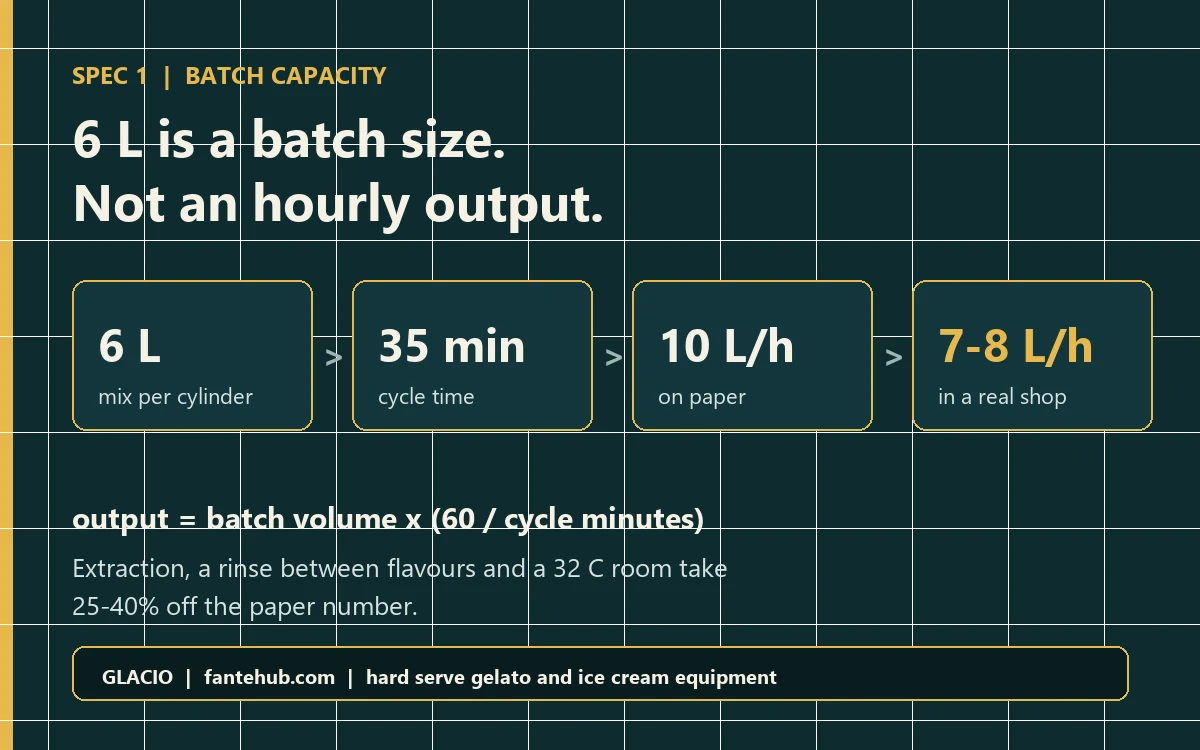
“6 L” or “12 L” describes the freezing cylinder or bowl volume, which is how much mix one cycle turns into finished product. Hourly output is batch size multiplied by cycles per hour: output = batch volume x (60 / cycle minutes).
A 6 L cylinder with a 35 minute cycle produces about 10 L/h on paper. Take off extraction time, a rinse between flavours and the fact that nobody runs the machine with a stopwatch, and 7-8 L/h is the honest planning number. A shop selling 40 kg of gelato on a strong day uses roughly four hours of machine time at that rate, which is comfortable. At 120 kg a day it is not.
For the demand side of that calculation, see batch freezer sizing by daily sales.
2. Compressor horsepower without a temperature is half a spec
Horsepower describes a motor, not cooling. What matters is cooling capacity in kW at a stated evaporating and condensing temperature. A 1.5 HP compressor on R290 can outperform a 2 HP compressor on an older high-GWP refrigerant at the same evaporating temperature, especially in a hot room, because refrigerant choice, condenser area and fan capacity decide how much of that motor power becomes heat removal.
When a supplier quotes horsepower only, ask for the cooling capacity table and the ambient temperature those figures assume. If there is no table, the horsepower number is marketing.
3. Freezing cylinder volume hides the recovery rate
Two machines can both have 2 L cylinders and behave completely differently. A larger cylinder freezes more mix per cycle and takes longer to recover between cycles, so a machine with smaller cylinders and fast recovery can beat it across a two-hour rush. Ask for cycle time per cylinder and recovery time between consecutive batches, not just volume. Multiple cylinders also let you produce two or four flavours at once, which matters more than raw liters when your menu runs to twelve flavours.
4. Warm mix versus chilled mix changes everything
Mix straight out of a batch pasteuriser is warm, often 30-40 C. Mix out of a walk-in cooler is 4 C. Freezing warm mix means the machine first removes that extra heat, which typically adds 20-40% to the cycle time and, on smaller units, can be the difference between freezing and stalling.
If your workflow goes from pasteuriser to machine, say so when you ask for a quote. If the machine cannot handle warm mix, the honest answer is to chill the mix first in a blast chiller or overnight in a cooler.
5. First-batch time is not continuous output
A “12 minute first batch” means a cold machine, a pre-chilled cylinder and one perfect cycle. The number that matters on a Saturday is what the machine does on batch four, with a warm condenser and a full shop. Ask for the continuous output over two hours, or plan at 60-75% of the quoted figure and you will rarely be disappointed.
6. Rated kW is not the circuit you need
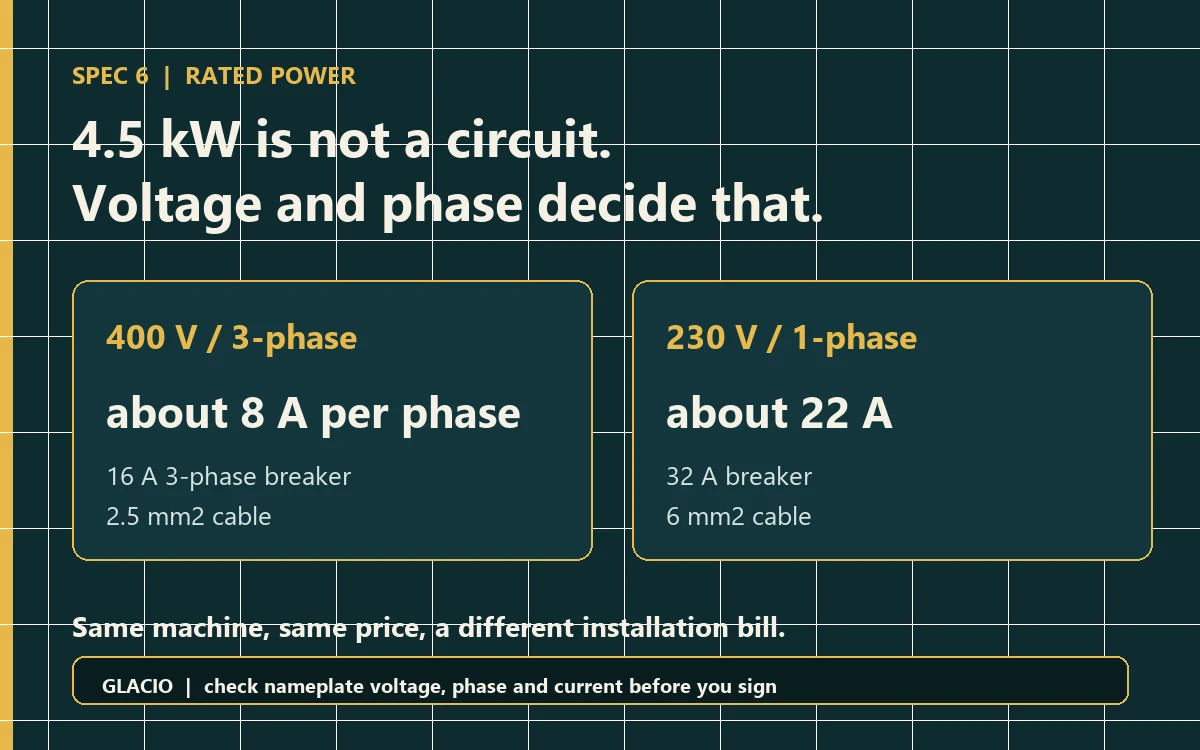
Rated power is measured at the machine. Your electrician installs the circuit at the wall. A 4.5 kW machine on 400 V three-phase draws roughly 8 A per phase and can sit on a 16 A three-phase breaker. The same 4.5 kW on a 230 V single-phase supply draws about 21-23 A, needs a 32 A circuit and 6 mm2 cable. Same machine, same price, a very different installation cost and a different answer from your landlord about whether you can run it at all.
Compare nameplate voltage, phase, frequency and current before you sign, using the same checklist as the power requirements and breaker sizing guide.
7. Refrigerant choice changes the room it works in
R404A, R452A, R134a and R290 behave differently at high ambient temperatures, and regulations differ by region: R404A is being phased down in the EU, R290 is flammable and carries charge limits, and several markets restrict high-GWP refrigerants outright. Ask which refrigerant the quoted machine uses, whether it is available where you operate, and who services it locally. A machine that cannot be serviced with local refrigerant is a delivery date, not a warranty.
8. Display capacity is not sellable capacity
Transparent domes and display cabinets sell product because customers can see it. But bowls showing gelato at minus 12 to minus 14 C are not free production capacity: every bowl you empty has to be refrozen, and that competes with the next flavour. A countertop unit that freezes, displays and holds in one body saves floor space and a separate display case, but plan its rhythm by how many times you can refill each bowl per shift, not by total bowl volume.
9. Dimensions and weight without service clearance
A machine that fits a 700 mm gap but needs 100 mm behind it for airflow and 800 mm in front for cleaning does not fit. Add the door swing, the drain position and the route into the shop, because a 180 kg unit does not go up a narrow staircase just because the footprint matched your drawing. Weight also decides floor loading and whether two people can move it on installation day.
How to compare three machines on the same terms
Put the numbers into one table with the conditions attached and most decisions become obvious.
| Spec on the sheet | What it says | What to convert it to |
|---|---|---|
| Batch capacity | 6 L per cylinder | Liters per hour at your cycle time |
| Compressor | 2 HP | Cooling capacity in kW at 25 C ambient |
| Production time | 12 minutes | Minutes with 4 C mix in a 32 C room |
| Power | 4.5 kW | Voltage, phase, amps, breaker and cable |
| Bowl volume | 4 x 5 L display domes | Refills per shift and flavours on display |
| Footprint | 700 x 600 mm | Footprint plus 100 mm rear and 800 mm front clearance |
Then apply the same season to all three: your busiest hour, your mix temperature, your room temperature. If a supplier cannot answer in those terms, that is information too.
Red flags in a specification sheet
- Hourly output quoted without mix temperature, ambient temperature or overrun.
- Compressor horsepower with no cooling capacity table.
- “Up to” figures with no test conditions.
- No nameplate voltage or current, only a single power figure.
- No refrigerant named, or a refrigerant already being phased out in your region.
- No service access, drain or clearance dimensions.
- A warranty that covers parts but not the compressor, or excludes freight.
What to send a supplier before you compare quotes
- Busiest day volume and busiest hour volume, in liters or kilograms.
- How many flavours you want available at once.
- Mix temperature at loading: warm from a pasteuriser, or chilled to 4 C.
- Summer room temperature, and where the machine will sit.
- Available voltage, phase, frequency and panel capacity.
- Floor space with clearance in front and behind.
With those six answers a supplier can size the machine instead of selling you whatever is in stock.
FAQ
What does the liter rating on a commercial ice cream machine mean?
It is the mix volume one freezing cylinder or bowl holds per cycle, so it is a batch size, not an hourly output. Multiply the batch volume by 60 divided by the cycle time in minutes, then reduce the result by 25-40% for extraction time, flavour changes and a warm room.
How many liters per hour do I need for 100 kg of gelato a day?
100 kg of gelato is roughly 105-115 L of finished product, which is about 85-95 L of mix at 25-30% overrun. Spread over eight hours that averages 11-12 L/h, but demand is not flat, so plan for a machine that holds 20-25 L/h across your busiest two hours.
Is a higher horsepower compressor always better?
No. Cooling capacity in kW at a stated ambient temperature decides performance, not the motor label. Ask for the cooling capacity table at your summer room temperature, because a well matched condenser with a modern refrigerant can beat a larger compressor with a small condenser.
Can I freeze warm mix straight from the pasteuriser?
Some machines can, and all of them need longer. Freezing 30-40 C mix adds roughly 20-40% to the cycle time compared with 4 C mix, and small countertop units may not be rated for it at all. Confirm it with the supplier before you order.
Why is the output in my shop lower than the spec sheet?
Spec sheets assume chilled mix and a cool room. A 32 C kitchen, 30 C mix and repeated flavour changes can cut real output by a third. Compare machines on the same conditions and the numbers start to mean something.
Next step
Send your busiest-day volume, busiest-hour volume, available voltage and the flavours you want on display. We will tell you which GB-series configuration holds that output in a real room, and what the electrician should prepare before delivery. Request a machine sizing review.
Which number on your supplier sheet still does not add up? Tell us in the comments and we will work through it with you.
Some information may be outdated
Comments
Questions about equipment capacity, voltage, or recipes? Leave a comment.
Loading comments...