

Gelato Display Freezer and Italian Display Counters: What to Check
Gelato is served warmer than ice cream, and that single fact changes the display equipment you need. A case built for minus 18 degrees holds gelato too hard to scoop cleanly, so staff either fight the product or let it sit out and lose its shape. Italian shops solved this decades ago with recessed pan displays, and the rest of the world now copies them. This guide covers what actually keeps gelato presentable for a full service day, and where a freeze-and-display machine replaces the case entirely.
Quick answer
Gelato is displayed between minus 12 and minus 14 degrees Celsius, which is roughly four to six degrees warmer than hard ice cream. That means the display needs a gentler temperature band, airtight lids that sit directly on the product, and a flat pan surface so the spade glides. A display-only freezer set to ice cream temperature will hold your gelato, but it will hold it too hard to serve well.
Why gelato display is its own category
Serving temperature is the whole argument
Hard ice cream is scooped at around minus 18 degrees and relies on a scoop with a curved bowl. Gelato is served warmer and softer, spread with a flat spade into ribbons and curls. Serve it at ice cream temperature and it crumbles instead of curling; serve it warm enough to curl and an open display lets it collapse at the edges. The display has to hold a narrow band, not simply stay cold.
Pans instead of tubs
Italian display counters use shallow recessed pans, called pozzetti, set into the counter surface. The product sits flush with the top of the counter, covered by a flat transparent lid. Because the lid rests almost on the gelato, there is very little air between product and glass, so the surface does not dry out or form ice crystals during a ten hour service.
Covers matter more than lighting
A gelato surface with a 20 millimetre air gap under a lid will frost over by mid-afternoon. Shops that complain about crusty edges almost always have lids that do not sit close enough to the product, or lids that get left open between customers. This is the cheapest thing to fix and the one most often ignored.
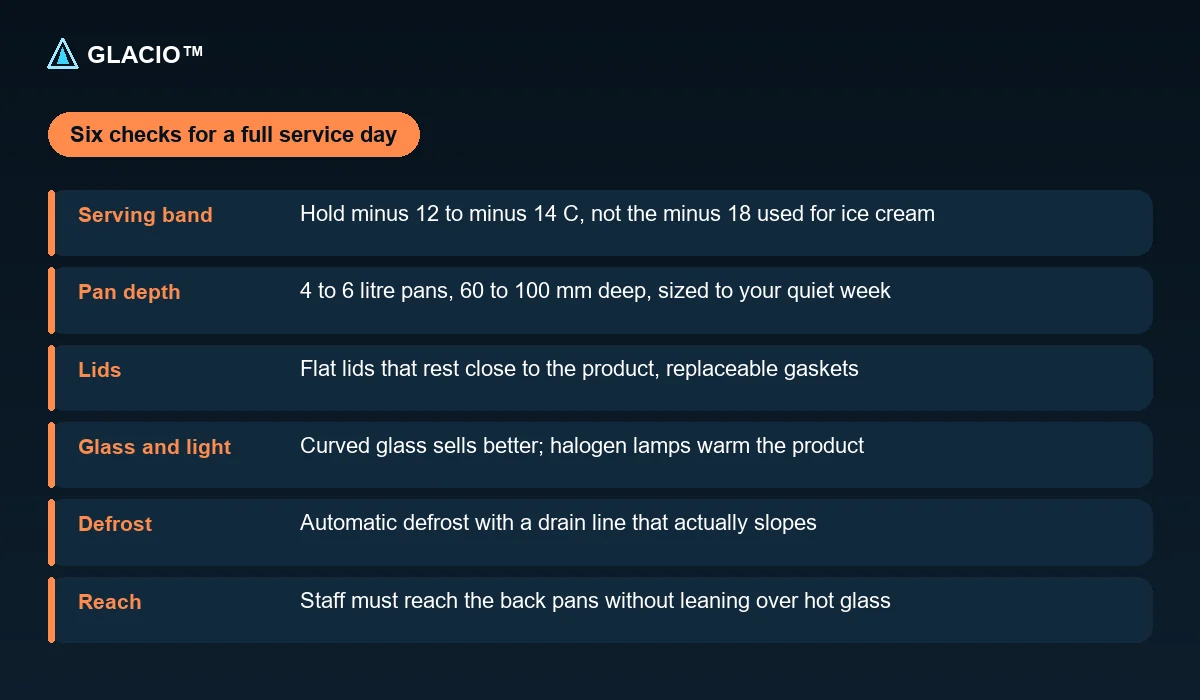
The six checks that decide it
1. Temperature band, not just minimum temperature
Ask the seller what the cabinet holds in a 30 degree room with the lids opened every three minutes. Gelato equipment needs to hold minus 12 to minus 14 consistently. A unit that swings between minus 9 and minus 16 will show you soft edges at one point and un-scoopable product at another, and staff start compensating by moving pans in and out of a storage freezer, which doubles handling work.
2. Pan depth and pan count
Deeper pans hold more product but slow down rotation and let the bottom of the pan sit colder than the surface. Most gelato shops run pans of 4 to 6 litres at 60 to 100 millimetres deep. Count the pans you fill in your quietest week: a 12 pan counter with six pans in use looks empty to customers and wastes power.
3. Lids and gaskets
Look at whether the lid is a flat glass or acrylic panel that sits close to the product, and whether the gasket around it is replaceable. Replaceable gaskets and lids are the difference between a counter that lives fifteen years and one that gets scrapped when the original curved cover cracks.
4. Glass and lighting
Curved glass shows more of the product from standing height, which is where customers decide. LED lighting adds almost no heat. Older halogen lamps add several degrees inside the case and are a common cause of icing on the glass and warmed product near the lamp. If a used counter still has halogen, price the LED conversion into the deal.
5. Defrost and drainage
Humidity creates frost on the evaporator. Automatic defrost with a drain line that actually slopes is worth paying for; a blocked drain is the most common service call on display equipment. Ask where the condensate goes and whether the line can be cleared without moving the counter.
6. Counter height and reach
Gelato counters are worked from two sides, customer-facing and staff-facing. Check that staff can reach the back pans without leaning across hot glass, and that the counter height matches how your team actually works. A display that is 50 millimetres too deep turns every service into a reach.
Countertop gelato display cases for small shops
Small shops, cafes adding gelato and market stalls often do not need a full counter. A countertop gelato display case with four to six pans covers a menu of eight to twelve flavours when you rotate pans through the day. The trade-offs are real, though: countertop units have smaller compressors, so recovery after opening the lid is slower, and they usually sit on a back counter rather than facing the customer. If the display has to sell the product, keep it at eye level. If it is purely holding, a countertop unit is the cheaper answer.
Shops at that scale usually pair the display with a smaller production machine. The countertop gelato machine guide covers the sizing arithmetic, and the equipment checklist lists everything else the counter needs.
Italian display cases and what the price buys
Italian-built gelato counters are the reference point for a reason: recessed pans, close-fitting lids, stable temperature and glass that was designed for showing food. That construction is what you pay for, and it is also why the category holds value well on the second-hand market.
| Option | Typical price | Best for | Main weakness |
|---|---|---|---|
| Countertop gelato display case, 4 to 6 pans | USD 1,200 to 4,000 | Cafes, market stalls, shops testing gelato | Small compressor, slower recovery, low visibility |
| Mid-size counter, 8 to 12 pans | USD 4,000 to 12,000 | Single-site gelato shops | Footprint, and it is display only |
| Italian display counter, 12 to 20 pans | USD 10,000 to 30,000 | Shops where presentation drives sales | Cost, lead time, service distance |
| Freeze-and-display machine, 3 to 6 bowls | USD 12,000 to 35,000 | Shops producing and selling from one counter | Capacity is tied to the machine, not to pan count |
If you are comparing a case with the display on a production machine, the display case versus machine display comparison is the more detailed read, and the display freezer guide explains where a display-only freezer stops being the right purchase.
Buying used: what to test
- Probe the temperature under load. Put a thermometer in the top pan position, fill the pans with water, close the lids and leave it for two hours in the shop, not in the seller’s warehouse.
- Check the glass and lid for cracks and yellowing. Replacement curved glass is expensive and often made to order.
- Inspect the gaskets and hinges. If parts are unavailable, budget for a full replacement set or walk away.
- Confirm the refrigerant. Older R404A counters are cheap to buy and increasingly awkward to service in Europe under fluorinated gas rules.
- Look for water damage under the counter. A long-term blocked drain rots panels and rusts frames, which is expensive to fix later.
- Ask about defrost cycles. If the seller says “we switch it off every night”, the unit is manual defrost and will cost you staff time every day.
Frequently asked questions
What temperature should gelato be displayed at?
Minus 12 to minus 14 degrees Celsius for service. That band keeps gelato soft enough to spread with a spade while still firm enough to hold its shape through a full service day.
What is a pozzetti display?
Pozzetti are the recessed pan wells set into an Italian style gelato counter. The pans sit flush with the counter surface so the product is level with the top, covered by a flat lid that rests close to the gelato.
Can I display gelato in a normal ice cream freezer?
You can store it, but a freezer set to minus 18 degrees serves gelato far too hard. If you must use one, keep it at the warm end of its range and rotate pans often, but expect a firmer texture than a proper gelato counter.
How many pans do I need?
Count the flavours you will sell in your slowest week. Most small shops settle at eight to twelve pans; countertop units with four to six pans suit cafes and stalls where gelato is an add-on rather than the main product.
Is a used gelato display case worth it?
Yes when the compressor holds temperature, the glass and gaskets are intact and the drain is clear. Budget for a gasket set, an LED conversion and a service visit, and test it in a warm room before you pay.
Do I need a display case if my machine has display bowls?
Not necessarily. If the machine shows the product at the front counter and holds it at serving temperature, it covers both roles and removes a footprint. The limitation is capacity: a machine display holds as much as the machine can hold, not as much as a 16 pan counter.
A gelato display is judged at eight in the evening, not at opening time. If the pans still look level, the lids sit close and the temperature has not drifted, customers buy the same way at close as they did at noon. Tell us in the comments how many pans you run and what temperature your counter holds, and we will tell you whether your display or your machine is the part holding you back.
Tell us the shop. We size the machine and price it.
Two numbers decide the model: how much you sell on a busy day, and how much you need in your busiest hour. Send those with your voltage and you get a model recommendation and an FOB quote within 24 hours.
- ✓ Sized to your peak hour
- ✓ FOB quote and lead time
- ✓ No obligation
Some information may be outdated
Comments
Questions about equipment capacity, voltage, or recipes? Leave a comment.
Loading comments...