

Ice Cream Machine Voltage and Phase: Buyer’s Pre-Ship Guide
Short answer: For an ice cream machine voltage order, match the factory configuration to the destination building: nominal voltage, phase, frequency, plug or hardwire method, circuit protection, and starting conditions. A machine rated for the wrong phase or frequency is not solved by a plug adapter, and shipping the wrong export version can leave it unusable at the port or in the shop. Confirm the site supply before you approve the drawing, pay the balance, or book freight.
An overseas installation rarely fails because the batch freezer was built badly. It fails because someone wrote 220 V on a form, assumed three phase was available, or discovered after arrival that the building supplied 208 V or 240 V split-phase. The machine then sits in storage while an electrician, a transformer supplier, and the factory negotiate who pays to correct a decision that should have taken 20 minutes.
This guide is for bakery owners, cafe operators, bubble tea shops, gelato founders, and home bakers moving into commercial production. The cost of getting electricity wrong is not just a new plug. It can include idle capital, port storage, return freight, replacement compressors, control damage, and weeks of lost selling time.
Why an Ice Cream Machine Voltage Mistake Follows You Across the Ocean
The electrical supply belongs to the building, not the country. A Canadian cafe may have 208Y/120 V three phase, while another shop two streets away has only 120/240 V single phase. A Chinese landlord may describe the service as 380 V, but the actual line-to-line reading could differ enough to matter. Export buyers need measured site data, not a flag on a map.
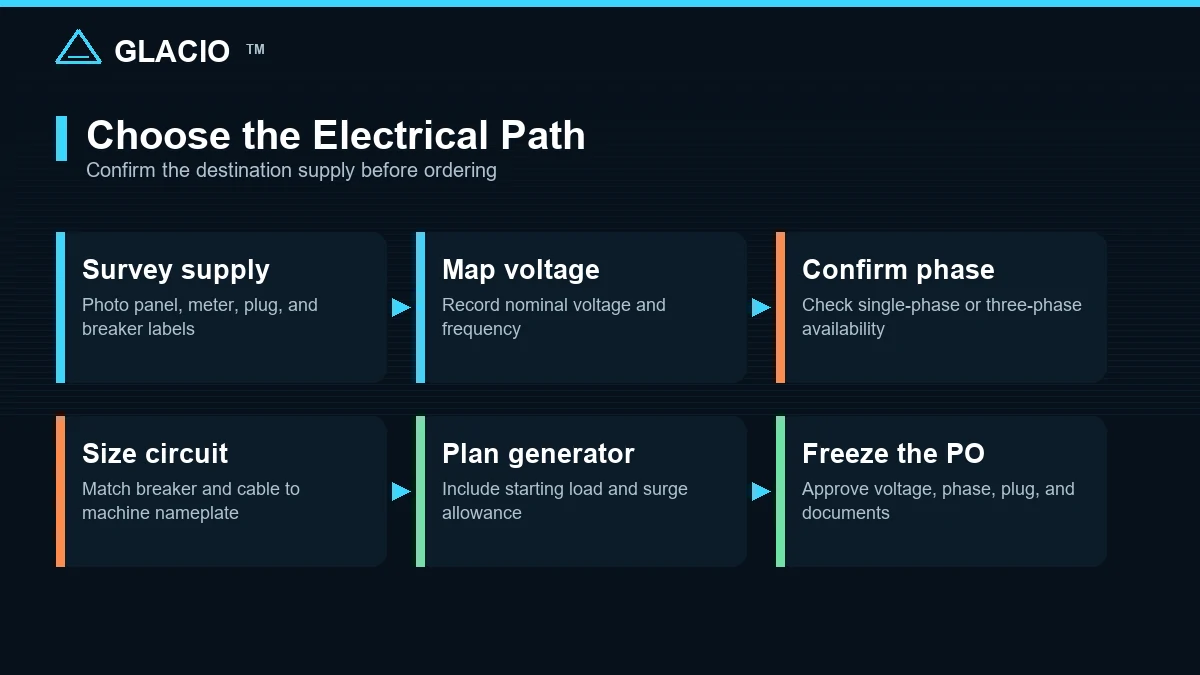
Once a machine is configured, changing voltage or phase can touch the compressor, motors, control transformer, contactors, heaters, wiring, plugs, and certification label. Some changes are straightforward at the factory and painful at the destination. A cafe that orders a 380 V three-phase unit for a 208Y/120 V service may need a phase conversion system, an upgraded service, or a different machine. Those are not interchangeable options with the same cost or warranty outcome.
The buyer also owns the schedule risk. If the electrical question is unresolved when production starts, the factory may build a standard export unit rather than the correct one. Freight leaves, customs clears, and the problem arrives with the crate. That is why voltage, phase, frequency, circuit, and connection details belong in the purchase order, not in a later email thread.
Answer the Building Supply Questions Before You Choose a Machine
Start with the intended counter position. A supply at the back wall does not help if the machine must sit at the front and the cable run creates voltage drop or blocks a walkway. Have a licensed local electrician record the answers below during a site visit. Photos of the panel, meter, breaker, outlet, and equipment nameplates are useful, but photos do not replace measurements.
- What service enters the building? Confirm whether it is single phase, split phase, or three phase, and record the measured voltage at the point of use.
- What is the frequency? Confirm 50 Hz or 60 Hz from the utility or meter. Do not infer frequency from the voltage.
- How much spare capacity remains? A panel may have an empty breaker space but no realistic capacity once ovens, refrigerators, air conditioning, and other kitchen loads run together.
- What circuit can be dedicated to the machine? Record breaker type, conductor size, route length, and whether local code requires residual current protection.
- How will the machine connect? Choose a hardwired connection or the exact local plug and receptacle standard. “European plug” is not a specification.
- Is the site leased? Landlord approval may be required before panel work, cable routing, or a new outlet is installed.
- Is backup power planned? If a generator will run the machine, its voltage, frequency stability, and starting capacity must be part of the machine decision.
Use the same site visit to review capacity. A machine that fits the electrical supply but cannot produce enough for peak service is still the wrong purchase. The batch freezer sizing guide by daily sales helps connect bowl count and production rhythm to the electrical load you are planning around.
Ice Cream Machine Voltage and Phase Comparison by Market
The table below shows common commercial supply values by market. It is a starting point for the electrician, not a substitute for a site reading. A destination can use more than one voltage, and older buildings often differ from new ones.
| Market | Common single-phase supply | Common three-phase supply | Frequency | Buyer note |
|---|---|---|---|---|
| United States and Canada | 120 V and 240 V split phase | 208Y/120 V or 480Y/277 V | 60 Hz | Many small food shops have no three-phase service |
| European Union and United Kingdom | 230 V | 400 V | 50 Hz | 230 V and 400 V are nominal values, not guaranteed readings |
| China | 220 V | 380 V | 50 Hz | Confirm line-to-line voltage, phase rotation, and site breaker |
| Australia and New Zealand | 230 V | 400 V | 50 Hz | Industrial plugs vary by current rating and configuration |
| India | 230 V | 400 V | 50 Hz | Voltage stability and local protection deserve extra review |
| Japan | 100 V or 200 V | 200 V | 50 Hz or 60 Hz by region | Frequency depends on region, so never infer it from the country alone |
If the measured voltage is 208 V, do not tell the factory “220 V” because it sounds close. If the measured three-phase voltage is 415 V, do not reduce it to “400 V” in a short message. Give the electrician’s actual readings and let the machine supplier confirm the approved configuration in writing.
Single Phase vs Three Phase Ice Cream Machine: Which Supply Fits?
The phrase single phase vs three phase ice cream machine describes two different electrical installations. Single phase uses two current-carrying conductors in a typical branch circuit, while three phase uses three current-carrying conductors and provides more power with lower current per conductor for a given load. The correct choice depends on the building, machine design, local code, and future expansion.
When single phase is the practical choice
- The building has no three-phase service and upgrading the utility supply is expensive or impossible.
- The machine is designed for single-phase operation and the circuit has enough dedicated capacity.
- The operator wants a simpler panel, fewer connection options, and easier local service support.
- The intended production level fits the machine’s design without relying on an unapproved phase converter.
When three phase earns its place
- The building already has a stable three-phase supply with spare capacity.
- The machine is factory-built for three-phase operation, including the correct voltage and frequency.
- Lower current per conductor helps with cable routing, motor starting, or future equipment expansion.
- The local electrician can provide the required protection, isolation, phase rotation check, and connection hardware.
A transformer changes voltage. It does not turn single phase into three phase, and it does not change 50 Hz into 60 Hz. A phase converter may be technically possible for some equipment, but it is not a universal fix. If the factory has not approved the exact converter arrangement, wiring method, and control supply, the buyer carries the risk.
Gelato Machine Electrical Requirements Beyond the Label
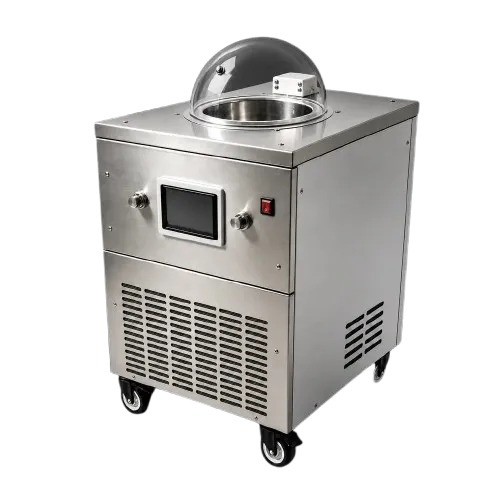
Gelato machine electrical requirements are often reduced to a headline voltage. That is not enough for a production machine. The electrician needs the complete nameplate data, the intended connection method, and the site conditions. A 220 V label on a quotation may describe a nominal market supply, a control voltage, or an older specification, so the approved machine data must be unambiguous.
Search results often flatten batch freezer voltage 220v 380v into one shopping filter. On site, those labels represent different installations, conductor counts, protective devices, and plug families. A 220 V single-phase circuit and a 380 V three-phase circuit are not two versions of the same connection.
Nameplate data the electrician needs
- Rated voltage and number of phases
- Rated frequency, either 50 Hz or 60 Hz
- Full-load current and, where supplied, minimum circuit ampacity
- Maximum protective device rating or manufacturer circuit guidance
- Connection method: hardwired or a defined plug and receptacle
- Control voltage and any separate supply requirement shown by the manufacturer
The breaker is not selected because the machine has 1, 2, 4, or 6 bowls. It is selected from the machine’s electrical data, conductor size, starting characteristics, cable route, and local code. If a machine nuisance-trips a shared circuit during compressor start, the answer is not a larger breaker by guesswork. That can remove protection from undersized conductors. The correct fix is a dedicated circuit reviewed by an electrician.
Frequency is not a formality
Frequency affects motor and compressor speed, controls, timers, pumps, and lubrication behavior. A unit configured for 60 Hz may not be suitable on a 50 Hz supply without factory approval, and the reverse can also create risk. Electronic controls may accept both frequencies, but that does not make the entire machine dual-rated. Confirm the complete configuration, not only the control display.
Plugs come last, after the electrical design. A 3-phase industrial connector is available in multiple current ratings and pin arrangements, and a plug that fits the wall is not proof that the circuit is correct. For some installations, hardwiring through a local isolator is cleaner than shipping a molded plug that must be cut off at the destination. The commercial ice cream machine power requirements guide covers the broader electrical planning picture.
Generator and Surge Considerations for Batch Freezers
A generator can keep production moving during an outage, but it can also create a new failure point. Batch freezers start compressors and motors, and that starting load is much harder on a generator than the steady running load. If the generator voltage sags or frequency moves outside the control’s tolerance, the machine may reset, draw soft, or stop mid-cycle.
Size for starting, not just running
- Use the machine nameplate and factory guidance as the first input, not the generator dealer’s estimate alone.
- Account for compressor starting current, motor start method, and other loads that may start at the same time.
- Ask the generator supplier to confirm stable voltage and frequency during the worst realistic starting sequence.
- Plan a transfer switch, grounding, and neutral arrangement that satisfy local electrical code.
- Do not assume a generator that runs lights and refrigerators can start a batch freezer.
A generator with excess running capacity can still fail the job if its voltage recovery is poor. The practical test is not whether the generator can carry the machine after it starts. The practical test is whether the machine can start, complete a cycle, and keep its controller powered while other kitchen loads switch on.
Protect controls from dirty power
Surge events can arrive from the utility, a generator transfer, nearby equipment, or a lightning strike on the distribution network. A surge protective device at the panel or at the machine can reduce risk, but it must be installed in a way that complies with local code and coordinates with existing protection. A residual current device, ground-fault protection, or RCBO may also be required. These devices can trip on normal motor leakage or inrush when the circuit and machine are not coordinated, so the electrician should review the full design.
Keep the machine on a dedicated circuit where possible. Shared circuits with fryers, ovens, mixers, and air conditioners create voltage dips and nuisance trips that look like machine faults. If the lights dim when a compressor starts, get the supply checked before blaming the recipe or the refrigerant system.
What to Put on the Purchase Order and the Mistakes That Strand Machines
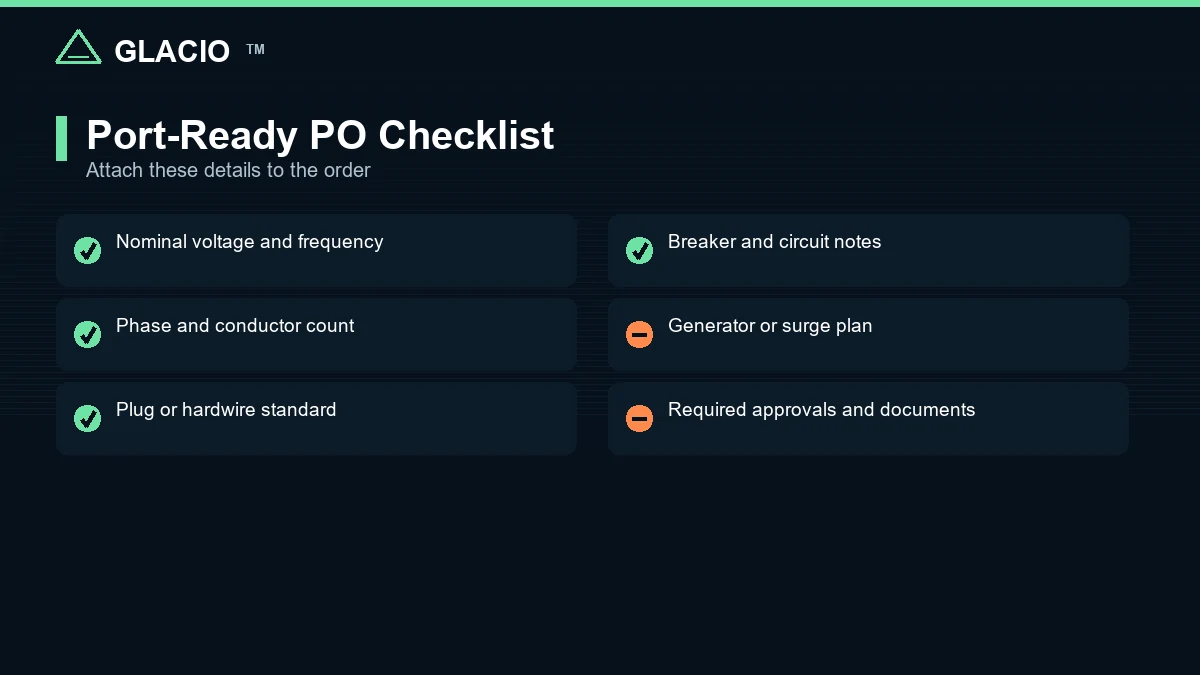
The purchase order is the last clean opportunity to fix the electrical configuration. A quotation can say “220 V” or “380 V” as a shorthand, but the PO must translate that shorthand into an approved build instruction. The factory, buyer, electrician, freight forwarder, and customs broker should all be able to read the same electrical details.
- Destination address and country. Include the city and site name so the factory can flag regional standards and shipping documents.
- Measured supply voltage. Use actual readings from the intended machine position, not the nominal country value.
- Phase configuration. State single phase or three phase, including conductor arrangement where the electrician considers it relevant.
- Frequency. State 50 Hz or 60 Hz and keep it consistent across the machine, controls, and accessories.
- Connection standard. Specify hardwired or the exact plug and receptacle type. If the buyer is unsure, omit a loose plug and plan a local connection with the electrician.
- Circuit and protection notes. Attach the dedicated breaker, cable, residual current, surge, and isolation plan once approved.
- Generator or grid operation. State whether the machine will run on utility power, a generator, or both, and send the generator details for review.
- Documents and labels. Confirm the required manual language, electrical label, certification documents, and any import paperwork before production.
- Final approval. Require the buyer’s electrician or responsible manager to approve the electrical page before the balance payment and shipping date are locked.
Port mistakes to prevent
- Ordering by country, not building. A national voltage table cannot reveal what the landlord installed or what the utility actually delivers.
- Treating 220 V and 380 V as universal. Both are common shorthand, but neither replaces measured voltage, phase, and frequency.
- Ignoring frequency. A machine can match voltage and phase and still be wrong for the destination power system.
- Choosing the plug late. Plugs, sockets, isolators, and cords should be resolved before the export crate is packed.
- Assuming a transformer solves everything. Transformers do not change frequency or convert single phase into true three phase.
- Leaving approval verbal. If the approved electrical configuration is not on the PO or drawing, it is not a production instruction.
- Skipping import documents. Electrical data, manuals, and declarations should travel with the shipment, not arrive after the machine is stuck in storage.
Use the commercial ice cream machine installation checklist when you brief the electrician, and use the shipping and import documents checklist when you brief the forwarder. One page with the wrong electrical shorthand can create a much larger bill than a careful site survey.
Frequently asked questions
Can a 230 V ice cream machine run on 220 V or 240 V?
The safe answer depends on the nameplate tolerance and the factory-approved configuration. The labels 220 V, 230 V, and 240 V describe market supply conventions, not a universal operating range. Send the measured voltage and frequency to the machine supplier before ordering, and do not rely on a plug adapter to resolve a mismatch.
Can a transformer turn a single-phase machine into a three-phase machine?
A transformer changes voltage, not phase or frequency. Single phase cannot become true three phase simply by adding a transformer. A rotary phase converter or variable frequency drive may be possible for some equipment, but the machine manufacturer must approve the exact arrangement because motors, controls, protection, and warranty terms can all be affected.
Does a 50 Hz ice cream machine work on a 60 Hz supply?
A 50 Hz machine should not be assumed to work on 60 Hz without factory approval. Frequency affects motors, compressors, pumps, timers, and control behavior, and the result can range from harmless to rapid overheating or failed cycles. A transformer does not correct frequency, so the export configuration must match the destination supply from the start.
What size generator does an ice cream batch freezer need?
There is no responsible universal generator size for every batch freezer. The calculation must use the machine nameplate, compressor starting method, starting current, control loads, and other equipment that may run at the same time. Ask the generator supplier to confirm stable voltage and frequency during the worst realistic starting sequence.
Which plug should an export ice cream machine ship with?
The machine should ship with the destination plug and receptacle standard or with a hardwired connection approved by the local electrician. Three-phase plugs are specific to current rating and pin arrangement, and a plug that fits does not prove the circuit is correct. Confirm the connection method in writing before production, or leave the plug off and plan local termination.
What happens if the machine arrives with the wrong phase?
A machine built for the wrong phase cannot be fixed with an adapter. The buyer may need a permitted phase conversion system, an electrical service upgrade, a replacement machine, or a factory-approved modification that may be impossible after arrival. That is why phase, voltage, frequency, and connection details should be frozen on the purchase order before shipment.
Specify the Electrical Configuration Before You Pay
The best time to solve an electrical problem is before the deposit, not after the crate reaches the port. Send your electrician’s measured voltage, phase, frequency, plug standard, breaker and cable plan, generator details, and site photos to GLACIO. We will help confirm the correct factory configuration for your destination and match it to the right GLACIO GB-Series batch freezer for your production plan.
Request a machine recommendation and quote
What electrical surprise has delayed an installation in your market, and what detail would you now put on the purchase order before shipping?
Tell us the shop. We size the machine and price it.
Two numbers decide the model: how much you sell on a busy day, and how much you need in your busiest hour. Send those with your voltage and you get a model recommendation and an FOB quote within 24 hours.
- ✓ Sized to your peak hour
- ✓ FOB quote and lead time
- ✓ No obligation
Some information may be outdated
Comments
Questions about equipment capacity, voltage, or recipes? Leave a comment.
Loading comments...