




A commercial ice cream machine is usually built around a ten-year design life and runs for seven to fifteen years in a working shop. The difference between the two numbers is not luck or brand. It is duty cycle, water, voltage, cleaning discipline, and whether anyone replaces the cheap parts before they take the expensive ones with them.
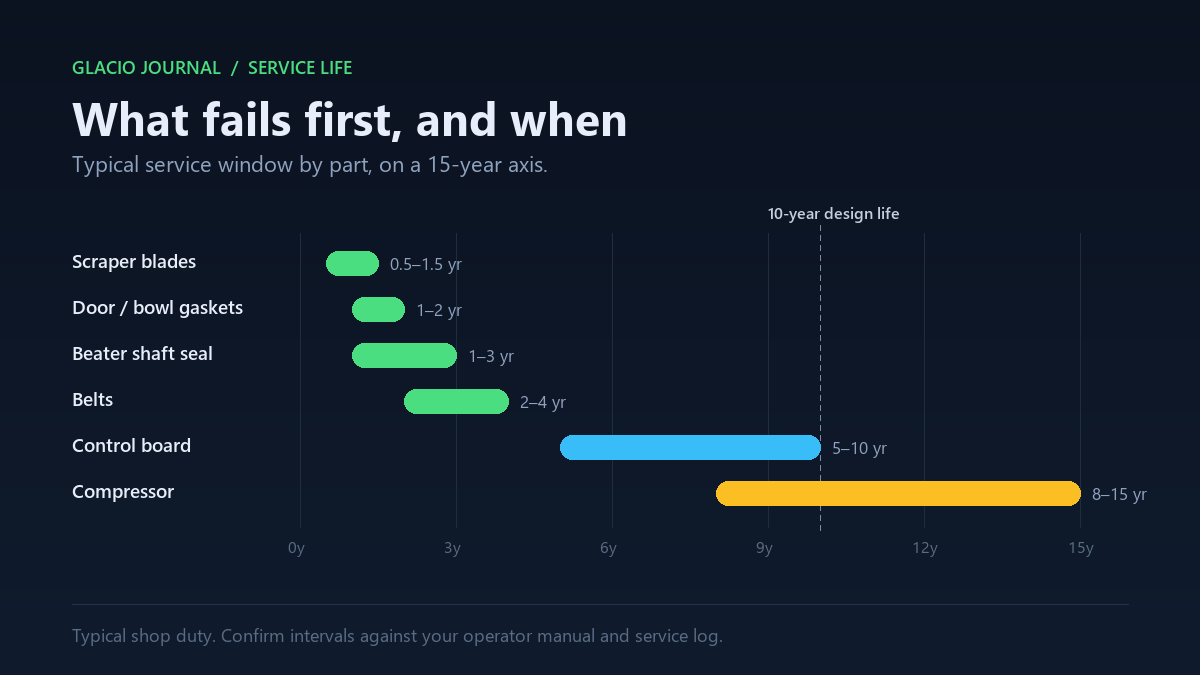
This is a wear map, not a warranty claim. It shows which parts decide the machine’s life, what usually fails first, and what a buyer should check before paying — whether the machine is new or used.
The short answer
Most commercial batch freezers and gelato machines are engineered for about a decade of full-time service. In practice:
- 7–10 years is the realistic range for a busy shop with basic maintenance and no water treatment.
- 10–15 years is achievable when the condenser stays clean, the water is soft or treated, electrical supply is stable, and wear parts are replaced on schedule.
- Under 5 years usually means something specific went wrong: scale build-up, voltage problems, running the machine hot, or months of skipped cleaning.
The compressor is the part most often cited as the limit. Refrigeration specialists put commercial freezer compressors at roughly 8–10 years on average, with well-maintained units reaching 10–15 years. Beyond the compressor, the machine’s cost of ownership is decided by seals, blades, gaskets, boards and whether spare parts are still available.
Design life, service life and economic life are three different numbers
Manufacturers design to a life target: components selected, cycle-tested and burn-in run to prove the machine can survive a decade of shop duty. GLACIO, for example, specifies a ten-year design life and runs every unit through an eight-hour full-load burn-in before the nameplate goes on.
Service life is what the machine actually delivers in your shop. It is the design target minus everything you did or didn’t do to it: water hardness, ambient temperature, voltage stability, cleaning, and load.
Economic life is the point where repairs stop making sense — not because the machine is dead, but because the next repair plus the downtime costs more than the machine is worth to your operation. A well-built machine often hits economic life before mechanical life, and the decision is a spreadsheet, not a scrapyard.
The wear map: what fails first
Wear is predictable. These are the parts that decide whether you get seven years or fifteen, with typical service intervals under normal shop duty — always check your own manual, because duty cycle and mix recipe move these numbers.
| Part | Typical life | What happens when it goes |
|---|---|---|
| Scraper blades / dasher blades | 6–18 months | Longer cycle times, uneven freeze, motor strain; cheap to replace, expensive to ignore |
| Door and bowl gaskets | 1–2 years | Air and moisture ingress, ice build-up, inconsistent batch temperature |
| Beater shaft seal | 1–3 years | Mix leaks into the drive area; the classic cause of a bearing or gearbox repair |
| Belts (belt-driven units) | 2–4 years | Slipping, squealing, reduced churn; a cheap part that takes a shift with it |
| Condenser coil | Clean monthly–quarterly | Dirty coils are the single most common driver of compressor failure and high discharge pressure |
| Compressor | 8–15 years | The big-ticket item; life depends mostly on coil cleanliness, refrigerant charge and supply voltage |
| Control board / touch panel | 5–10 years | Board revisions and spares availability matter more than the failure itself |
| Refrigerant circuit | No scheduled life | Refrigerant is not consumed; a leak is a fault, and repeated top-ups without finding the leak shorten compressor life |
Read the table top-down and the logic is obvious: the inexpensive parts at the top protect the expensive part in the middle. A shop that replaces blades, seals and gaskets on time rarely meets the compressor failure that ends a machine’s life early.
What kills machines early
Five causes account for most premature deaths, and none of them are mysterious.
Scale and hard water. Water-borne minerals coat the bowl, the beater and the heat-exchange surfaces. Insulation gets worse, cycle times grow, the compressor runs longer and hotter. If your area has hard water, a softener or a filter is cheaper than a compressor.
Unstable voltage. Compressors are not tolerant of brownouts and spikes. A machine rated for a specific voltage and phase needs that supply, not “close enough”. In markets with weak grids, a voltage stabiliser is not an accessory — it is part of the installation.
Heat and blocked airflow. Machines pushed against a wall or boxed into a hot corner cannot reject heat. Discharge pressure rises, the compressor works harder, and the failure moves forward by years. The installation clearance in the manual exists for a reason.
Skipped cleaning. Dairy residue hardens, seals dry out, mould grows in places you cannot see, and the machine starts to smell. Cleaning is not cosmetic; it is the maintenance task that protects the seals and the heat exchanger.
Running past the failure point. A leaking seal or a worn blade is a small repair. Run it for another season and it becomes a gearbox, a bearing or a motor. Most catastrophic failures are cheap parts that were ignored.
Duty cycle beats age
Two machines of the same age can be five years apart in wear. What matters is how many batches they have drawn. A shop doing 30 batches a day puts an order of magnitude more cycles on blades, seals and the compressor than a café doing four.
A rough way to estimate your own duty: batches per day × operating days × years. A machine at 10 batches a day for six years has run about 18,000 cycles; at 30 a day it is closing on 55,000. When you compare a used machine against a new one, compare cycle estimates, not just the year on the plate — and check the service records, not the paint.
How to read your machine’s remaining life
Six signals tell you more than the age:
- Cycle time drift. If a batch that used to take 15–20 minutes now takes longer for the same mix and setting, the machine is telling you something — usually blades, refrigerant charge or coil condition.
- Leaks and residue. Mix or oil where it should not be means a seal is going.
- Noise and vibration. New noises from the drive or compressor are early warnings, not background music.
- Temperature stability. Unstable hold temperature or frequent defrost cycles point to the refrigeration side.
- Service history. A machine with documented annual service and a parts log is worth more than a lower-hour machine with no records.
- Parts availability. If the board or a seal is no longer produced, the remaining life is decided by the spares shelf, not the compressor.
For a used purchase, this is exactly what a structured inspection checks. The 35-point used machine inspection checklist walks through it in order.
The maintenance calendar that gets you to ten years
You do not need a service contract to reach a decade, but you do need a rhythm. A practical schedule:
- Daily: rinse and sanitise per the cleaning SOP; check the bowl, lid and drain; listen for new noises.
- Weekly: inspect gaskets and blades visually; check for leaks; clean the condenser intake area.
- Monthly: clean the condenser coil properly; check belt tension on belt-driven units; log cycle times per flavour.
- Quarterly: check electrical connections and voltage; inspect seals; review spare-parts stock.
- Annually: service the refrigeration side (pressures, charge, leak check); replace wear parts as a kit; review the service log and decide repair vs replace at year 8+.
The commercial ice cream machine maintenance checklist expands this into tasks you can assign to staff, and the warranty and spare-parts guide covers what to confirm before you need it. Keep a simple log — date, task, part, finding — because at year eight the log is the document that tells you whether to repair or replace.
Buying for longevity: what to check before you pay
Lifespan is decided at purchase as much as in service. Six questions separate a machine you can keep for a decade from one you will replace in five years:
- Which compressor brand and model, and is it a commercial-duty unit with published service data?
- Are wear parts (blades, seals, gaskets, belts) standard, in stock, and priced sensibly — or proprietary?
- Is there a service manual and a fault-code map, or only a user leaflet?
- What is the burn-in or factory test record, and does it come with the machine?
- Which components are replaceable by a local technician, and which require returning the unit?
- What is the spare-parts dispatch commitment after the warranty ends — days, or weeks?
GLACIO builds around these questions: TECUMSEH compressors, standard wear parts, an eight-hour full-load burn-in with logged curves, a fault-code map for remote diagnosis, and a 48-hour parts dispatch commitment with a year of wear parts shipped with every machine. Those are the details that decide whether year nine is a repair or a replacement.
FAQ
Is 10 years realistic for a busy shop?
Yes, if the machine is sized correctly and maintained. The shops that fall short usually have one of three problems: hard water without treatment, blocked airflow around the condenser, or cheap parts replaced late. Fix those three and ten years is a normal outcome, not an optimistic one.
What usually fails first?
Blades, gaskets and seals — the inexpensive parts. The compressor is the expensive failure, but it is usually a consequence of dirty coils, a refrigerant leak that was never found, or voltage problems rather than a compressor that simply wore out.
Does a used machine have remaining life worth buying?
Sometimes, if you can verify cycle counts, service history and parts availability. A machine with documented maintenance and standard parts can deliver years more; one with no records and obsolete boards is a parts donor. Use an inspection checklist and price the first-year repair risk into the offer.
How much does maintenance actually cost per year?
For most shops, routine maintenance is a small fraction of the machine’s price: cleaning supplies, occasional blades and seals, and one annual service visit. The expensive year is the one where preventive maintenance was skipped — a compressor or gearbox repair can exceed several years of routine upkeep in one invoice.
What is the single highest-impact maintenance task?
Keeping the condenser coil clean. It is cheap, it takes minutes, and it protects the component that most often ends a machine’s life. If the machine is struggling to hold temperature or cycling longer than usual, check the coil before you call a technician.
If you are sizing or replacing a machine and want the lifespan calculation done against your actual batch count and voltage, tell us your daily batches, cup count and supply — an export engineer replies within 24 hours with bowl count, unit count and FOB quote. Request a machine quote.
Sources: Taylor Company, “How Preventive Maintenance Saves You Thousands in Equipment Repairs” (preventive vs reactive maintenance, seals and coil checks, service-log practice); Compressors Unlimited, “Replace or Repair My Commercial Freezer Compressor” (commercial compressor service life); GLACIO factory data (ten-year design life, eight-hour burn-in, 48-hour parts dispatch). Service intervals are typical shop-duty estimates — confirm against your own operator manual.
Some information may be outdated
Comments
Questions about equipment capacity, voltage, or recipes? Leave a comment.
Loading comments...