




Overrun is the air churned into ice cream, measured as the percentage by which the mix grows in volume on its way to the bowl. A 30% overrun means one litre of mix becomes 1.3 litres of finished product. At 100%, the same litre becomes two litres — and half of what the customer is eating is air.
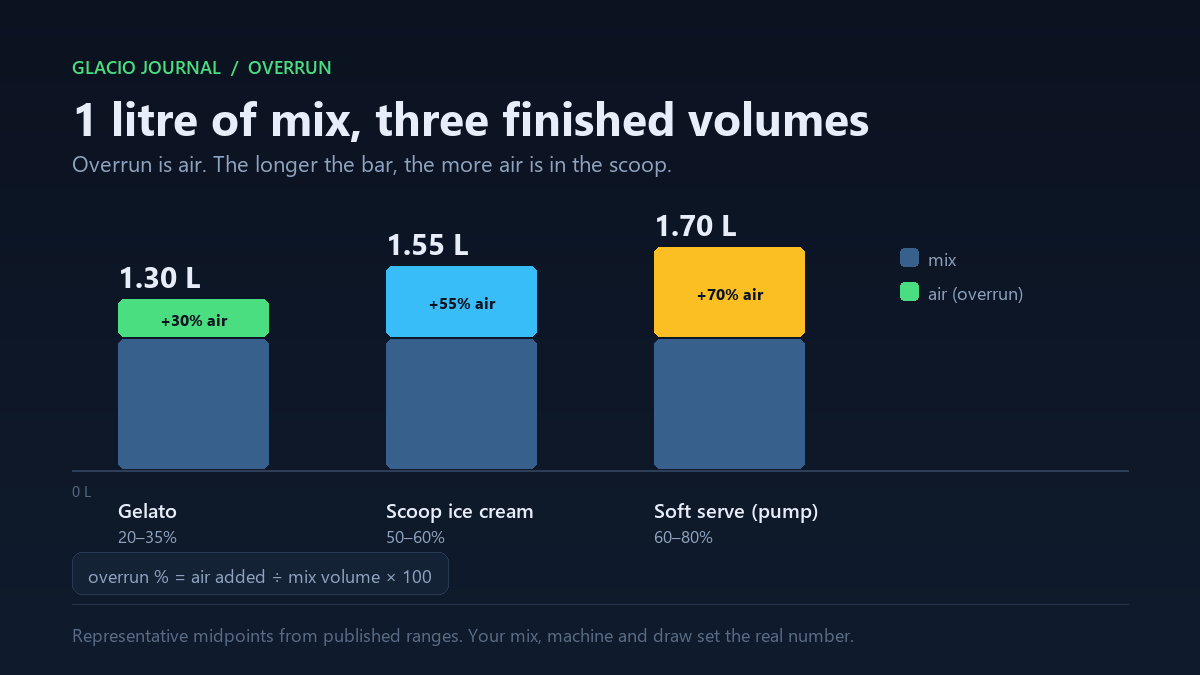
That single number decides how dense a scoop feels, how fast it melts, how much flavour lands per bite, and how many scoops one litre of mix actually sells. Gelato sits at the low end, most shops running 20–35%; scoop ice cream typically runs 50–60%; soft serve from a pump machine can reach 60–80%. The gap between those numbers is not a detail. It is the difference between a dense product and a foamy one.
What overrun actually measures
Overrun is the percentage increase in volume caused by air incorporated during freezing. Two forms of the same formula are useful — one works in the freezer, one works on a kitchen scale:
- By volume: overrun % = (volume of frozen product − volume of mix) ÷ volume of mix × 100
- By weight: overrun % = (weight of mix − weight of the same volume of frozen product) ÷ weight of the frozen product × 100
In a shop, the weight version is the practical one. Fill a container with mix and weigh it, then fill the same container to the same level with finished gelato and weigh that. Because air has almost no mass, the lighter the finished sample, the more air it holds.
A worked example. Suppose 1,000 g of mix fills a one-litre tub. After churning, that same one-litre tub holds 770 g of finished gelato. Overrun = (1,000 − 770) ÷ 770 × 100, which is about 30%. That is a normal gelato number. If the same tub held 500 g of finished product, the calculation would return 100% overrun — the industry reference point where the product is half air.
Two cautions. First, weigh a clean sample with no inclusions; fruit pieces, nuts and cookie chunks break the assumption that the only variable is air. Second, test a fully drawn batch, not the first few seconds of the draw. The overrun target is a property of the finished batch, and the start of a draw is always denser than the end.
The numbers by product type
Industry references and shop-floor practice agree on the shape of the scale, even where the exact bands differ. The table below combines the category ranges published in the Tetra Pak Dairy Processing Handbook with the typical values an ice cream equipment dealer sees in working shops.
| Product | Typical overrun | What it means in the cup |
|---|---|---|
| Water ice | 0% | No air; frozen sugar and fruit solution |
| Craft gelato (batch freezer) | 20–35% | Dense scoop, concentrated flavour, slower melt |
| Scoop ice cream | 50–60% | Classic scoop texture, lighter body |
| Premium ice cream (industry band) | 20–80% | Wide range; the low end sells as dense |
| Standard ice cream (industry band) | 60–120% | Volume-led product; cost per litre drives the mix |
| Soft serve, gravity machine | 30–35% | Denser draw, shorter hold time |
| Soft serve, pump machine | 60–80% | Light, airy, high yield per litre of mix |
| Frozen dessert (vegetable fat) | 80–180% | Maximum yield; texture depends on stabilisers |
Read the table one way and it looks like a quality ladder. Read it the way an operator should and it is a pricing decision: every point of overrun above your recipe’s target is free volume you can sell, and every point below it is mix you paid for that stays in the batch.
Why gelato runs at 0–35% while ice cream runs higher
Three forces keep gelato dense, and only one of them is tradition.
Mix composition. Air is held in place by a membrane of partially agglomerated fat around each air cell. Richer mixes with more solids resist taking on air, while leaner mixes accept it more readily. A well-built gelato base — higher solids, lower fat than premium ice cream — naturally lands in the low band. The handbook is explicit that fat has to be treated correctly during ageing for that membrane to form at all; poor ageing is one of the documented reasons a batch fails to develop its intended overrun.
Machine design. A batch freezer folds in only the air its dasher drags into the bowl. A continuous freezer has an air intake, an air mass flowmeter and a PLC that meters air in proportion to mix flow to hit a set overrun — the machine can be told to run at 100% and it will. That control is why industrial ice cream can be sold at 60–120% overrun while a batch-frozen gelato cannot practically be pushed anywhere near it.
Serving temperature. Gelato is served warmer than ice cream, around −12 to −14 °C, and a warmer, denser product releases aroma on the tongue instead of numbing it. A dense product served cold would be hard and flavourless; a high-overrun product served warm collapses. Overrun and serving temperature are a matched pair, not two independent settings.
Some hard-serve batch freezers go further and publish a nominal 0% overrun. GLACIO’s GB platform is one example: the machines run no air-injection system, so there is no pump or valve for an operator to dial air in, and the factory specifies 0% overrun for the standard draw. In practice the number follows the mix and the draw — the point is that it stays at the dense end of the scale rather than being set by a machine parameter.
What low overrun does to texture, melt and flavour
Air is structural. It sits in tiny cells, each wrapped in fat, dispersed through ice crystals and unfrozen mix. More air means a lighter, softer structure with more surface area; less air means a denser matrix that holds its shape.
In the mouth, the effect is immediate. A 30% gelato reads as creamy and flavour-forward because most of what melts on the palate is the mix you formulated. Push the same recipe to 70% and the first bite feels light, then turns to a thin, foamy film — the bubbles that felt pleasant are also what makes the texture fall apart. Melt behaviour follows: more air means a flimsier matrix that collapses faster in a warm case or a customer’s hand.
The caveat is that low is not automatically better. A 0–15% product served at −18 °C is hard, difficult to scoop and slow to release flavour. Dense products need the warmer serving temperature and a properly balanced recipe — freezing-point depression, solids and stabilisers — to scoop cleanly. Overrun is one dial; it does not work alone.
The money side: yield, cost per scoop, and the litres-per-hour trap
High overrun is profitable, and pretending otherwise does not help anyone. Air costs nothing. One litre of mix becomes 1.3 litres at 30% overrun and 1.7 litres at 70% — roughly 30% more sellable volume from the same ingredients. Across a year of production, that gap is the difference between two different businesses.
The catch is what the customer gets for the money. A premium scoop at 30% overrun carries roughly 77% mix by volume; at 70% it carries about 59%. If both are priced per scoop, the high-overrun product is cheaper to make and delivers less dairy, sugar and flavour per serving. That is a legitimate business model — it is just a different product, and it needs a different price and a different promise.
This is also where machine comparisons go wrong. Batch freezer output is usually quoted as litres of mix per hour, and a 14 L/hour figure says nothing about finished volume until you know the overrun it is drawn at. Two machines quoting the same mix throughput will land at very different finished litres if one runs at 30% and the other at 60%. When you compare quotations, ask for the overrun basis behind the output number — the same discipline that applies to running cost per litre applies to capacity claims.
How to measure overrun in your own shop
You do not need a lab. You need a scale, one container, and the discipline to do it the same way every time.
- Weigh a clean, level container of mix. Record the weight.
- Draw a full batch at your normal setting, then fill the same container to the same level with finished product.
- Weigh it. The difference between the two weights, divided by the finished weight, times 100, is your overrun.
- Record it per flavour and per week. A trend matters more than a single reading.
- When the number drifts, check the usual suspects: mix viscosity and ageing time, draw temperature, worn seals or air leaks, and dasher or beater condition.
Two readings a week per flavour is enough to catch a machine that is quietly changing character. A batch that suddenly gains 10 points of overrun will taste lighter and melt faster, and by the time a customer notices, you have already sold a week of it.
How the machine sets your overrun ceiling
On a batch freezer, the operator controls overrun indirectly: through draw time, draw temperature, batch size, mix viscosity and the condition of the dasher. There is no air valve to set, so the achievable band is narrow and repeatable — which is why batch-frozen gelato lands in the same range batch after batch, and why small process changes show up as texture changes rather than as a number on a display.
On a continuous freezer, overrun is a setpoint. Air enters through a check valve, an air mass flowmeter measures it, and the PLC holds the ratio to mix flow. Cylinder pressure matters too: the handbook notes a default around 4 bar, adjusted proportionally to overrun, with low overrun requiring lower cylinder pressure. Dasher speed (typically in the 230–350 rpm band on industrial machines) changes shear and churn, so it changes structure independently of the air setpoint.
What that means for a buyer: the machine type decides whether overrun is a recipe outcome or a dial. If you are building a dense, gelato-style product, a batch freezer with no air injection gives you a repeatable low band. If you need to hit 80–100% for a volume product, you need a continuous freezer or a pump-equipped soft serve machine — no amount of operator skill will turn a batch freezer into one.
What to ask a supplier before you buy
Six questions separate a useful quotation from a brochure:
- Does the machine inject air, or is overrun purely a result of agitation? Is there a setpoint, and what range does it cover?
- What overrun is the quoted output measured at — and is that mix litres or finished litres?
- What is the cylinder pressure range, and how does it change at low overrun?
- How is overrun verified at factory testing, and what record comes with the machine?
- What serving temperature is the machine designed around, and what happens to texture at the low end?
- Which parts wear in a way that shifts overrun over time, and how often are they replaced?
For a dense, display-led product, the answers should point to a batch machine with a stable low band, a serving temperature around −12 °C, and a parts plan that keeps the draw consistent for years. A useful companion read is the commercial gelato machine buying guide, which covers bowl count and display configuration, and the open bowl versus closed cylinder comparison for the machine architecture itself.
FAQ
Is 0% overrun better than 30%?
Neither is universally better. 0–15% gives the densest scoop and the most flavour per bite, but it needs a warmer serving temperature and a well-balanced recipe or it eats hard. 20–35% is the practical gelato band: dense, scoopable, and stable in a display case. Above 50% you are selling volume, and the texture becomes lighter and faster-melting.
Can I change overrun on a batch freezer?
Only indirectly. There is no air setpoint, so overrun responds to batch size, draw temperature, draw time, mix viscosity and the condition of the dasher and beater. You can move it a few points; you cannot turn a 30% machine into an 80% one.
Why does overrun drift between batches?
Usual causes are mix viscosity and ageing time, a change in draw temperature, worn seals or a small air leak on the suction side, and inconsistent batch sizes. If your recipe has not changed and the number moved, treat it as a maintenance signal before treating it as a style choice.
Does overrun affect melting and display life?
Yes. More air means more surface area and a weaker matrix, so high-overrun product melts faster and collapses sooner in a warm case. Low-overrun gelato holds its shape longer, which is one more reason display temperature and overrun should be specified together.
How do I compare two machines’ output fairly?
Convert both to finished litres at the overrun you will actually run. A machine rated at 14 L of mix per hour produces about 18 L of finished product at 30% overrun and about 22 L at 60%. Then compare price, power, bowl count, and service — the commercial ice cream maker guide walks through the rest of the specification.
If you are sizing a machine around a dense, low-overrun product, tell us your daily litres, cups per day and voltage — an export engineer replies within 24 hours with a bowl count, unit count and FOB quote. Request a machine quote.
Sources: Tetra Pak Dairy Processing Handbook, Chapter 21 “Ice Cream” (overrun bands, 100% overrun = 50% air, continuous freezer air control); Machinery World, “What does ice cream overrun mean and how do I calculate it?” (shop-floor typicals); Free Gelato Balancing, “Gelato Overrun Explained” (weight formula, yield comparison, serving temperature).
Some information may be outdated
Comments
Questions about equipment capacity, voltage, or recipes? Leave a comment.
Loading comments...