




An ice cream machine is not a box of T-shirts. It is heavy for its volume, it cannot be stacked on its side, and the freight quote you receive is usually about half the money you will actually spend to get it running in your shop. The difference between the FOB price and the landed cost is where most first-time importers get surprised.
Three numbers decide the freight: chargeable volume, gross weight, and the Incoterm you buy on. Get those right and the rest is arithmetic — the same arithmetic for one machine or a container of sixteen.
The three numbers that decide everything
Chargeable volume (CBM). Sea freight is priced per cubic metre for LCL and per container for FCL. A batch freezer’s carton is the number that matters, not the machine’s footprint on your floor. Ask the supplier for the packed carton dimensions and the total CBM, not the product dimensions.
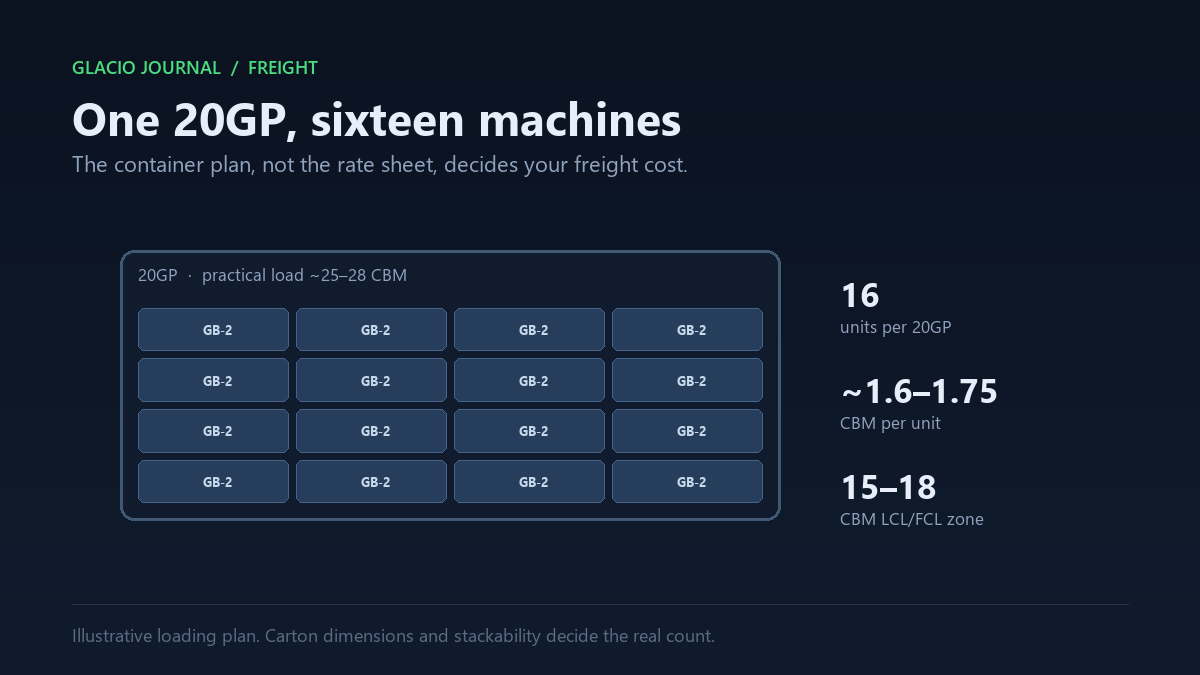
Gross weight. Machines are dense. A 20GP is a heavy-cargo container: roughly 33 CBM of internal space but a practical load of about 25–28 CBM, with a payload around 28 tonnes. You will usually hit volume or loading logic before you hit the weight limit — but you must check both, because road limits at destination can bite before the container does.
The Incoterm. FOB, CIF, DAP, DDP — the three-letter term decides where the seller’s cost and risk end. Two suppliers quoting “the same” machine on different Incoterms cannot be compared line by line until you convert both to a landed cost.
What actually fits: container math for machines
Published container dimensions are planning references. The numbers that matter are internal volume, practical loading volume, and payload.
| Container | Theoretical CBM | Practical load | Payload (approx.) | Good for |
|---|---|---|---|---|
| 20GP | ~33 | 25–28 CBM | ~28,000 kg | Heavy, dense cargo; smaller full-container orders |
| 40GP | ~67 | 55–58 CBM | ~26,000–27,000 kg | Medium volume, general cargo |
| 40HQ | ~76 | 62–68 CBM | ~26,000–28,000 kg | Light, bulky cargo; taller cartons |
For GLACIO’s GB-2 two-bowl batch freezer, a 20GP carries 16 units. Do the division and each unit occupies roughly 1.6–1.75 CBM of the container — which tells you more about the freight than any rate sheet: the container is volume-limited by the cartons, and the loading plan (how the cartons are arranged, whether they can be stacked) decides whether you get 14 or 16 in.
Two practical notes. First, door opening is smaller than internal height; a tall carton can fit inside the container on paper and fail at the door. Second, palletising costs you volume: a 20GP fits roughly 10 standard pallets, and pallet height that cannot be stacked wastes the space above it.
LCL vs FCL: where the break-even really is
LCL means your cargo shares a container. It is priced per CBM plus origin and destination charges per shipment. FCL means you book the whole box; you pay for the container, not the cubic metres.
Industry guidance puts the LCL/FCL comparison zone around 15–18 CBM: below that, LCL is often cheaper at origin; above it, FCL usually wins once destination charges are counted. For machines, the decision is sharper than the CBM suggests, for three reasons:
- Handling risk. LCL cargo is loaded and unloaded more times. A machine with a glass display lid and a refrigerant circuit prefers fewer touches.
- Destination charges. LCL attracts CFS fees, destination handling and documentation per shipment — costs that do not scale with volume the way the ocean rate does.
- Timing. LCL waits for consolidation and for the container to fill. FCL sails on the booked vessel.
The practical rule: one to three machines usually go LCL; a full 20GP of 16 units is almost always FCL. Between those, compare total logistics — not the ocean freight line.
Incoterms: buy FOB, but understand what it leaves you
GLACIO quotes FOB Shanghai or Ningbo, and accepts LCL with nominated forwarders. FOB means the seller delivers the goods on board the vessel at the origin port; risk passes there, and the buyer arranges and pays the main carriage, insurance, destination charges and import formalities.
That is a clean split for an experienced importer, and it is why factory-direct quotes usually land on FOB. Two details are worth knowing before you sign:
- FOB was written for bulk cargo, not containers. With containers you hand the box to the terminal days before loading. The ICC’s own guidance prefers FCA for containerised goods because risk transfers at handover to the carrier. Many buyers still use FOB out of habit; if your contract uses FOB, understand that there is a small risk window at origin before the vessel is loaded.
- FOB is not a landed cost. Under FOB you still owe destination terminal handling, customs clearance, duty, VAT and delivery. A quote comparison that stops at FOB compares only the first half of the journey.
The other terms you will see: CIF adds cost and freight plus minimum insurance to the destination port (the seller insures, but only at minimum cover, and risk still passes at origin); DAP delivers to your door but leaves import clearance and duties to you; DDP puts everything on the seller, including duties, which is convenient but usually carries a margin for the risk the seller is taking in your country.
Landed cost, line by line
Landed cost is the only number that lets you compare a factory quote against a local dealer. The components, in the order they hit your invoice:
| Line | What it is | Usually paid by |
|---|---|---|
| FOB price | Machine + export packing + inland transport to port + export clearance | Buyer, to seller |
| Origin charges | Terminal handling at origin, documentation, export filing | Buyer, to forwarder |
| Ocean freight | Container or LCL space to destination port | Buyer |
| Cargo insurance | Typically a small percentage of CIF value; covers the sea leg | Buyer (unless CIF) |
| Import duty | Depends on HS code and destination country — confirm the rate, do not assume | Buyer |
| VAT / GST | Charged on CIF + duty; usually recoverable if you are registered | Buyer (cash flow) |
| Customs clearance | Broker fee, entry filing, inspection if selected | Buyer |
| Destination handling | Terminal handling, CFS fees for LCL, documentation | Buyer |
| Delivery | Trucking from port to your door, unloading | Buyer |
| Contingency | Demurrage, storage, re-inspection, address changes | Buyer |
Freight rates move weekly; duty rates depend on your HS code and country. So do not anchor on any single number — anchor on the structure. Get each line quoted separately, then add them.
A worked example (illustrative rates)
Four GB-2 units, FOB Shanghai, going to a European port. The rates below are illustrative — replace them with your forwarder’s quote:
- FOB price: 4 × US$3,800 = $15,200
- Origin charges: $450
- Ocean freight (20GP, part-loaded): $2,400
- Insurance at 0.4% of FOB + freight: $70
- Duty at an example 2.5% of CIF: $442
- Customs clearance: $180
- Destination terminal handling: $260
- Delivery to the shop: $320
Landed cost excluding recoverable VAT: $19,322, or about $4,831 per unit — roughly 27% above FOB. If you are VAT-registered, the VAT is a cash-flow item, not a cost, but you still pay it at import and reclaim it later.
Now look at what the freight portion actually is: about $3,310 of the $4,122 added above FOB, or roughly 18% of the FOB price. That is the number to negotiate — and the reason a factory that quotes 16 units per 20GP is giving you a better landed cost than one that quotes 12 units in the same box.
The charges buyers forget
- Demurrage and detention. Free time at destination is limited. If your customs paperwork is incomplete, the container sits and the meter runs — often more per day than the freight itself.
- Inspection. Customs may inspect; the cost and the delay land on you.
- LCL destination fees. CFS handling, documentation and warehouse charges are per shipment, not per CBM, and they are where LCL quotes surprise people.
- Last-mile access. A tail-lift or forklift may be needed; not every delivery address can take a 20GP.
- Voltage and compliance work. If the machine arrives as 380V three-phase and your site is 220V single-phase, the installation cost is real — check the voltage and phase guide before you book.
How to compare two quotes fairly
Ask every supplier for the same eight data points, then compare only landed cost:
- Packed carton dimensions and total CBM per unit, and units per 20GP / 40HQ
- Gross weight per unit
- Incoterm and named port (FOB Shanghai/Ningbo, CIF destination port, DAP/DDP address)
- HS code the supplier uses on the commercial invoice
- What is included in the FOB price (export packing, inland haulage, export clearance)
- Warranty and spare-parts dispatch terms after arrival
- Document set provided (invoice, packing list, B/L, certificate of origin, conformity documents)
- Lead time from deposit to port
The paperwork side deserves its own checklist — the shipping and import documents guide covers the set, and the customs data guide explains what trade records can and cannot tell you about a machine’s origin and value. For a destination-specific view, the UK buying guide walks through voltage, import costs and the buying checklist for that market.
FAQ
How many ice cream machines fit in a 20GP?
It depends on the model’s packed carton. For GLACIO’s GB-2, a 20GP carries 16 units. Always confirm from the packing list: the same container can lose units if the cartons cannot be stacked or are palletised.
Is LCL cheaper for one machine?
Usually yes, at the ocean-freight line. Whether it is cheaper overall depends on destination CFS fees, handling and timing. Get both quotes to your door, not to the port, before deciding.
Should I buy FOB or CIF?
FOB gives you control of the freight and insurance and usually costs less if you have a forwarder. CIF is simpler but includes only minimum insurance cover and hides a freight margin in the price. For containers, also consider FCA, which the ICC recommends for containerised cargo.
How long does shipping take from China?
Ocean transit varies by route and season — typically weeks, not days, port to port, plus customs and inland delivery. Ask your forwarder for the port-to-port transit time and the free-time window together, because the second number decides whether you pay demurrage.
What can make a shipment cheaper?
Loading more units per container, booking FCL once you exceed roughly 15–18 CBM, shipping outside peak season, providing complete paperwork so the container clears without storage, and choosing a model whose carton is designed for the container rather than one that wastes space.
If you want the container math run against your actual order, tell us the model, destination port and address — an export engineer replies within 24 hours with units per 20GP, a loading plan and an FOB quote. Request a shipping and machine quote.
Sources: SeaFreightGo container dimensions guide (20GP/40GP/40HQ practical CBM, payload, LCL/FCL comparison zone); OVRSEA Incoterms 2020 guide (cost and risk allocation, FCA recommendation for containerised cargo, CIF/CIP insurance levels, DAP vs DDP); GLACIO factory data (16 units of GB-2 per 20GP, FOB Shanghai/Ningbo, LCL acceptance). Rate examples are illustrative — confirm with your forwarder.
Some information may be outdated
Comments
Questions about equipment capacity, voltage, or recipes? Leave a comment.
Loading comments...