

Ice Cream Machine Shipping: Import Documents Buyer Checklist
Short answer: Successful ice cream machine shipping depends on a document set that matches the machine, the sale terms, and the customs entry: commercial invoice, packing list, bill of lading or air waybill, certificate of origin when required, insurance certificate when applicable, and any electrical or food-contact declarations the destination asks for. Before pickup, confirm the HS code, Incoterm, pallet dimensions, gross weight, consignee identity, and who will clear customs, because a mismatch in any one of those details can trigger an inspection hold and port storage fees.
Most buyers spend weeks comparing bowls and cycle times, then treat freight as an afterthought. GLACIO GB-Series machines cover one to six 6-liter bowls, with typical 15-20 minute cycles and roughly 14 liters per hour per bowl, so the purchase is already a production decision. A GB-1 weighs about 96 kg; a GB-6 weighs about 330 kg. At that size, the freight file stops being paperwork and starts being part of the machine’s protection plan.
This guide is for bakery owners, cafe and bubble tea operators, gelato shop founders, and home bakers who are about to import a hard ice cream or gelato batch freezer. You do not need to become a customs broker. You do need to give your forwarder complete facts, check the documents before the container leaves, and know which charges land on your side of the Incoterm.
The cost of getting it wrong rarely appears as one big invoice. It shows up as a revised bill of lading, a customs exam, a transfer to a warehouse, detention on a container, or a crate that cannot be lifted safely. Each delay pushes installation later and can turn a planned opening menu into a scramble.
What documents must be ready before ice cream machine shipping begins?
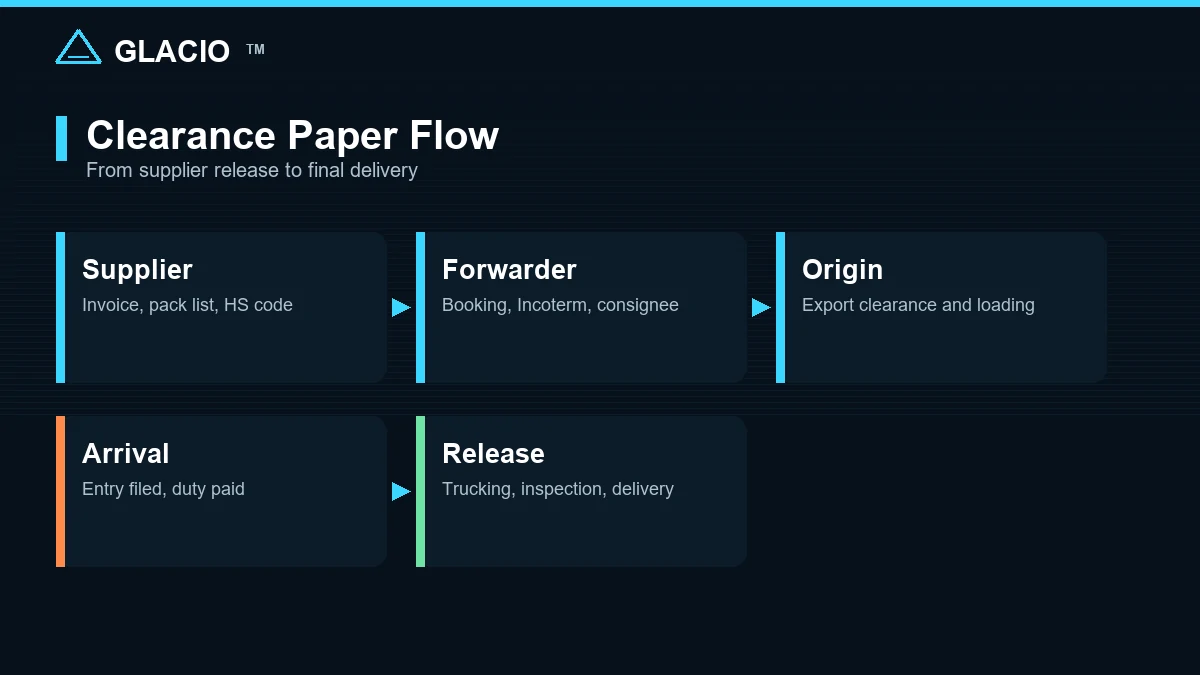
Good gelato machine customs documents share one quality: the same facts appear in the same form across every file. The invoice, packing list, transport document, and customs entry must agree on model, quantity, value, origin, weights, package count, buyer, and seller. If one document says two machines and another says one machine plus spare parts, expect questions.
| Document | What it must show | Check before pickup |
|---|---|---|
| Commercial invoice | Seller and buyer legal names, invoice number, currency, Incoterm, full machine description, model, HS code, unit value, origin, and reason for export | Confirm model, serial plan, price, and currency match the purchase order and payment record. |
| Packing list | Package count, package type, dimensions, net weight, gross weight, pallet or crate marks, and machine serial numbers | Do not use the machine weight as the gross shipping weight, because the skid, bracing, and crate add more. |
| Bill of lading or air waybill | Shipper, consignee, notify party, port or airport pair, package count, cargo description, freight terms, and release instructions | Correct the draft before the carrier issues it; later amendments cause delay and extra charges. |
| Certificate of origin | Producing country and the exact exporter or manufacturer details required by the destination program | Order it only when the tariff treatment or import rule needs it. An unused certificate is money spent twice. |
| Insurance and compliance file | Cargo policy or certificate, declaration of conformity, electrical information, and food-contact declarations where required | Match voltage, phase, plug, model, and serial to the invoice. Do not send a generic certificate for every model. |
| Clearance authority package | Importer tax or registration number, broker power of attorney, arrival notice, cargo release, and any permit or license | Give the broker authority before departure, not after the vessel arrives. |
If you import commercial ice cream machines regularly, keep a master data sheet for every model. It should hold the correct description, HS classification, net and gross weights, crate dimensions, electrical data, and spare-parts description. Your customs broker can review the classification, but the supplier should provide technical literature that supports it. You can compare how classifications appear in real trade records in this guide to commercial ice cream machine customs data.
- Use the legal importer name, not a trading name or a personal nickname.
- Put the destination country and delivery place in full, including the postal code.
- Describe the machine as a hard ice cream or gelato batch freezer, not as machine parts or a sample.
- List accessories and spare parts separately when their value affects duty or customs review.
How should you brief a freight forwarder?
A forwarder cannot quote accurately from “one ice cream machine.” Give a complete handoff in writing, then ask for a written quote with charge names and assumptions. A useful first email contains the following facts.
- The Incoterm and the exact named place, such as FOB Shanghai or DAP Chicago warehouse.
- The supplier pickup address, contact person, ready date, and loading hours.
- Package count, package type, gross weight, dimensions, and whether each unit is crate-mounted.
- Machine model, quantity, serial numbers if known, and a commercial description with HS code.
- Declared value, currency, and whether spare parts ship in the same crate.
- Importer legal name, tax or registration number, consignee, and broker details.
- Destination address and access limits, including forklift, liftgate, dock, appointment, or narrow-door constraints.
- Delivery deadline, insurance requirement, and who must approve charges if the carrier adds fees.
Ask the forwarder to separate origin charges, main freight, destination charges, customs brokerage, duty, delivery, and any detention or demurrage exposure. If a quote says only “port to port,” confirm who handles export clearance, terminal charges, arrival notice, and final trucking. That single question prevents many disputes after the cargo is already moving.
LCL or FCL: Which fits your batch freezer freight shipping?
LCL means your pallet shares a container with other cargo. FCL means you control the whole container. For batch freezer freight shipping, the right choice depends less on the machine alone and more on total order size, handling tolerance, timing, and destination charges.
| Factor | LCL | FCL |
|---|---|---|
| Order profile | A single GB-1 at about 96 kg or GB-2 at about 140 kg may suit LCL when the crate is strong. | A GB-4 at about 230 kg, a GB-6 at about 330 kg, or several machines often justify FCL when combined with other equipment. |
| Handling | Cargo is consolidated and deconsolidated, so it passes through more terminals and more forklift movements. | The container stays sealed from loading to arrival, which reduces handling exposure. |
| Cost structure | You pay for billable volume or weight plus destination container freight station charges. | You pay for the container and drayage, which can be efficient when the load fills or nearly fills the box. |
| Transit control | Departure can wait for consolidation, and release can wait for other cargo in the group. | The schedule follows one container, but you still face terminal free time and delivery deadlines. |
| Risk | More touches increase damage risk, especially for trim, panels, and long control assemblies. | Fewer touches reduce handling risk, while missed pickup can create demurrage. |
- Choose LCL for one well-crated GB-1 or GB-2 if the landed cost and schedule make sense.
- Ask for both LCL and FCL quotes once the order includes a GB-4, a GB-6, or multiple pieces.
- Price the destination fees, not just ocean freight. LCL often looks cheap until terminal and delivery charges appear.
- Compare the all-in landed cost before choosing. The lower freight line is not always the lower total.
If you are still deciding between one bowl and six, start with daily sales and peak-hour demand rather than freight. This batch freezer sizing guide helps you match capacity to the menu you can actually sell.
What does the machine need on the pallet or in the crate?
An ice cream machine is heavy, top-heavy in some configurations, and sensitive to impact. The crate must protect the frame, control panel, bowl area, refrigeration lines, and exterior finish. A pallet under the machine is not enough if the machine can slide, rotate, or settle during handling.
Minimum packing standard
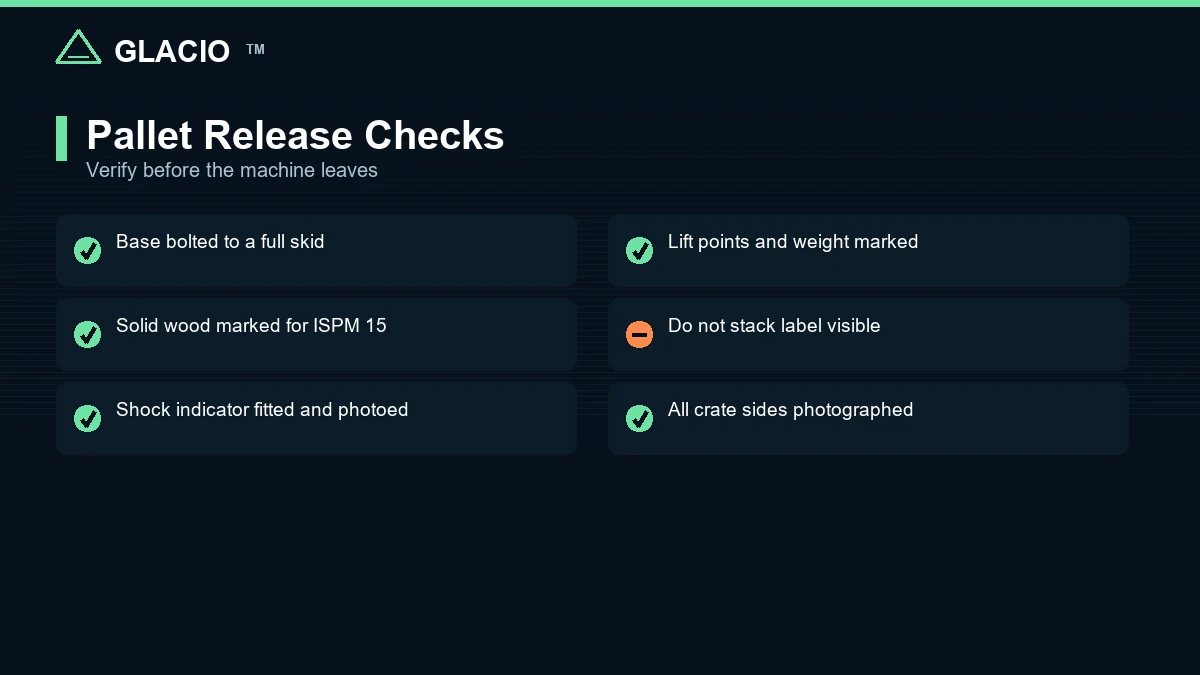
- Base support: Use a full-length skid or plywood base that supports the machine footprint, with lag bolts through approved base points where the factory permits.
- Machine protection: Use protective film, foam or board at contact points, and edge protection on panels and corners.
- Moisture control: Seal the machine from damp air and include desiccant when the route involves humidity or long storage.
- Impact monitoring: Use a shock or tilt indicator when the route includes multiple transfers, and photograph the indicator before loading.
- Wood treatment: Solid wood packaging must meet ISPM 15 treatment and marking rules in most international shipments. Engineered wood may be exempt, but confirm destination rules.
- Handling and labeling: Mark lift points, center of gravity, gross weight, model, serial number, destination, and “do not stack” where stacking is unsafe.
Do not let anyone strap across the control panel or lift the machine by a decorative panel. A 330 kg GB-6 is not a parcel, and an LCL terminal will move it with equipment that does not know where the internal components sit. Put lifting instructions on the crate and send them to the forwarder before pickup.
Take photos of all four sides, the top, the base, the strapping, and the container seal before the machine leaves. If the crate arrives with a shifted pallet, crushed corner, torn film, or moisture stain, the photos become evidence instead of an argument. Keep the packing list accessible because the driver or broker may need the package marks and gross weights.
Who pays which charge under common Incoterms?
An Incoterm divides tasks, costs, and risk at a named place. It does not set the price, transfer ownership, or replace the sales contract. The named place matters: DAP to a port is very different from DAP to your shop door with a liftgate appointment.
| Term | Seller typically pays | Buyer typically pays | Risk transfer |
|---|---|---|---|
| EXW | Makes the goods available at the seller’s premises | Loading, export clearance, freight, insurance, import clearance, duty, and delivery | When goods are available at the named place |
| FOB | Export clearance and delivery on board the vessel at the named origin port | Main freight, insurance, destination charges, import clearance, duty, and final delivery | When cargo is on board the vessel |
| CIF | Export clearance, ocean freight, and minimum cargo insurance to the destination port | Import clearance, duty, destination port charges, delivery, and any insurance above the minimum | When cargo is on board the vessel, despite the seller paying freight |
| DAP | Freight to the named destination and delivery ready for unloading | Import clearance, duty, taxes, and unloading unless the contract says otherwise | When goods arrive ready for unloading at the named place |
| DDP | Export clearance, freight, import clearance, duty, and delivery to the named place | Unloading unless included. The seller still needs a legal route to act as importer of record. | When goods arrive ready for unloading at the named place |
For a first import, FOB or CIF gives you more control over insurance and destination costs. EXW is usually a poor first choice because you also inherit loading and export clearance at the origin. DDP looks simple, but it can be expensive or impossible when the seller cannot be the importer of record in your country.
- Ask whether the quote includes origin pickup, export documents, terminal handling, ocean or air freight, arrival notice, brokerage, duty, delivery, and detention.
- Confirm who pays for a customs exam if the broker or authority orders one.
- Confirm who arranges cargo insurance and whether cover is all-risk or a narrower minimum.
- Put the named place, unloading method, and appointment rules in writing.
How do you prevent port storage and demurrage fees?
Port fees begin when the cargo or container passes the carrier’s free time. Free time is not a safety net you can rely on, because carriers, terminals, and ports set different rules. The way to avoid the fee is to prepare the entry before arrival and to have a trucking plan ready before release.
- Demurrage is generally a charge for a container or cargo staying at the terminal beyond free time.
- Detention is generally a charge for keeping the container outside the terminal beyond the allowed period.
- Storage is a charge for uncollected cargo or warehouse space, and it can apply even when demurrage does not.
Late documents are the usual trigger. If the certificate of origin, corrected invoice, insurance certificate, or importer authorization arrives after the broker files the entry, release can wait while the container sits. If the consignee name on the bill of lading does not match the importer registration, the broker may need a correction before anyone can release the goods.
- Before booking, name the importer of record, customs broker, and person authorized to pay duty.
- Before pickup, collect the invoice, packing list, HS code, model data, and gross weights.
- Before loading, confirm the Incoterm, consignee, notify party, delivery address, and insurance.
- When the bill of lading draft appears, correct it immediately and keep the final copy accessible.
- Before arrival, have the broker file the entry, confirm funds, and prepare any permit or inspection response.
- Before release, book trucking, confirm equipment, and tell the driver about loading-dock or liftgate limits.
Keep one shared folder with the final invoice, packing list, transport document, origin certificate, insurance certificate, broker instructions, arrival notice, entry summary, release, and delivery receipt. When someone asks for a document at 4 p.m. on Friday, the answer should be a link, not a search through email.
What should you check after clearance and before installation?
Do not treat delivery as the finish line. Inspect the crate and machine before the driver leaves, and note exceptions on the delivery receipt. Photograph the seal, crate, pallet, panels, and serial plate. If the crate is crushed or the machine has shifted, do not simply sign a clean receipt because unloading is inconvenient.
- Match model and serial number to the invoice, packing list, and warranty record.
- Check for dents, cracked panels, oil stains, moisture, loose wires, and damaged refrigeration lines.
- Keep the machine upright and protected until installation, following the supplier’s orientation and storage instructions.
- Do not energize a machine with visible transit damage. Ask the supplier or a qualified technician for direction.
- File any shortage or damage claim promptly with the forwarder, broker, and insurer, using the photos and signed delivery note.
Installation planning should include voltage, phase, breaker size, drainage, ventilation, and clearance for service. Use the machine’s nameplate and your electrician’s measurements rather than a guess. The commercial ice cream machine installation checklist covers those site checks, while this guide to warranty and spare parts helps you confirm what the freight file must preserve.
Frequently asked questions
What documents do I need to import a commercial ice cream machine?
You normally need a commercial invoice, packing list, bill of lading or air waybill, and broker authorization. Depending on the destination and tariff treatment, you may also need a certificate of origin, insurance certificate, declaration of conformity, food-contact declaration, import permit, or electrical compliance evidence. The importer registration and tax number must match the consignee on the transport document.
Is LCL safe for a batch freezer freight shipping order?
LCL can be safe when the machine is lag-bolted to a strong skid, fully crated, and protected from impact. The trade-off is more terminal handling, a longer release process, and destination container freight station charges. A GB-1 at about 96 kg or GB-2 at about 140 kg may suit LCL, while a GB-6 at about 330 kg or a multi-machine order deserves an FCL comparison.
Does my machine need a fumigation certificate?
Solid wood packaging normally must meet ISPM 15 treatment and carry the required mark. This is a treatment standard for the wood packaging, not a general requirement to fumigate the machine itself. Plywood and engineered wood may be exempt in many destinations, but confirm the rule for your route before the crate is built.
Who pays customs duty under CIF or DAP?
Under CIF, the buyer normally pays import clearance, duty, destination port charges, and delivery beyond the port. Under DAP, the seller pays freight to the named destination, while the buyer normally pays import clearance, duty, and taxes. DDP shifts import clearance and duty to the seller, but only when the seller can legally act as importer of record.
Can I use the supplier’s HS code without checking it?
Use it as a starting point, not as the final classification. Customs classification depends on the machine’s function, construction, and destination tariff schedule, and the importer is responsible for the entry. Give your broker the model specification, technical brochure, and invoice description so the code can be reviewed before departure.
What should I do if the machine arrives damaged?
Photograph the damage before moving the machine, note it on the delivery receipt, and notify the forwarder, broker, and insurer promptly. Keep the crate, packing materials, labels, and impact indicator because they support the claim. Do not energize the machine or discard packaging until the carrier and insurer have responded.
Match the machine to the paperwork before you pay the balance
The practical recommendation is simple: choose LCL or FCL only after you have real crate dimensions, gross weights, destination charges, and a delivery address. Then lock the Incoterm, consignee, HS code, document checklist, and broker contact before the machine leaves the factory. For a GB-1 or GB-2, that may mean a tightly managed LCL shipment; for a GB-4, GB-6, or multi-machine order, it usually means comparing FCL against the full landed cost.
Send GLACIO your destination, order size, delivery address, and preferred Incoterm. We can help you match the GB-Series model to your production plan and prepare the machine data your forwarder needs. Request a machine recommendation and quote.
Which document has caused the longest delay in one of your imports, and what would you check earlier next time?
Tell us the shop. We size the machine and price it.
Two numbers decide the model: how much you sell on a busy day, and how much you need in your busiest hour. Send those with your voltage and you get a model recommendation and an FOB quote within 24 hours.
- ✓ Sized to your peak hour
- ✓ FOB quote and lead time
- ✓ No obligation
Some information may be outdated
Comments
Questions about equipment capacity, voltage, or recipes? Leave a comment.
Loading comments...