

Commercial Ice Cream Maker: Types, Output and What to Pay
Short answer: “commercial ice cream maker” is a search phrase, not a machine category. Four different machines answer to it: a batch freezer that makes hard ice cream and gelato one bowl at a time, a display batch freezer that makes and sells from the same footprint, a soft serve machine that serves two flavors from a spout, and a continuous freezer for factories. If you sell scoops, cones, cups or tubs, you want a batch freezer, usually with 2 to 4 six-liter bowls, and expect to pay $2,500 to $12,000 for a new machine before freight and duty.
Buying the wrong one of those four is the most expensive mistake in this category. A cafe that buys a soft serve machine to sell gelato ends up with the wrong texture and no way to show flavors. A shop that buys a single-bowl countertop maker for a 400-scoop Saturday spends the afternoon cleaning bowls instead of serving customers.
This guide is for small business buyers: cafe, bakery and bubble tea owners, gelato shop founders, food truck operators and small producers. It assumes you want to sell ice cream, not to win an argument about terminology. If you already know you are buying a batch freezer and want the deeper specification walkthrough, read the commercial ice cream machine buying guide next.
Which machine does the buyer actually mean?
| Machine | What it makes | How it serves | Typical buyer |
|---|---|---|---|
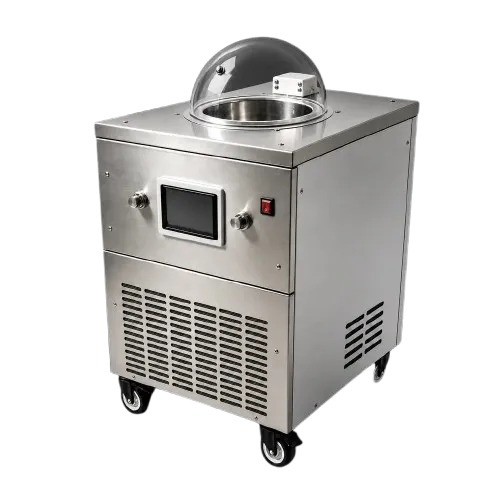
| Batch freezer | Hard ice cream, gelato, sorbet, frozen custard | Draw into pans or tubs, serve by the scoop | Cafes, bakeries, scoop shops, small producers |
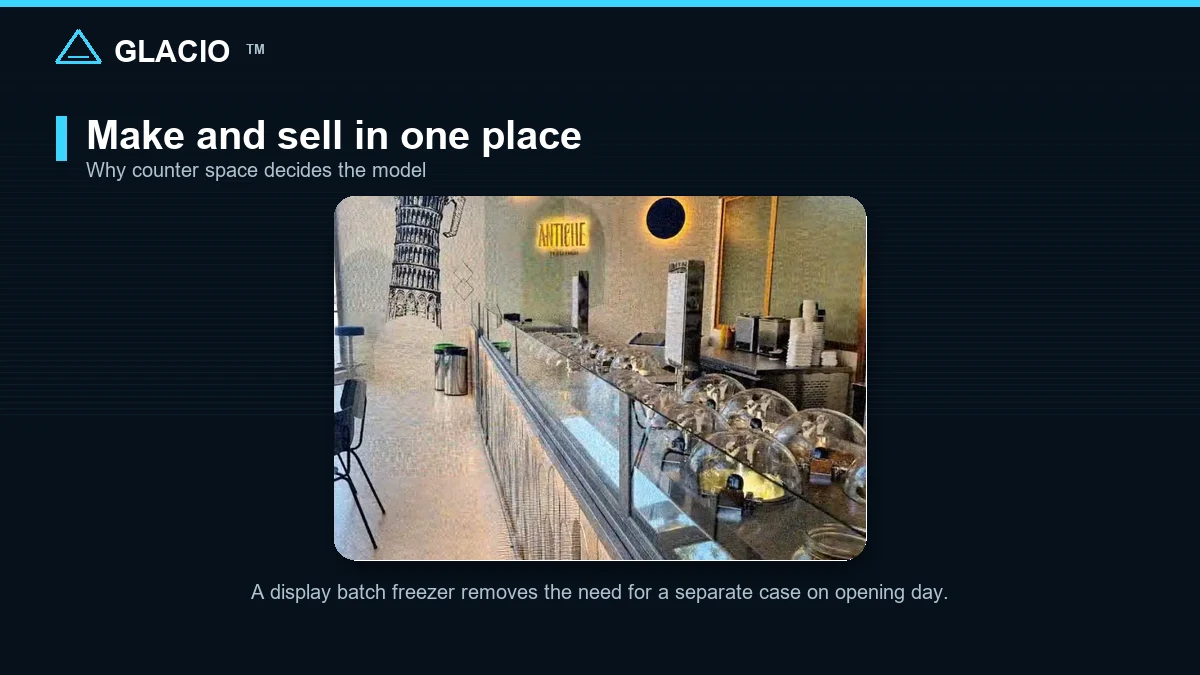
| Display batch freezer | Same products, made in front of customers | Served directly from the freezing bowls behind domes | Bubble tea shops, dessert bars, bakery counters, food halls |
| Soft serve machine | Soft serve at around -6 C | Pulled from a spout into cones and cups | Quick service counters, kiosks, events |
| Continuous freezer | Large volumes of one flavor | Product flows to a filling or packing line | Factories, private label, wholesale production |
Notice that three of the four make something you scoop, and only one makes soft serve. The texture and the service model are different products, not different settings on the same machine.
Match the maker to the business
| Business | Recommended setup | Why |
|---|---|---|
| Cafe or bakery | 2 bowls, 6 L, countertop | Two flavors cover the dessert menu without taking a second counter. |
| Bubble tea or dessert bar | 2 to 4 bowls with display domes | Product must be seen to sell, and space is measured in centimeters. |
| Gelato shop | 4 to 6 bowls plus a display case | Six or more flavors must be visible for several hours of service. |
| Food truck or pop-up | 1 to 2 bowls, single phase | Power and weight limits dominate the decision. |
| Small producer or wholesale | 6 bowls or a continuous freezer | Volume per hour and consistent batches matter more than counter appeal. |
Output math before you compare prices
Two numbers decide whether a machine can carry your sales: how much a bowl produces, and how many bowls you can run through an hour.
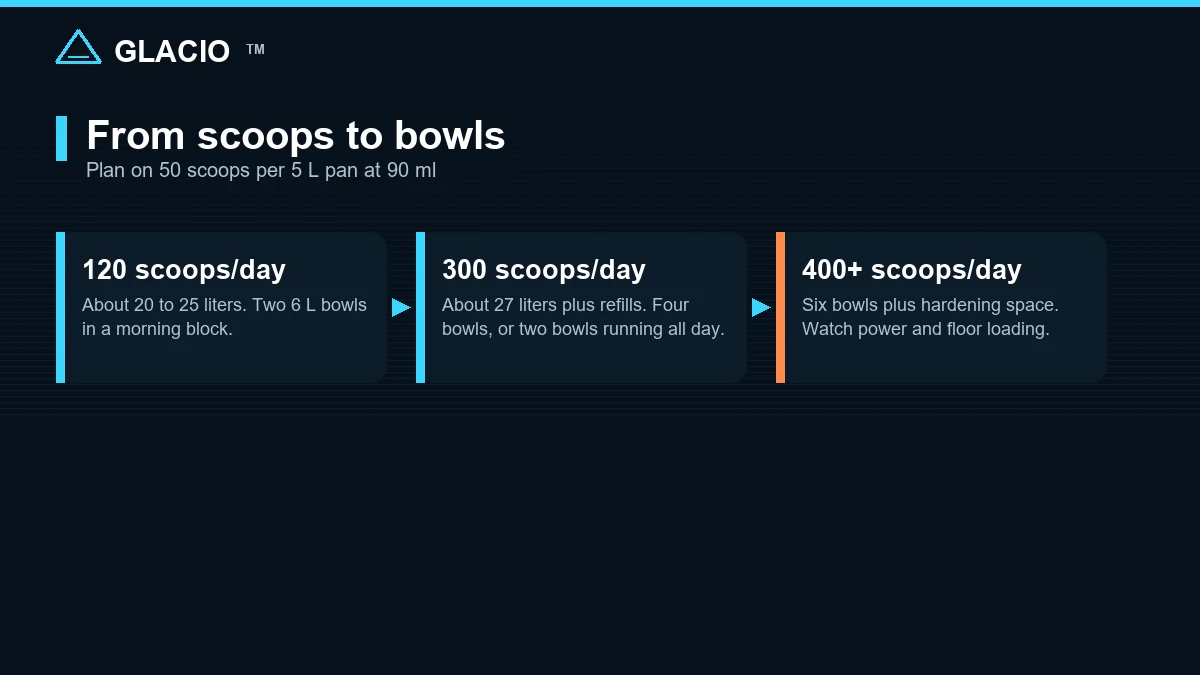
- A 6-liter bowl yields about 7.8 liters at 30 percent overrun (gelato) and about 9 liters at 50 percent overrun (hard ice cream).
- A cycle runs 15 to 20 minutes, plus 3 to 5 minutes to draw and reload.
- That works out at 2.5 to 3 finished batches per bowl per hour, or roughly 14 to 18 liters per bowl per hour of active production.
- One 5-liter pan holds about 50 scoops at 90 ml, so 300 scoops a day is roughly 27 liters of product.
Worked example: a bakery sells 120 scoops a day across 4 flavors. That is 20 to 25 liters depending on scoop size, comfortably inside a 2-bowl machine with a morning production block. The same machine in a gelato shop selling 400 scoops across 12 flavors will run all afternoon and still be short on freezer space, which is the signal to move to 4 or 6 bowls.
What makes a maker “commercial”
Home machines and commercial machines are separated by five practical differences, none of which is the price tag alone.
| Difference | Home machine | Commercial maker |
|---|---|---|
| Duty cycle | One or two batches, then rest | Runs all day with short recovery between batches |
| Compressor | Small, sealed, low tolerance for heat | Sized for ambient heat and continuous load |
| Materials | Mixed plastics and coatings | Food-grade stainless contact surfaces, removable seals |
| Service | Replace the appliance | Spare blades, seals, dashers and boards available |
| Power | Standard wall socket | Dedicated circuit, often three phase above 4 bowls |
This is also why a “commercial” maker that costs $400 should worry you. If it cannot run three batches back to back in a 30 C room, it will not survive a shop.
Hard serve or soft serve
The single biggest fork in the road. Hard ice cream and gelato are made in batches, hardened, then scooped. Soft serve is frozen at the point of sale and pulled from a spout.
- Choose hard serve if you want a flavor range, the ability to display product, takeaway tubs, and a menu that changes with the seasons.
- Choose soft serve if speed per customer matters more than range, and you are happy with two flavors plus a twist.
The day-to-day differences, including staffing and cleaning load, are covered in hard ice cream machine versus soft serve machine.
What a commercial ice cream maker costs
Bands below are new-equipment quotes seen in 2026, before freight, duty, VAT and installation. Factory-direct pricing sits at the lower end.
| Configuration | Typical price band (USD) | Daily output |
|---|---|---|
| 1 bowl, 6 L | $1,200 – $3,000 | 15 to 25 L |
| 2 bowls, 6 L | $2,500 – $6,000 | 30 to 50 L |
| 4 bowls, 6 L | $5,000 – $12,000 | 60 to 100 L |
| 6 bowls, 6 L | $8,000 – $18,000 | 90 to 150 L |
| Soft serve, 2 flavors + twist | $4,000 – $15,000 | Depends on throughput per hour, not liters |
Add the pieces that make the machine useful rather than just present: a blast freezer or hardening space, pans and lids, a display case if you are showing more flavors than the machine holds, and the electrical work. Those extras often total 30 to 60 percent of the machine price, and leaving them out of the budget is how opening day slips.
Running costs people forget
- Electricity. A 2-bowl machine on a production block plus a display case can add 500 to 900 kWh a month in a small shop. Insulation and door discipline matter as much as the label.
- Mix waste. Every recipe change costs product. A shop running five new flavors a week wastes more than one running a stable menu.
- Staff time. Production, cleaning and pan rotation are labor. A machine that cleans in 10 minutes instead of 30 pays back in wages.
- Hardening space. Freezer capacity is a capital cost that shows up on the electricity bill twice.
If you want to see how these numbers turn into a payback period, the commercial ice cream machine ROI guide works through contribution margin and break-even volumes.
Checklist before you buy
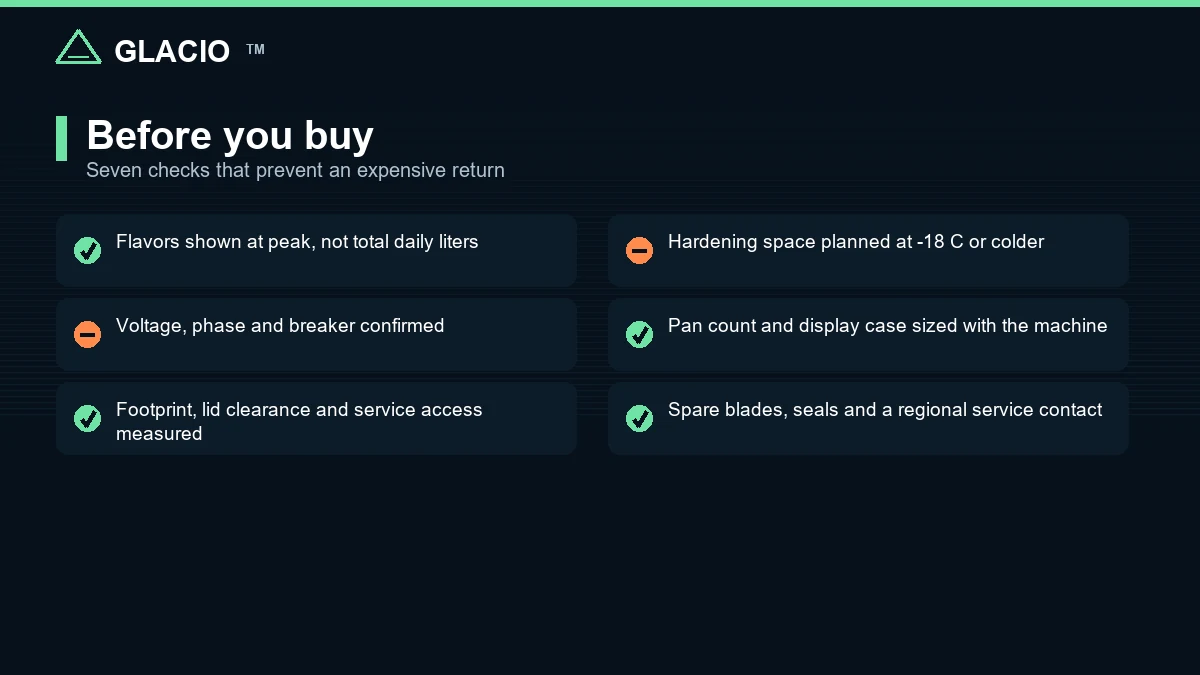
- Menu fixed. How many flavors at once, how many scoops at peak, and whether you sell tubs.
- Power confirmed. Voltage, phase, breaker size and the route for a new cable. See commercial ice cream machine power requirements.
- Space measured. Machine footprint, lid clearance, service access and the door it has to pass through.
- Hardening planned. Where the product goes after the draw, and at what temperature.
- Display planned. Pan count and case size, if you need one.
- Spares available. Blades, seals and a service contact in your region.
- Ambient reality. The temperature your shop reaches in the hottest month, not the average.
Five buying mistakes
- Treating “maker” and “machine” as different products. They are search terms for the same equipment.
- Buying soft serve when the menu is scooped. The texture and the service model will not match.
- Sizing on price per liter. The cheapest machine per liter is often the one that cannot hold temperature at 4 pm.
- Forgetting the hardening step. Budget for the freezer before you commit to the maker.
- Ignoring service. A machine with no local spare parts is a machine with a countdown on it.
Frequently asked questions
Is a commercial ice cream maker the same as a commercial ice cream machine?
Yes. Both phrases describe the same category of equipment, and most suppliers use them interchangeably. The useful distinction is not maker versus machine, it is batch freezer versus display batch freezer versus soft serve machine versus continuous freezer.
What is the best commercial ice cream maker for a small business?
For most cafes, bakeries and dessert bars, a two-bowl 6-liter countertop batch freezer is the practical starting point: it handles 30 to 50 liters a day, usually runs on single phase power, and fits an existing counter. Shops selling more than 6 flavors at once should price 4 or 6 bowl machines instead.
How much does a commercial ice cream maker cost?
New prices in 2026 typically run from $1,200 to $3,000 for a single-bowl countertop machine, $2,500 to $6,000 for two bowls, and $5,000 to $12,000 for four bowls. Budget another 30 to 60 percent of the machine price for hardening space, pans, display and electrical work.
Can one machine make gelato and hard ice cream?
Yes, when it is a batch freezer. You change the mix, the overrun target and the draw temperature rather than the machine. Gelato usually runs 25 to 35 percent overrun and is served around -12 C to -14 C; hard ice cream runs 50 percent or more and is served near -16 C to -18 C.
How much space does a commercial ice cream maker need?
Plan for the machine footprint plus 10 to 15 cm of rear and top clearance for airflow, and enough counter space to load mix and draw product safely. A two-bowl countertop unit typically needs about 0.6 to 0.9 m of counter width, while a six-bowl floor-standing machine needs its own footprint and service access.
Tell us how you sell
Send us your busiest-day scoop count, the number of flavors you want on display, your available power and the counter length you have. We will come back with a bowl count and a configuration that matches the way you actually serve, not the biggest machine in the catalogue.
Tell us the shop. We size the machine and price it.
Two numbers decide the model: how much you sell on a busy day, and how much you need in your busiest hour. Send those with your voltage and you get a model recommendation and an FOB quote within 24 hours.
- ✓ Sized to your peak hour
- ✓ FOB quote and lead time
- ✓ No obligation
Some information may be outdated
Comments
Questions about equipment capacity, voltage, or recipes? Leave a comment.
Loading comments...