

Gelato Display Case Buying Guide: Size, Temperature, Cost
Short answer: a gelato display case holds finished gelato at serving temperature so customers can see it and staff can scoop it. Match the case to the number of flavors you must show at once, not to your total daily liters. For most cafes and small gelato shops that means a 1.2 m to 1.5 m case holding 6 to 10 five-liter pans, set to about -12 C to -14 C, with double-glazed glass and a door that opens on the staff side. Expect roughly $1,400 to $4,500 for a new case of that size before freight, duty and tax. A case is not a freezer: it displays what you already froze, and it cannot rescue a batch that was drawn soft or stored badly.
The mistake I see most often is buying the case last. A shop spends weeks choosing a batch freezer, then grabs whatever display is on promotion, and discovers in July that the glass fogs every afternoon, the pans do not fit, or the compressor never rests in a 30 C room. The case sits in front of customers all day, so it sets both your menu size and your electricity bill.
This guide is for cafe owners, bakery operators, gelato shop founders and small producers buying a display case for the first time. Every number below is a working range, not a promise about a specific model, and you should confirm final figures with the supplier quote.
What a gelato display case actually is
Four pieces of equipment get called a display case in the same conversation. They do different jobs.
| Equipment | Holds temperature | Freezes mix | What it is for |
|---|---|---|---|
| Gelato display case | Yes, around -12 C to -14 C | No | Showing 6 to 16 pans of finished gelato at scooping temperature. |
| Ice cream display cabinet | Yes, often -16 C to -18 C | No | Harder ice cream and tubs, usually behind flat or curved glass lids. |
| Machine display (display batch freezer) | Yes, in the freezing bowls | Yes | Making and selling from the same footprint, with 1 to 6 bowls. |
| Upright or chest freezer | Yes, -18 C and below | No | Back-of-house storage and hardening, not counter display. |
If you are still deciding whether you need a case at all, read the comparison of a gelato display case versus a machine display first. Plenty of small shops open with a display batch freezer and add a case later.
The five numbers that decide the case
1. Pan count, not case length
Case length is a proxy. The real number is how many pans of the size you actually use will fit at a workable depth. Most gelato shops run 5-liter stainless pans, roughly 360 x 165 x 120 mm, and a 1.2 m case typically holds 6 to 8 of them. If your supplier quotes you in pans, ask for the pan dimensions they assumed, because the same cabinet can look generous in a brochure and tight in person.
Count flavors you want visible at 3 pm on Saturday, then add two pans for rotation: one flavor coming out, one going in. A shop showing eight flavors should be shopping for ten pan positions, not eight.
2. Holding temperature and its tolerance
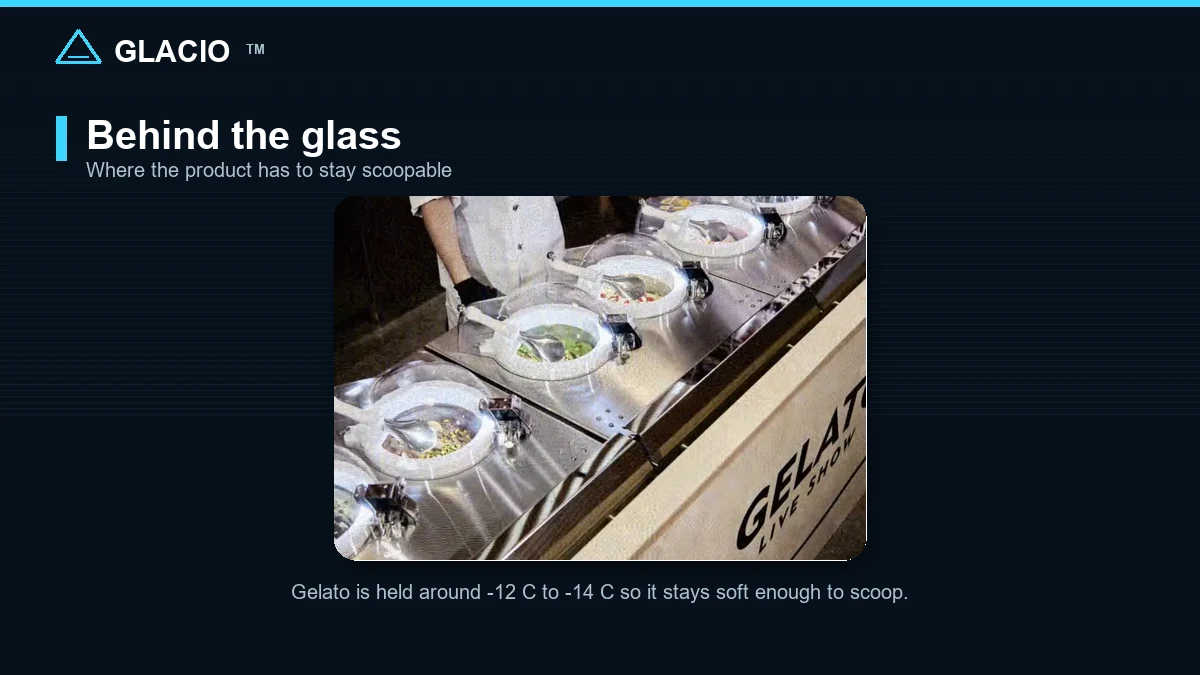
Gelato is served warmer than hard ice cream so it stays soft and aromatic. Most shops hold gelato around -12 C to -14 C, sorbet a little colder at -14 C to -16 C, and hard ice cream near -16 C to -18 C. A case that swings 4 degrees through the day will make one flavor soupy and another icy, so ask the supplier what the cabinet holds under load and at what ambient room temperature that figure was measured.
3. Glass, opening direction and access
Curved glass shows more product and looks better from the customer side. Flat glass is easier to clean and cheaper to replace. More important than the shape is which side opens: a case that opens toward the customer forces staff to reach across the product, which slows service and lets warm air in on every scoop. Staff-side sliding or lift-up doors keep the cold air where it belongs.
4. Footprint, counter height and sight line
Measure the counter, then measure the route the case must travel to reach it. A 1.5 m case that cannot pass a 0.9 m doorway, a service lift or a staircase corner is a very expensive object to return. Also check the sight line: if the case sits low and customers approach from the side, they see glass edges and lids instead of product.
5. Power, heat and ventilation
A 1.2 m to 1.5 m gelato case typically draws 1.2 kW to 2.5 kW and runs most of the day, so it needs its own circuit rather than a shared socket with a blender and a coffee grinder. Plan 10 to 15 cm of rear clearance for airflow, and keep the condensing unit out of direct sun and away from the batch freezer‘s exhaust if you can. In small shops the case and the freezer together are often the largest heat source in the room.
Temperature: the number that decides texture
Display temperature is a texture decision, not a storage decision. Colder is not automatically better.
| Product | Typical holding range | What happens when it is wrong |
|---|---|---|
| Gelato | -12 C to -14 C | Warmer turns soft and collapses; colder turns dense, icy and dull on the palate. |
| Sorbet | -14 C to -16 C | Too warm and the water separates; too cold and it sets like a block. |
| Hard ice cream | -16 C to -18 C | Served too warm it loses the firm scoop customers expect. |
| Back-of-house hardening | -18 C or colder | Incomplete hardening shows up later as ice crystals in the pan. |
Check the reading with your own probe thermometer at the center of a pan, mid-service, not from the cabinet’s digital display. Display sensors read air temperature, and air temperature is not product temperature.
Pan math: how many pans you actually need
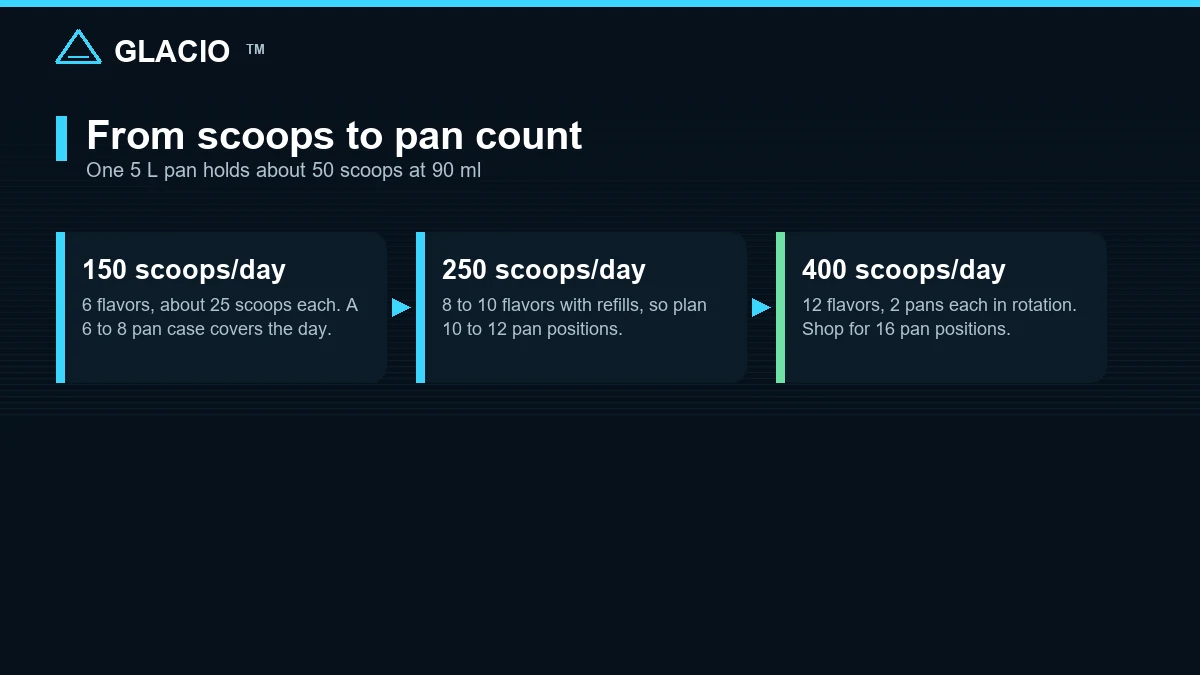
A full 5-liter pan yields roughly 50 scoops at 90 ml or about 75 scoops at 60 ml once you allow for the working level and the scraped bottom. Use that to size the case around a real day.
Worked example: a cafe sells 150 scoops a day across 6 flavors. That is about 25 scoops per flavor per day, or roughly half a pan each. A 6-pan case covers the day with room to refill, and an 8-pan case leaves space for a seasonal flavor and for pans resting while others are drawn.
A busier shop selling 400 scoops a day across 12 flavors needs about 33 scoops per flavor, so two-thirds of a pan each. That is 12 pans on display plus spares for rotation, which points at a 1.8 m to 2.0 m case with 16 pan positions.
Static cooling or fan-assisted cooling
| Design | How it works | Good for | Watch out for |
|---|---|---|---|
| Static (direct plate) | Evaporator plates sit close to the pans and cool by contact and still air. | Gelato and sorbet displayed for hours; product keeps a glossy surface. | Slower pull-down after a big refill; temperature varies between the front and back rows. |
| Fan-assisted (ventilated) | A fan moves cold air through the cabinet. | Faster recovery, more even temperature in wide cases. | Moving air dries the surface of gelato and can frost the tops of exposed pans. |
For gelato, static cooling usually wins on presentation. For a wide case that gets refilled constantly, fan-assisted cooling recovers faster. Some cases combine both, and that is often the practical answer for a busy counter.
What a gelato display case costs
These bands come from quotes we see for new cases in 2026. They exclude freight, duty, VAT, and installation, and factory-direct pricing sits at the bottom of each band.
| Case size | Pans (5 L) | Typical new price band (USD) | Fits |
|---|---|---|---|
| 0.9 m to 1.0 m | 4 to 6 | $900 – $2,200 | Cafes, bakeries and dessert bars starting with a short menu. |
| 1.2 m | 6 to 8 | $1,400 – $3,200 | The most common small gelato shop case. |
| 1.5 m | 8 to 10 | $2,000 – $4,500 | Shops with a real flavor range and steady all-day traffic. |
| 1.8 m to 2.0 m | 12 to 16 | $3,000 – $7,000 | Busy shops and shops that sell cakes and tubs as well. |
| Custom or remote condensing | 16+ | $7,000 – $15,000+ | Custom counters, curved glass, or noise and heat moved off the shop floor. |
Two context points. European-branded cases with the same pan count often quote two to three times these numbers, and a used case typically sells for 30 to 50 percent of new. On a used case, budget for a new gasket set and a refrigerant check before you rely on it in August.
The cost nobody quotes you
The purchase price is not the running cost. A 1.5 m case drawing about 1.5 kW for 14 hours a day uses roughly 21 kWh a day, which is 600 to 650 kWh a month before you count the defrost cycles. In a warm climate that number rises, because the compressor simply runs longer. If your electricity is expensive, a well-insulated double-glazed case with a good gasket pays back faster than a cheaper cabinet that never settles.
Site checks before the case arrives
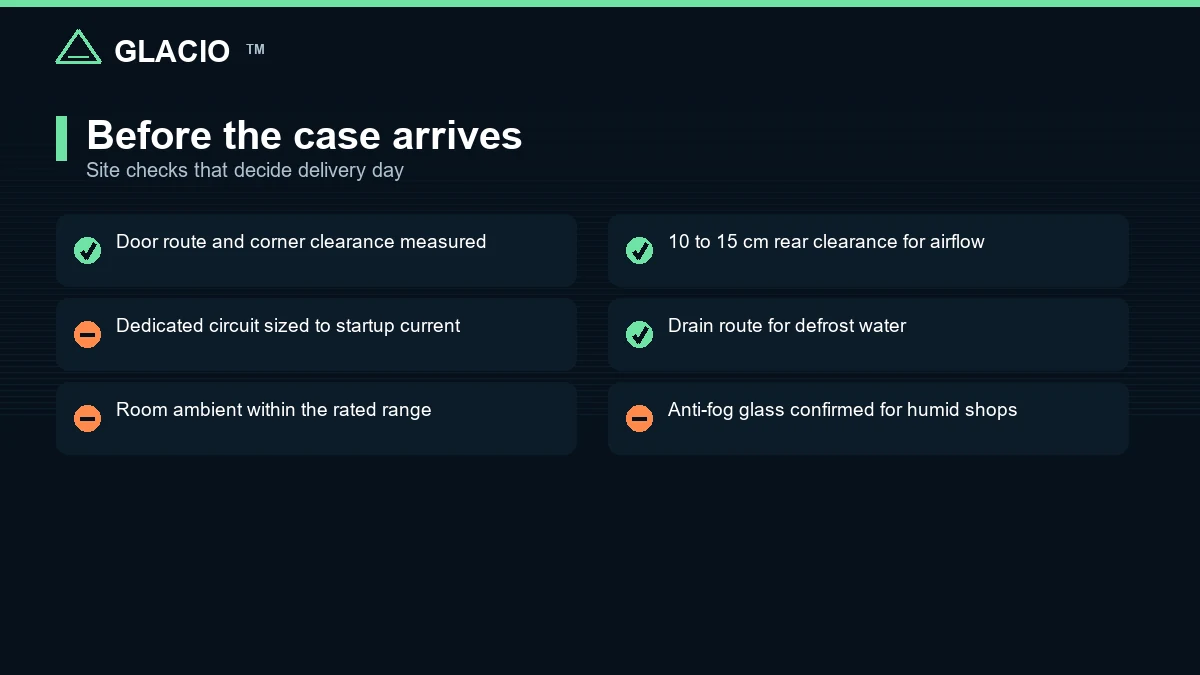
- Door route measured. Width, corners, lift size and any step between the street and the counter.
- Dedicated circuit. Confirm breaker size against the startup current, not just the running draw.
- Ambient limit respected. Most cases are rated around 25 C to 30 C ambient; a shop that hits 34 C in summer needs the supplier to confirm performance at that temperature.
- Rear and side clearance. 10 to 15 cm for airflow, more if the wall is sunny or the machine room is warm.
- Drain and defrost water. Know where the water goes during automatic defrost.
- Floor level. A case that rocks will not seal, and a poor seal means condensation and fogged glass.
- Anti-fog heater. If your shop is humid, confirm the glass has heater wires or a heated frame, not just double glazing.
Daily rhythm that keeps the case healthy
Wipe the glass in the morning before service, check the product temperature with a probe at midday, and rotate pans front to back whenever you refill. Lift the lids rather than leaving them open, and never refill a pan with warm, freshly drawn gelato and close the case on it. Let the batch come down first, or you will spend the afternoon fighting a compressor that cannot catch up.
Once a week, look at the door gaskets and the drain tray. Once a month, clean the condenser coil if it is accessible and check that the case still holds temperature at the busiest hour. The maintenance rhythm for the rest of the counter is covered in the gelato shop equipment checklist.
Five buying mistakes
- Buying the case before the machine. Fix your pan size and daily output first; the case has to match what you produce.
- Counting case length instead of pans. A long cabinet with shallow pans holds less than you think.
- Ignoring ambient temperature. A case rated for 25 C will struggle in a 34 C shop with no air movement.
- Choosing looks over access. Customer-side openings slow service and warm the product all day.
- Skipping the electrical check. Adding a 2 kW case to a full circuit is a problem you discover on opening weekend.
Frequently asked questions
What temperature should a gelato display case be set to?
Most gelato is displayed and served around -12 C to -14 C. Sorbet usually sits a little colder at -14 C to -16 C, and hard ice cream near -16 C to -18 C. Confirm the setting with a probe thermometer in the center of a pan during service, because cabinet displays read air temperature, not product temperature.
How much does a gelato display case cost?
A new 1.2 m case with 6 to 8 pans typically quotes between $1,400 and $3,200 before freight, duty and tax. A 1.5 m case runs roughly $2,000 to $4,500, and a 2.0 m case with 12 to 16 pans sits around $3,000 to $7,000. Custom curved designs and remote condensing units go well above that.
Can I use a normal freezer or fridge instead?
You can store product in a freezer, but you cannot sell from one. A chest or upright freezer holds -18 C or colder, which makes gelato too hard to scoop and hides the product from customers. A display case holds a warmer, controlled temperature and shows the range.
Why does the glass keep fogging and icing?
Fogging usually comes from humidity plus a weak seal, a case sitting in direct sun, or a room above the cabinet’s rated ambient temperature. Check the door gasket first, then airflow and clearance, then whether the glass has working anti-fog heating. Icing on the inside of the glass often means the case is being opened constantly during service.
How many pans do I need for my menu?
Count the flavors you want visible at peak time and add two positions for rotation. As a reference, one 5-liter pan yields roughly 50 scoops at 90 ml, so 150 scoops a day across 6 flavors works comfortably in a 6 to 8 pan case, while 400 scoops a day across 12 flavors points at 16 pan positions.
Match the case to the machine
Tell us how many flavors you want on display, how many scoops you sell on your busiest day and how much counter length you actually have. We will come back with the pan count, the case size and the machine that fills it, so the two are bought as one decision instead of two.
Tell us the shop. We size the machine and price it.
Two numbers decide the model: how much you sell on a busy day, and how much you need in your busiest hour. Send those with your voltage and you get a model recommendation and an FOB quote within 24 hours.
- ✓ Sized to your peak hour
- ✓ FOB quote and lead time
- ✓ No obligation
Some information may be outdated
Comments
Questions about equipment capacity, voltage, or recipes? Leave a comment.
Loading comments...