

Gelato Display Case vs Machine Display: Pick the Right Setup
Short answer: Choose a gelato display case when customers need to browse many flavors, linger over dessert, and see a full, tempting selection for several hours. Choose a front-counter machine display when your menu is focused, turnover is fast, and the visible batch freezer can handle production and presentation in one footprint. Most bakery, cafe, bubble tea, and small gelato operators should choose one primary display first, then add the second format only when sales and staffing prove it can pay its way.
Display format looks like a merchandising decision. In practice, it decides how much cold storage sits in your customer area, how often staff handle product, how much working capital stays tied up in equipment, and how consistently every scoop tastes. A machine can freeze a perfect batch and still lose the sale because nobody can see the gelato from the door.
This guide is for bakery owners, cafe and bubble tea operators, gelato shop founders, and home bakers moving into small-scale production. You do not need to know refrigeration engineering. You need to understand the daily consequences of putting product in a machine bowl, a separate cabinet, or both.
The wrong setup shows up quietly. Staff start scraping hard edges, flavors sit too long, the counter becomes crowded, and another compressor runs all day. Fixing that after opening usually means rewiring, rebuilding the counter, or accepting lower throughput for months. The choice is easier when you compare visibility, holding temperature, capital, energy, and labor as one system.
Machine display versus gelato display case: what actually changes?
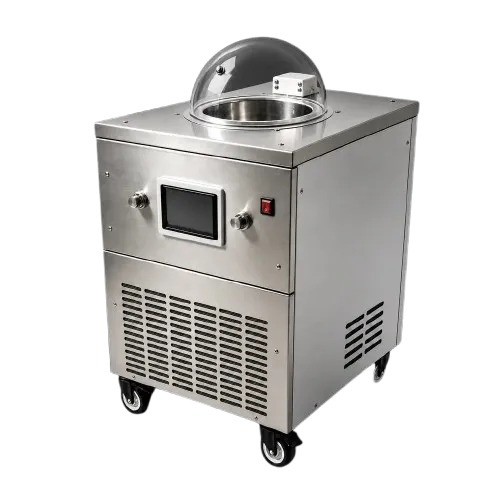
A machine display combines production and presentation. The GLACIO GB-Series is a front-counter display style hard ice cream and gelato batch freezer. It comes with 1 to 6 six-liter bowls, runs a typical cycle in 15-20 minutes, and produces roughly 14 liters per hour per bowl. Draw temperature, cycle time, and output depend on the mix, starting temperature, ambient conditions, and operating cycle.
A gelato display case separates production from presentation. The batch freezer still makes the product, but the finished gelato goes into an ice cream display cabinet with its own temperature control, defrost cycle, lighting, pans, and cleaning routine. That cabinet can show more variety, but it does not add production capacity.
What a machine display gives you
- One footprint for making and selling: staff draw directly from the batch freezer instead of moving product between rooms.
- Visible production: customers see fresh batches, dasher movement, and a product that appears active rather than pre-packed.
- Fast service when turnover is strong: a 15-20 minute cycle keeps fresh product moving if the menu is tight and demand is concentrated.
- A smaller cold chain: you maintain the machine rather than maintaining a machine and a separate display cabinet.
What a separate case gives you
- More visual range: customers can compare colors, textures, toppings, and flavor combinations before ordering.
- Better browsing for eat-in service: a case supports dessert menus, coffee pairings, and table service without tying every order to the freezer station.
- Separation between production and service: batches can be finished, hardened, and transferred while the front counter keeps selling.
- More equipment to manage: the case adds holding temperature, defrost logic, gasket care, pan rotation, lighting, and another service contract.
The useful question is not which format looks more professional. It is whether your customer flow needs production speed or presentation range at the point of sale. A GB-1 weighs about 96 kg, while a GB-6 is about 330 kg. That weight already tells you that the machine affects floor support, counter design, and traffic flow before you add any cabinet.
Visibility and service flow: which one sells better?
A front counter gelato display should make the product obvious within the first few steps through the door. A machine display does that with motion and freshness. A separate case does it with range and abundance. Neither wins in every shop because customers behave differently in a takeaway queue and an eat-in cafe.
In a busy bubble tea shop, the counter is often the bottleneck. If two staff members handle drinks, toppings, and desserts at peak, a case that pulls one person away for repeated opening, scooping, wiping, and restocking can slow the whole line. A machine display keeps the gelato station close to the production point and shortens the path between order and handoff.
In a bakery or cafe with tables, browsing is part of the purchase. Customers may order coffee first, walk past a case, and add dessert later. The visual menu matters more than production theater. A case can show several flavor families, which makes it easier to sell a second item without persuading the customer to study a handwritten board.
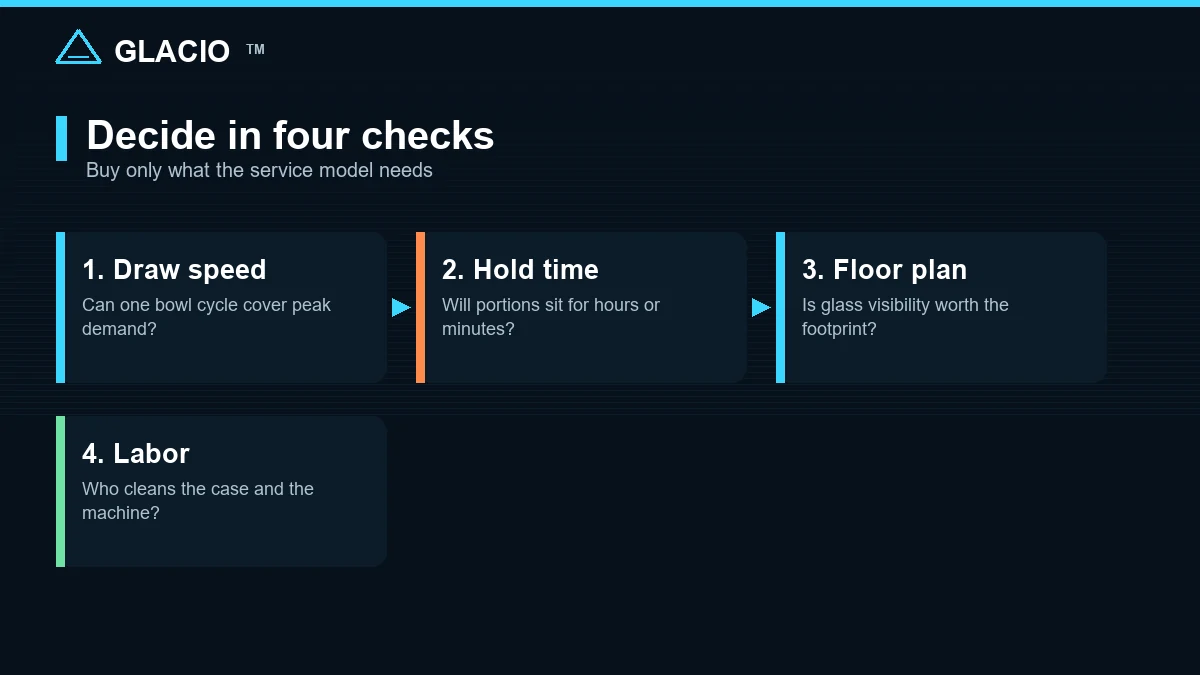
Walk your proposed layout before buying. Use these checks:
- Entry sightline: can a customer identify the dessert offer before reaching the register?
- Queue path: does display viewing slow the line or let waiting customers decide without blocking pickup?
- Staff reach: can one worker serve without crossing another station, a doorway, or a seating aisle?
- Restock path: can product move from the freezer to the case without passing through customer traffic?
- Cleanup access: can staff reach gaskets, drains, lids, and floor edges at closing time?
A good display sells before a customer speaks. If people can see only the machine’s side panel, the best batch in the room is invisible. If the case is beautiful but staff cannot reach it during a rush, the display creates work instead of orders.
Holding temperature and texture consequences
Temperature is where a display decision becomes a texture decision. Many gelato cabinets serve product around -12 to -14 degrees C. Hard ice cream is often held and served colder, around -16 to -18 degrees C. Frozen storage should remain at -18 degrees C or colder. The difference is intentional: warmer gelato tastes more aromatic and scoops more softly, while colder ice cream holds its shape and melts more slowly.
A machine display and a separate case create different temperature patterns. The machine is close to the production cycle, so product can be fresher, but every lid opening, scraping, and refill exposes the surface to warmer air. A case provides steadier merchandising, but defrost cycles, airflow gaps, and overfilled pans can create local warm spots. The cabinet’s sensor does not tell you the temperature inside every pan.
Set the batch up to succeed
- Chill the mix before loading: aim for 2-4 degrees C. Warm mix makes the cycle run longer and may draw soft.
- Match the draw to service: if product will be sold within a short push, machine display reduces handling. If it must stay attractive for hours, use a case with controlled holding.
- Transfer in shallow, dated batches: deep pans and mixed old and new product make rotation harder and increase the chance of icy edges.
- Check texture after each holding period: a batch that scoops well at draw can become grainy, gummy, or too soft after several hours.
What warmer holding does
Warmer holding gives a softer scoop, faster flavor release, and a more appealing first bite. It also speeds melting, softens edges, and narrows the time between a full-looking display and a messy one. In a hot room, a case set warm can turn a neat pan into a rush job by mid-service.
What colder holding does
Colder holding protects shape and slows melting, but the first bite can taste muted and the scoop can feel hard. Staff then press harder, which damages texture and slows service. A case that is too cold is not automatically safer for the product; it can push workers into rough handling and create waste at the bottom of the pan.
If the product spends hours outside a controlled display, no machine setting can rescue it. Keep it in a case or freezer as the manual and local food-safety rules require, and test the texture at the temperature customers actually receive.
Side-by-side comparison: machine display versus display case
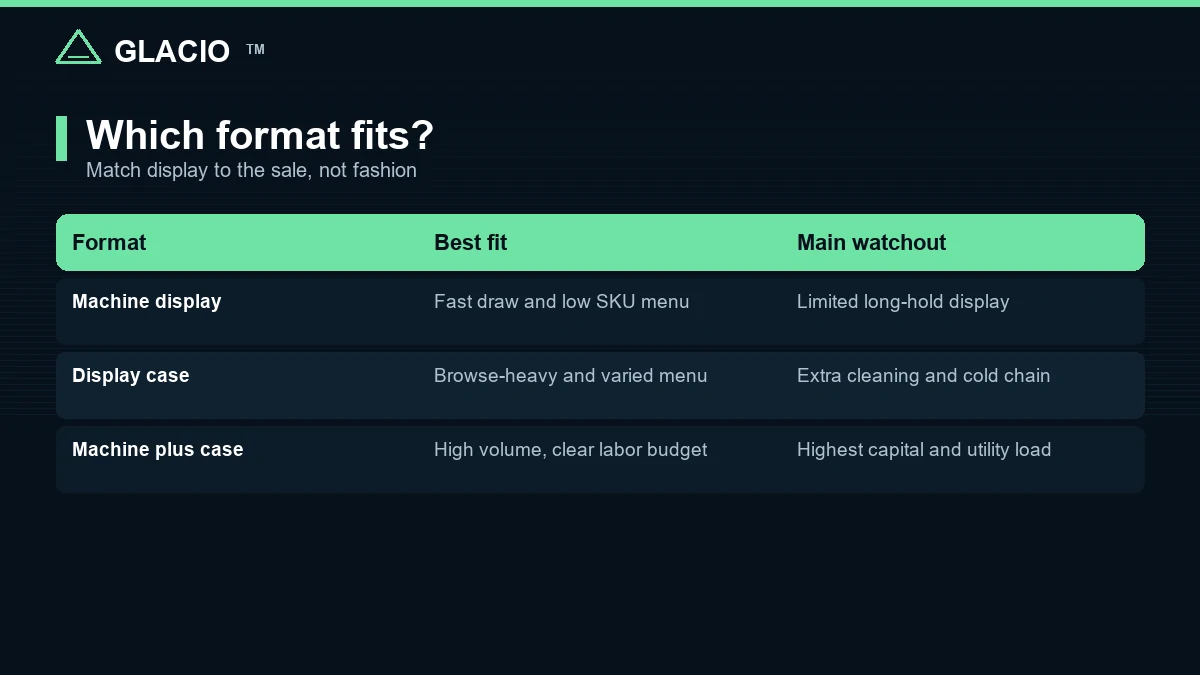
Use this table as a decision aid, not a scorecard. The correct cell depends on your menu, service window, floor plan, and labor model.
| Decision factor | Machine display | Gelato display case | What to decide |
|---|---|---|---|
| Visibility and menu range | Strong freshness signal; range limited to the machine bowls you can manage. | Strong browse value; can present more flavors and combinations. | Choose range if customers compare before ordering; choose freshness if they order fast. |
| Holding temperature | Close to production and draw temperature; long holding depends on the manual and local rules. | Designed for merchandising temperature, often -12 to -14 degrees C for gelato. | Confirm cabinet range, defrost logic, pan fit, and approved hold time. |
| Texture over service | Rapid turnover reduces refreeze risk; repeated lid opening can warm the surface. | Stable display protects shape; poor rotation and frost create icy or grainy edges. | Decide who checks texture and rotates pans during every shift. |
| Working capital | 1 machine covers production and primary display. | Adds a second cold unit, installation work, spare parts, and more floor space. | Do not add a case just to make the counter look fuller. |
| Energy use | Compressor cycles with production and holding mode; output affects duty cycle. | Runs through open hours with lighting, fans, controls, and defrost cycles. | Compare rated draw, expected duty cycle, ambient heat, and ventilation. |
| Daily labor | Clean bowls and dashers after production; keep the display area presentable. | Clean pans, glass, gaskets, and drains; rotate product and monitor temperature. | Count the closing work before adding both formats. |
The table exposes the central trade-off. A machine display saves footprint and handling. A case buys range and a stronger browse experience. Running both can be right for a high-volume shop with a clear labor plan, but it is rarely the cheapest way to open a focused dessert counter.
Capital, energy, and daily labor: the real monthly load
Buying both formats doubles the number of cold systems in the customer area, but it does not double production. If a GB-4 runs 4 six-liter bowls, adding a display case gives you somewhere else to show and hold product; it does not create another 14 liters per hour per bowl. That distinction matters when you are trying to protect cash and floor space.
The batch freezer is also physical infrastructure. A GB-1 is about 96 kg, a GB-2 about 140 kg, a GB-4 about 230 kg, and a GB-6 about 330 kg. A separate cabinet adds its own footprint, weight, ventilation needs, drainage considerations, and service access. On paper, the second unit may look like a modest line item. In the room, it can change counter height, aisle width, electrical layout, and where staff stand during a rush.
Energy deserves the same scrutiny. A case that merchandises all day has a longer running window than a batch freezer that cycles through production. Lighting, fans, defrost, door openings, and room temperature all add load. The batch freezer’s compressor duty cycle changes with mix temperature, batch size, and ambient conditions. Ask for rated draw and realistic operating assumptions, then compare those numbers with your electrical capacity and ventilation plan using the Commercial Ice Cream Machine Installation: Voltage, Drainage, and Ventilation checklist.
Daily labor is easier to underestimate than energy. Both formats need cleaning, but the work is different. Use the Batch Freezer Cleaning: Daily Sanitising SOP for Ice Cream Shops as a baseline for the machine side, then add the case routine if you operate both.
- Machine: break down, clean, and sanitize bowls and dashers; dry and reassemble correctly.
- Case: remove pans, wipe glass and gaskets, clear drains, and check temperature logs.
- Product flow: date and rotate pans, discard unsellable edges, and avoid mixing fresh batches with old ones.
- Service floor: wipe drips, cones, toppings, and scoop wells before they become a sticky mess.
- Training: one missed step can turn a clean machine into a contaminated one or a good case into a grainy display.
Labor is not only minutes at closing. It is the attention required during service. A case with 12 pans but no rotation plan becomes a hiding place for tired product. A machine display with no draw schedule becomes a bowl of partially softened gelato. The format should match the discipline your team can actually repeat.
Which layout fits takeaway, eat-in, and hybrid service?
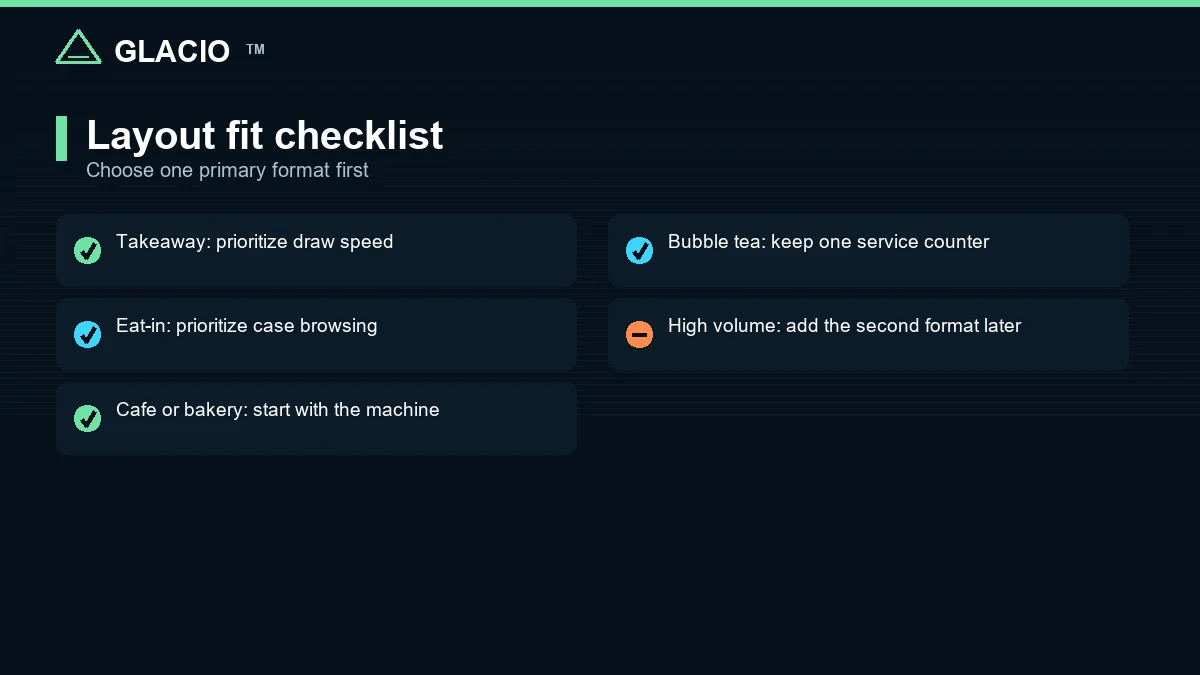
Takeaway service rewards speed and a clear order path. Eat-in service rewards browsing, visual range, and a dessert moment that lasts longer than the queue. Bakeries and bubble tea shops often sit between the two, which is why they are most at risk of buying both formats before either one has proved itself.
- Takeaway counter: make the machine display primary. A focused menu of 2-4 flavors, fast scooping, and one service station usually beats a large cabinet with slow rotation.
- Eat-in cafe or bakery: make the gelato display case primary if dessert browsing drives add-on sales. Keep production efficient and replenish in small batches.
- Bubble tea shop: protect the drink line first. A machine display with a tight flavor menu keeps staff close to the pickup point and reduces counter congestion.
- Gelato shop founder: a case often fits the browse-led retail model, but the machine still determines how quickly you can refill flavors during peaks.
- Home baker or small producer: start with a machine display unless customers already choose from a retail case. One unit keeps the workflow simple.
- High-volume hybrid: run both only when production, pickup, and table service are separate enough to justify the extra cold chain.
Floor plan decides more than furniture. If the customer queue crosses the production area, a machine display can expose staff to traffic and heat. If the case sits too far from the freezer, every refill becomes a trip through the room. If both units face the same narrow aisle, customers and staff will compete for space.
A takeaway shop needs a straight line from order to handoff. An eat-in shop needs a visual pause where customers can choose without blocking service. A hybrid shop needs a clear primary format and a secondary format that supports it, not two displays competing for attention.
The no-both strategy: choose 1 primary display
The safest buying sequence is boring, and it protects cash. Define the customer experience, choose 1 primary display, and reserve space and utilities for the second format only if demand proves the business needs it.
- Write the service promise: draw-to-order freshness or browse-first variety. You cannot optimize both equally at launch.
- Map the peak window: note how long a full-looking display must remain attractive and how many staff can serve it.
- Match production to the promise: use the Batch Freezer Sizing: How to Match Machine Capacity to Daily Sales guide before choosing bowl count.
- Pick the primary display: machine display for speed and footprint, case for range and browsing.
- Leave room for growth: reserve a breaker, drainage path, ventilation zone, and floor position for the second format without buying it yet.
This is where the GLACIO GB-Series gives you a useful range. A GB-1 with 1 bowl weighs about 96 kg and suits a focused counter. A GB-2 with 2 bowls weighs about 140 kg and supports a broader menu. A GB-4 with 4 bowls weighs about 230 kg, and a GB-6 with 6 bowls weighs about 330 kg. The GB-1 vs GB-2 vs GB-4 vs GB-6 Hard Ice Cream Machine Guide can help you connect bowl count to the way you plan to serve.
Do not buy both because a package looks complete. Buy the display that removes the biggest bottleneck. Later, add the second unit when it solves a measured problem: more customers wanting variety, longer holding requirements, or a service line that cannot reach the production station.
Frequently asked questions
Is a gelato display case better than a machine display?
A gelato display case is better when customers need to browse many flavors or when product must stay presentable for long service hours. A machine display is better when the menu is focused, floor space is tight, and fresh batches turn over quickly. The right answer depends on the service pattern, not on which unit looks more impressive.
Can I serve gelato directly from a batch freezer?
You can serve directly from a front-counter batch freezer when the manual and local food-safety rules allow it. The machine is first a production tool, so holding time, lid opening, and cleaning discipline still matter. If product must remain on display for many hours, a separate case gives you more control.
What temperature should a gelato display case hold?
Many gelato cabinets hold product around -12 to -14 degrees C so it stays soft enough to scoop and aromatic enough to taste. Hard ice cream is often held and served at -16 to -18 degrees C. Frozen storage should remain at -18 degrees C or colder, and the cabinet must be set according to its manual and local rules.
Does a display case improve gelato texture?
A display case can stabilize service temperature, but it cannot fix a badly frozen batch. Poor rotation, blocked airflow, frost buildup, and repeated partial thawing can still make gelato grainy or icy. Texture starts with correct mix temperature, freezing, draw, and storage before the product ever reaches the case.
How many flavors should I show in a display?
Show only as many flavors as you can sell and replenish cleanly. A GLACIO machine can have 1 to 6 six-liter bowls, while a case may offer more pan positions. More pans mean more labels, rotation, waste, and cleaning, so a focused menu often sells better than a crowded one.
Can a cafe or bakery start with a machine display only?
Yes, a cafe or bakery can start with a machine display if turnover is steady and the dessert menu is narrow. Add a case later if customers browse slowly, if peak service lasts several hours, or if the machine station becomes a production bottleneck. That staged approach keeps capital and closing labor under control.
The recommendation: choose 1 primary display
For most new bakeries, cafes, bubble tea counters, and small gelato shops, one primary display beats two half-used units. Choose the machine display if your customers order quickly, your menu is focused, and you want production and service in one footprint. Choose the gelato display case if your customers browse, you need a wider flavor range on view, and your team can manage rotation and cleaning every day.
If you are still deciding between bowl count, counter layout, and holding format, Request a machine recommendation and quote. Bring your peak-hour order count, menu size, available counter length, and the longest time product must stay on display. Those 4 details will narrow the choice faster than a catalog will.
What is the longest hold time your customers need to see a full, attractive display?
Tell us the shop. We size the machine and price it.
Two numbers decide the model: how much you sell on a busy day, and how much you need in your busiest hour. Send those with your voltage and you get a model recommendation and an FOB quote within 24 hours.
- ✓ Sized to your peak hour
- ✓ FOB quote and lead time
- ✓ No obligation
Some information may be outdated
Comments
Questions about equipment capacity, voltage, or recipes? Leave a comment.
Loading comments...