

Ice Cream Machine Heat and Noise: Site It for Stable Batches
Short answer: Ice cream machine heat and noise are installation constraints, not cosmetic problems. Site the machine where room air can enter the condenser, hot air can leave the zone, service panels stay reachable, and mix can be loaded at 2-4 degrees C. Keep the ordering position around 65 dBA or lower during normal conversation, because a hot, noisy corner can stretch a 15-20 minute cycle and produce a softer draw.
A small shop has no spare air. A machine that works well in an open showroom can become a slow, loud problem when it is pushed into a 1-meter alcove between a bakery oven, a display case, and a wall.
This guide is for bakery owners, cafe and bubble tea operators, gelato shop founders, and home bakers who are choosing a hard ice cream or gelato batch freezer. The cost of getting siting wrong is not only comfort. It is a machine that cannot keep pace at peak, staff who must shout over the compressor, and a service call that ends with advice you could have followed before the counter was built.
What does ice cream machine heat and noise actually change in a small shop?
Heat and noise travel through the same small space, but they have different fixes. Heat control is about moving rejected air. Noise control is about distance, structure, and load.
- Heat: A batch freezer pulls heat from mix and rejects it into the room. In a closed room, that heat raises ambient temperature, which makes the condenser work against warmer air.
- Airflow: If exhaust air returns to the intake, the machine breathes its own hot air. A 20-minute cycle may become longer because the refrigeration system loses capacity.
- Noise: The compressor and condenser fan create the steady sound. The drive and dasher create a load-dependent sound when frozen mix gets stiff.
- Placement: Distance, cabinet mass, and hard surfaces decide how much of that noise reaches the counter. A machine at the end of a tile wall sounds different from the same unit against an upholstered banquette.
Where should you place a gelato machine when every wall is busy?
A display machine sells ice cream while it works, but only if the guest side stays comfortable. Put it where the front panel faces customers and the compressor end faces a service or ventilation zone. If that is impossible, the next best position is a side wall with open air on the intake and a clear path for hot exhaust.
- Front counter, end position: Strong sales visibility, shorter product travel, and easier staff access. Keep seating at least 1 meter from the noisiest end when the room is narrow.
- Back production area: Better for noise, worse for theater and service flow. The room still needs real ventilation, not a closed door with a floor gap.
- Side wall with return path: Usually the best compromise for cafes and bakeries. Air enters low, crosses the machine, and leaves high without crossing the guest tables.
- Closed alcove or undercounter cabinet: Accept only if the manual allows it and both intake and exhaust remain open. A machine that fits with 2 cm to spare has not solved clearance.
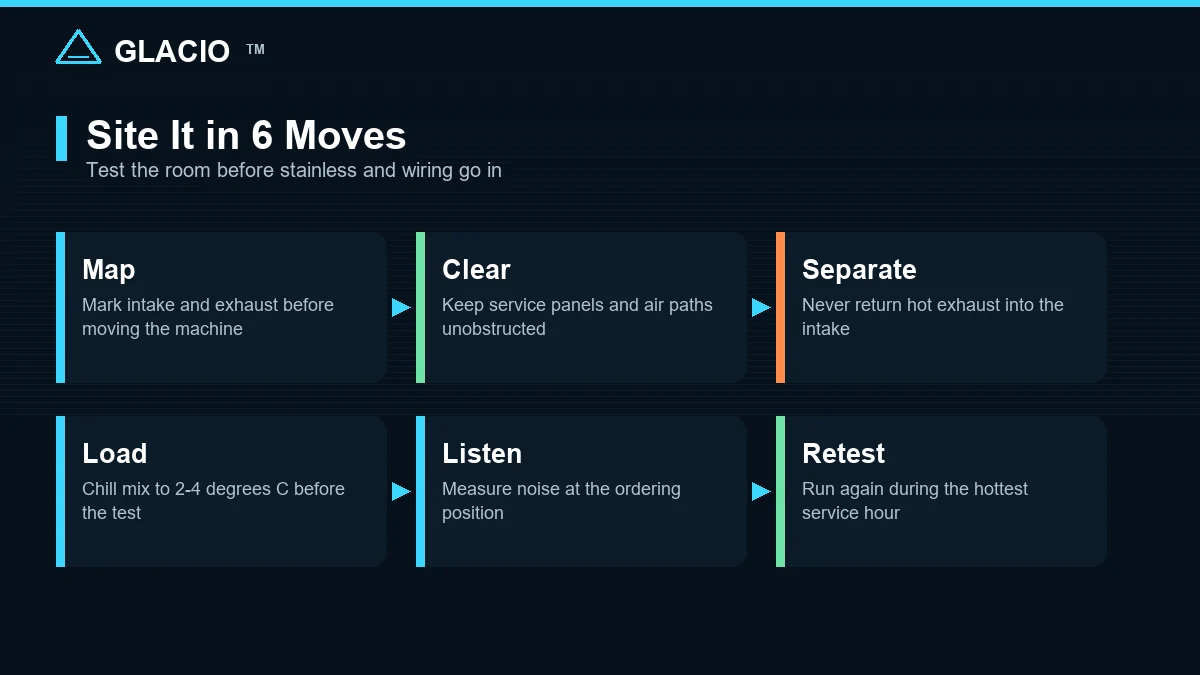
For a new layout, mark the machine, the mix cart, and the operator’s feet before you approve the counter. Then ask where 2 people will stand during the evening rush. If the answer is “beside the machine,” noise matters more than the spec sheet suggests. Before the counter is approved, compare the airflow and drainage sequence in Commercial Ice Cream Machine Installation: Voltage, Drainage, and Ventilation.
How much batch freezer clearance should you plan for?
Batch freezer clearance is an air and service dimension. The machine manual is the authority, but the planning question is simple: can a service technician remove panels, and can room air reach the condenser without being preheated?
Use 100 mm as a minimum conversation starter around an open air path, then increase it when the machine sits beside an oven, fryer, dishwasher, or another heat source. Allow 600-750 mm in front of panels when the layout permits. For a 6-liter bowl, leave enough room to lift and turn the bowl without twisting your back. These are planning targets, not a substitute for the model-specific manual.
- Intake: Room-temperature air must reach the inlet. Warm air at the intake means you have found a short circuit.
- Exhaust: Hot air must leave the machine and the room. A hot wall or ceiling pocket above the unit is a warning sign.
- Service: A panel that opens into a customer aisle is not service access. Plan for the machine to be isolated and moved safely.
- Loading: Keep the path from mix fridge to bowl clear. Warm mix and awkward lifting both slow production.
What is the right ice cream machine ventilation path?
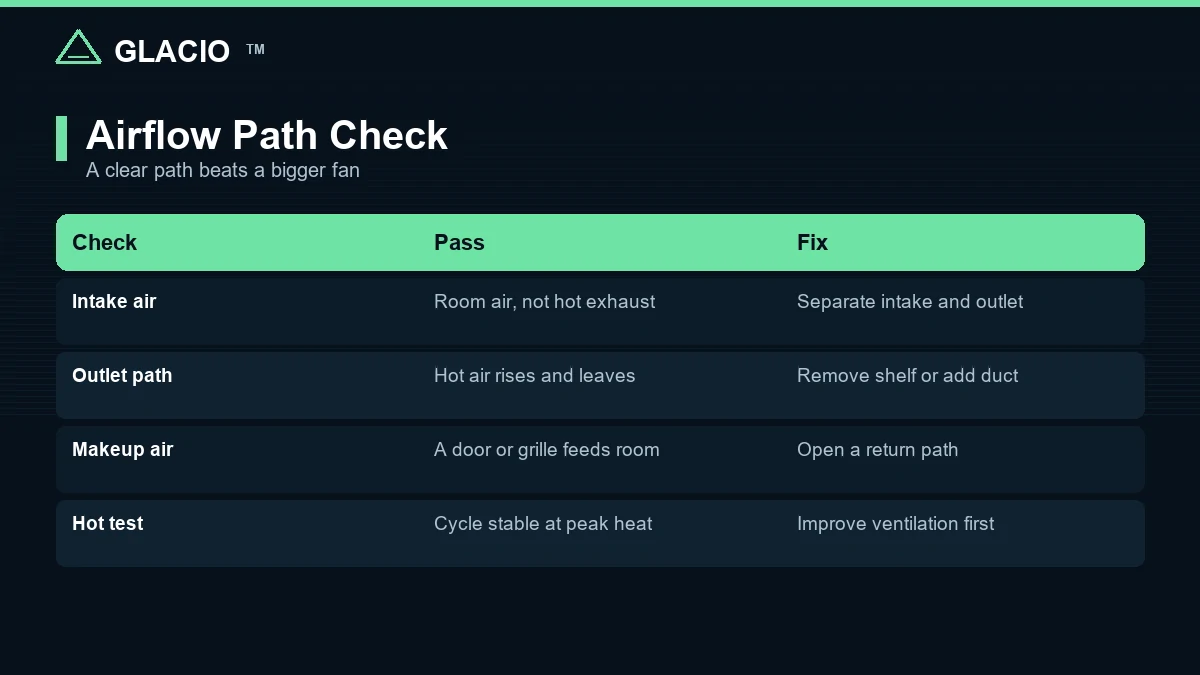
Ice cream machine ventilation works best as a path, not a single fan. The goal is a deliberate route from cool makeup air, across the condenser, and out of the occupied zone.
- Trace the intake. Hold a tissue near the inlet and confirm it draws room air rather than exhaust from the rear or side.
- Trace the exhaust. Follow the hot-air plume with your hand or a smoke pencil. If it curls back toward the intake, break the loop with a duct, baffle, or changed machine position.
- Confirm makeup air. An exhaust fan cannot remove air from a sealed room. A door or transfer grille must let replacement air enter.
- Separate paths. Keep intake and exhaust openings apart, and do not discharge into an HVAC return or a shared ceiling plenum.
- Test at peak. Run the machine with ovens, dishwashers, display cases, and doors in their normal service positions. A test in an empty room proves very little.
A cheap airflow mistake is more common than a defective machine. If the room gets hotter as the machine runs, the machine is not “overheating” on its own. It is telling you where the air is going.
How does ambient temperature stretch batch time?
Ambient temperature stretches batch time because an air-cooled refrigeration system has less capacity when the air around it is warmer. The compressor runs longer, discharge pressure rises, and the machine takes longer to pull the same mix down to a firm draw.
Mix starting temperature adds a second load. Load at 2-4 degrees C. If mix goes in at 10 degrees C, the machine must remove extra heat before it can freeze the batch. That delay shows up during the busiest hour, when you cannot afford to wait.
The GLACIO GB-Series has a typical cycle of 15-20 minutes per bowl and roughly 14 liters per hour per bowl under normal conditions. Those figures depend on mix, starting temperature, ambient conditions, and operating cycle. Watch the pattern, not just the clock.
| Ambient pattern | What you may see | Operator response |
|---|---|---|
| 22-25 degrees C with clear airflow | 15-20 minute cycle stays near normal | Keep intake and exhaust clear |
| 26-29 degrees C during peak service | A 20-minute cycle may drift toward 22-25 minutes | Pre-cool mix and start earlier |
| 30-34 degrees C or a blocked alcove | A 20-minute cycle may run 25-30 minutes | Stop stacking batches and fix the airflow |
| Above the manual’s maximum ambient | Soft draw, long recovery, and unstable output | Correct the room before production |
If one bowl normally finishes in 20 minutes and begins taking 25, hourly output falls, bowls wait in the freezer, and staff compensate by drawing softer product. That is how a heat problem becomes a texture problem. The fix may be as simple as moving a shelf that blocks the exhaust or as serious as adding mechanical cooling. Use Peak-Hour Capacity: How Fast Does Your Ice Cream Machine Need to Be? to separate a capacity problem from a siting problem.
Which noise sources matter most at the counter?
Measure noise at the ordering position, at ear height, with the machine under normal load. Normal conversation is roughly 60 dBA. A target below 65 dBA keeps ordering comfortable; 70 dBA starts to make guests lean in and staff raise their voices. OSHA’s hearing conservation action level is 85 dBA as an 8-hour time-weighted average, so a short peak is not the same as an all-day exposure, but sustained levels near that range deserve attention.
Rank the sources before buying acoustic panels:
- Compressor and condenser fan: Usually the steady, dominant sound. It gets louder or more persistent when the room is hot or the coil is dirty.
- Dasher and drive motor: Load-dependent. A stiff batch, wrong mix temperature, or oversized load makes the drive work harder.
- Cabinet and floor vibration: Low-frequency hum that can travel through a counter or framed floor. Rubber isolation and secure panels often help more than wall foam.
- Hard-room reflections: Tile, glass, and bare walls make the same machine sound louder at the counter. Softening one nearby surface can reduce the annoyance without changing the machine.
- Other equipment: Blenders, exhaust fans, music, and refrigeration compressors raise the background. A machine rated at 65 dBA can still feel loud in a room already at 70 dBA.
Do not try to silence the machine by boxing it in. That may reduce direct sound while creating a heat trap that stretches every batch. If the noise target and the heat target disagree, move the machine or correct the room.
Cheap ventilation fixes versus real HVAC work
Start with free fixes. Clear the intake, remove packaging and boxes from the exhaust path, clean the condenser coil, and stop storing warm mix beside the machine. A portable fan is a temporary tool, not an installation. Aim it to move room air through the machine, not to blast hot exhaust back into the intake.
- Low intake, high exhaust: Often the cheapest meaningful upgrade in a small room. It works only when makeup air can replace what leaves.
- Dedicated exhaust or canopy: Captures hot air near the machine and sends it outside. Good when the room cannot absorb more heat, but the duct route and code requirements matter.
- Air conditioning: Removes room heat, but it does not fix a short-cycled condenser. The machine still needs an unobstructed air path.
- Makeup air and HVAC balance: Real work for rooms that go negative, pull in humid air, or overheat after 20 minutes of production.
- Acoustic isolation: Helpful for vibration and hard-surface noise. It cannot compensate for a machine placed beside guest seating or a machine that is running hot.
The decision rule is blunt: cheap fixes restore a good design, while HVAC work changes a room that was never designed to reject the heat. If the machine’s airflow path is clear and the room still climbs during a 30-minute test, stop adding fans and call an HVAC professional.
What should be on your final siting checklist?
Use this siting checklist before you approve electrical, drainage, or counter work. A pass means the condition holds during peak service, not only at opening.
| Siting check | Pass standard | Failure warning |
|---|---|---|
| Code and service access | Power, drainage, and panels remain reachable | Machine boxed in behind a cabinet |
| Airflow | Room air enters and hot air leaves | Intake and exhaust share one pocket |
| Clearance | Manual minimum plus working access | Machine touches walls or shelves |
| Mix handling | Mix stays at 2-4 degrees C | Buckets sit warm beside the machine |
| Noise | Ordering point stays near 65 dBA | Guests lean in or staff shout |
| Peak-hour heat test | Cycle stays normal at 7 p.m. | Room climbs through service |
If the layout cannot pass this check, revisit Batch Freezer Sizing: How to Match Machine Capacity to Daily Sales before you accept longer cycles as normal. Moving a batch freezer after installation is far more expensive than marking its airflow path on the floor plan.
Frequently asked questions
How much clearance does a batch freezer need?
A batch freezer needs enough open space for room air to reach the condenser, hot air to leave, and a technician to remove service panels. Start with the exact clearance in the model manual, then increase it beside ovens or dishwashers. A 100 mm gap is a useful starting point for an open air path, while 600-750 mm in front of service panels is a practical working target when the room allows it.
Where should I place a gelato machine in a small shop?
Place it where the customer side looks intentional and the service side has an unobstructed airflow path. A side wall with a low intake and high exhaust is often better than a closed alcove, even if the alcove looks tidier. Keep guest seating at least 1 meter from the noisiest end when possible.
What ambient temperature is too hot?
Use the maximum ambient from the machine manual as a hard ceiling, not a daily target. Plan production in the 24-26 degrees C range when possible, and expect longer cycles as the room warms. If a 20-minute cycle begins taking 25-30 minutes, treat that as a heat and airflow warning.
How loud is a commercial ice cream machine at the counter?
Many commercial batch freezers produce sound in the low 60s to mid 70s dBA at 1 meter, depending on compressor, fan, load, and room. Aim for 65 dBA or lower at the ordering position so normal conversation remains easy. Measure the machine under load because a warm room and stiff batch can raise the sound.
Does an open door improve ice cream machine ventilation?
An open door can supply makeup air, but it can also let in heat, humidity, pests, and unstable airflow. A fixed low intake and high exhaust is more reliable than relying on a propped door. If the door must stay open for the machine to run normally, the room is not set up correctly.
Should I choose a quieter machine or fix the room?
Fix the room and position first because airflow, vibration, and distance usually control the perceived noise. If the machine still exceeds the target after those changes, compare sound ratings at the same distance and load. Silence cannot compensate for a hot closet or a machine pressed against the counter.
Siting rules that save the season
The safe recommendation is to design the position before the machine arrives. Keep the airflow path open, load mix at 2-4 degrees C, watch ambient temperature during the hottest hour, and measure noise at the counter instead of guessing from the showroom. GLACIO GB-Series batch freezers cover 1 to 6 6-liter bowls, with a typical cycle of 15-20 minutes and roughly 14 liters per hour per bowl when mix, starting temperature, ambient conditions, and operating cycle are controlled.
If you are planning a cafe, bakery, bubble tea shop, or gelato counter, Request a machine recommendation and quote. Tell us the room size, other heat sources, and where guests sit; those details matter as much as the bowl count. What is the hottest or noisiest corner in your shop right now?
Tell us the shop. We size the machine and price it.
Two numbers decide the model: how much you sell on a busy day, and how much you need in your busiest hour. Send those with your voltage and you get a model recommendation and an FOB quote within 24 hours.
- ✓ Sized to your peak hour
- ✓ FOB quote and lead time
- ✓ No obligation
Some information may be outdated
Comments
Questions about equipment capacity, voltage, or recipes? Leave a comment.
Loading comments...