

Best Commercial Ice Cream Machine: How to Rank One for Your Shop
Search for the best commercial ice cream machine and you will get a page of brand lists that all say the same thing: it depends. That answer is useless when you are about to spend five figures. What actually helps is a way to rank machines against your menu, your busiest hour and your service situation. This guide gives you that ranking method, the numbers to fill it in with, and the three buying paths that real shops choose from.
Quick answer
There is no single best machine, but there is a best machine for a product and a peak hour. Decide the product first (scooped hard ice cream, gelato, or soft serve), size the machine from your busiest hour rather than your daily total, then compare only machines that clear four minimum conditions: a compressor rated for continuous duty, a freezing cylinder you can get spares for, hardening that matches your storage, and a service route you can reach within a week. Everything else – brand, colour, screen size – is a tiebreaker.
Step 1: name the product before the machine
| What you sell | Machine category | What it does well | Where it struggles |
|---|---|---|---|
| Scooped hard ice cream and gelato | Batch freezer, one or more cylinders | Flavour rotation, dense texture, tubs and cones from the same batch | Needs a hardening step and a display case |
| Soft serve cones and sundaes | Soft serve freezer with a pressurised barrel | Speed at the counter, short training curve | Narrow menu, mix supply dependency |
| Both, in one small shop | Batch freezer plus a small soft serve unit | Menu flexibility | Two power feeds, two service contracts |
| Tubs and wholesale packs | Batch freezer with blast hardening | Volume, consistent pack weight | Floor space and cold storage |
This step eliminates half the market. A machine advertised as the best commercial ice cream machine for one product can be the wrong machine for the next, and no specification fixes that.
Step 2: size from the peak hour, not the daily total
Selling 60 litres on a Saturday sounds modest until you look at when it leaves the counter. If 30 of those litres go out between 7pm and 9pm, you need a machine that freezes and recovers roughly 15 litres an hour during that window, not one rated at 60 litres a day.
Work it out in three lines:
- Peak litres = your busiest two hours of sales in litres.
- Required hourly output = peak litres divided by 2, plus a 20 percent buffer for a hot day and a second flavour on the go.
- Cycle maths = output per cycle, multiplied by how many complete cycles fit in an hour, including recovery time.
A machine that freezes 6 litres in 20 minutes but needs 10 minutes to recover produces 12 litres an hour, not 18. Sellers quote the freeze time; your customers experience the total cycle. Two cylinders help here because one freezes while the other is emptied, which is why paired-cylinder machines dominate busy shops even when a single bigger bowl looks cheaper per litre.
Step 3: the four specifications that decide whether it survives
Compressor and duty rating
Ask for the duty rating, not the horsepower label. A machine sold as continuous duty should run all day in a 30 degree kitchen without tripping its thermal cutout. If the seller cannot tell you the compressor brand and duty class, that is your answer. Shops that run one busy machine for six hours a day are the ones that expose an undersized compressor in the first month.
Cylinder and beater
The freezing cylinder and its scraper blades set your texture and your maintenance bill. Confirm that blades, seals and gaskets are available for the specific model, and that the beater can be removed by one person for daily cleaning. A machine that takes two staff and fifteen minutes to strip will be cleaned badly, and badly cleaned machines freeze slowly within a year.
Hardening and storage
Batch freezers dispense at roughly minus 6 to minus 9 degrees Celsius. That is firm enough to scoop and too warm to store. You need a hardening cabinet, a blast freezer, or a walk-in at minus 18 to 22 degrees for at least two hours before service. Buyers who skip this step end up with soft tubs and a machine that gets blamed for it.
Power supply and heat
Countertop units run on 230V single phase. Mid-size machines usually need 400V three phase. Air-cooled machines dump heat into the room, which matters in a small shop in summer: a 35 degree kitchen can stretch a 20 minute cycle to 30. Water cooling solves this but needs a supply and a drain. Check what the room can actually absorb before you fall in love with a machine.
Step 4: pick your buying path
| Path | Typical spend | Best for | Main risk |
|---|---|---|---|
| Budget import, marketplace listing | USD 2,500 to 8,000 | Testing a product line, low volume, kiosk concepts | Output claims, no local spares, warranty freight. Read the budget machine checklist first. |
| Used premium machine | USD 7,000 to 30,000 | Shops that already know the brand and have a technician | Refurbishment cost, discontinued boards, refrigerant rules. See the used machine guide. |
| New factory-direct machine | USD 8,000 to 35,000 | Shops that need a known capacity, a warranty and spare parts on the shelf | Lead time, and confirming the factory supports your voltage |
Each path can be right. What ruins the decision is mixing them: buying on the budget path and expecting the support of the factory-direct path, or paying premium prices for a machine that has sat unserviced for three years.
The scoring sheet
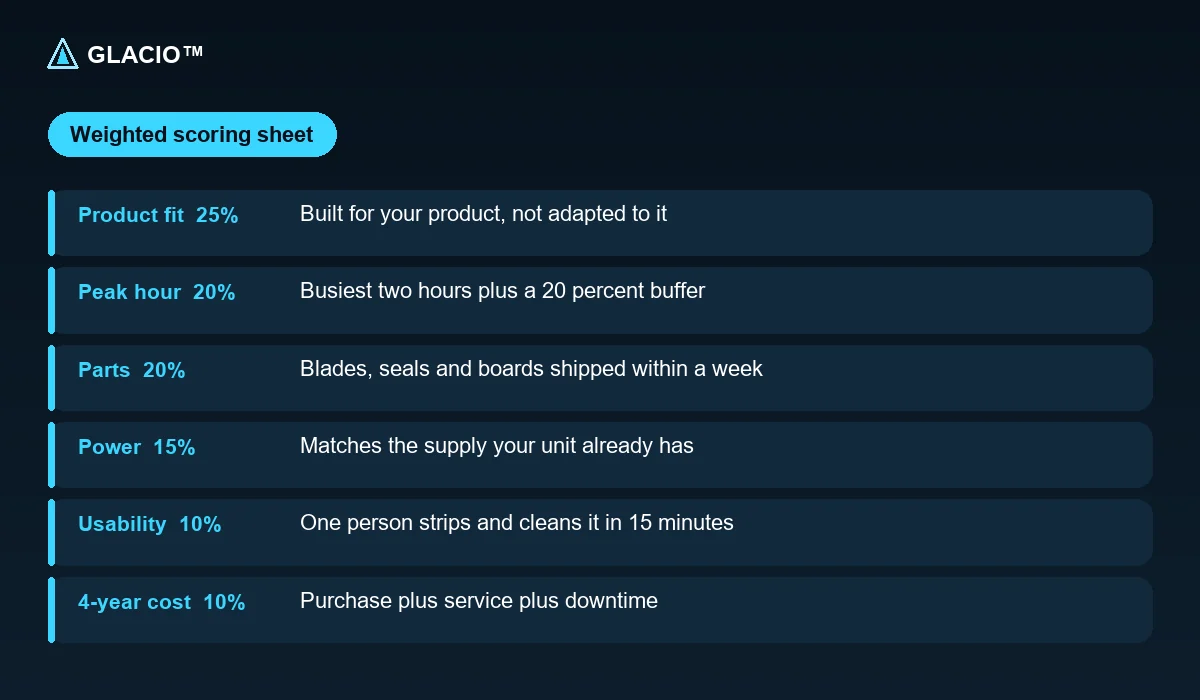
Score every candidate from 1 to 5 on these six criteria, then multiply by the weight. Anything under 60 out of 100 should not be on your shortlist, however good the price looks.
| Criterion | Weight | What a 5 looks like |
|---|---|---|
| Product fit | 25% | Built for your exact product, not adapted to it |
| Peak-hour output | 20% | Meets your busiest two hours with a 20 percent buffer |
| Parts and service route | 20% | Blades, seals and boards available locally or shipped within a week |
| Power and installation fit | 15% | Matches your supply without new cabling or cooling works |
| Cleaning and staff usability | 10% | One person can strip, wash and reassemble it in under fifteen minutes |
| Four-year cost | 10% | Purchase plus service plus downtime beats the next option |
Run the same numbers for the machine you already own before replacing it. Plenty of shops buy a second machine when a worn cylinder, tired blades or a badly sized unit was the real problem. The reliability checklist covers the faults worth fixing rather than replacing, and the ROI and payback guide turns the purchase into a monthly figure you can compare against your sales.
Mistakes that make a good machine the wrong machine
- Buying output you cannot store. A machine that freezes 40 litres an hour is useless if your freezer holds 60 litres.
- Ignoring recovery time. The number that matters is complete cycles per hour, not the headline freeze time.
- Choosing on bowl size alone. A bigger bowl with an undersized compressor freezes more slowly and produces softer product.
- Skipping the electrical check. Cable, breaker and a dedicated circuit can add thousands to the project after delivery.
- Forgetting the display side. Product that is frozen well and displayed badly still reaches the customer in poor condition. Pair the machine with a display case that holds temperature without icing over.
- Buying for a menu you have not launched. If you are adding gelato to a cafe, start with the smallest configuration that covers your true peak and reinvest after two seasons. Small shops usually start with a countertop gelato machine, then move up when the demand is proven.
Frequently asked questions
What is the best commercial ice cream machine for a small business?
The one that matches your product and your busiest hour at a total cost you can service. For most small shops that means a single or double cylinder batch freezer in the 6 to 12 litre per cycle class, with a 230V or 400V supply that already exists in the unit, and spare blades and seals available within a week.
How much should a shop expect to spend?
Budget imports run USD 2,500 to 8,000, used premium machines USD 7,000 to 30,000, and new factory-direct batch freezers USD 8,000 to 35,000 depending on capacity and controls. Add installation, hardening storage and consumables to every path.
Is a soft serve machine better than a batch freezer?
They sell different products. Soft serve is faster at the counter with a fixed menu; a batch freezer gives you scooped texture and flavour rotation. If your menu needs both, that is two machines, not one compromise. The hard serve versus soft serve comparison works through the trade-off.
How many litres per hour do I need?
Take your busiest two hours of sales in litres, divide by two, then add 20 percent. A shop selling 30 litres in that window needs roughly 18 litres an hour of usable output, counting recovery time between cycles.
Can one machine handle gelato and hard ice cream?
Yes. Both are made in a batch freezer; the recipe, the overrun and the serving temperature decide which one you get. The machine choice is about capacity and hardening, not about the product name on the menu.
Rank machines on the six criteria, run the peak-hour maths with your own numbers, and the shortlist usually shrinks to two machines within an afternoon. If you send us the product you sell, your busiest two hours in litres and your power supply, we will tell you which capacity fits and what the four-year cost looks like. Which machine are you comparing right now? Tell us in the comments and we will work through the numbers with you.
Tell us the shop. We size the machine and price it.
Two numbers decide the model: how much you sell on a busy day, and how much you need in your busiest hour. Send those with your voltage and you get a model recommendation and an FOB quote within 24 hours.
- ✓ Sized to your peak hour
- ✓ FOB quote and lead time
- ✓ No obligation
Some information may be outdated
Comments
Questions about equipment capacity, voltage, or recipes? Leave a comment.
Loading comments...