

Countertop Gelato Machine: What It Can and Cannot Do in a Small Shop
A countertop gelato machine is the cheapest way to put real gelato on a menu, and the most common way to buy the wrong capacity. The machine itself is not the problem. The problem is that countertop units are sold on peak numbers while shops are judged on their busiest hour. This guide sets out what the category genuinely does well, where it runs out of headroom, and the arithmetic that tells you when to move up.
Quick answer
A countertop gelato machine freezes one small batch at a time, usually in fifteen to thirty minutes, and then needs recovery time before the next batch. Realistically that is a few litres per hour, not a few dozen. It suits a café adding gelato to an existing menu, a bakery selling tubs at the weekend, or a market concept testing flavours. It stops being the right machine when your peak demand needs more litres in one hour than the machine can freeze and recover in that hour, or when you need a full display case every day.
What “countertop” actually means
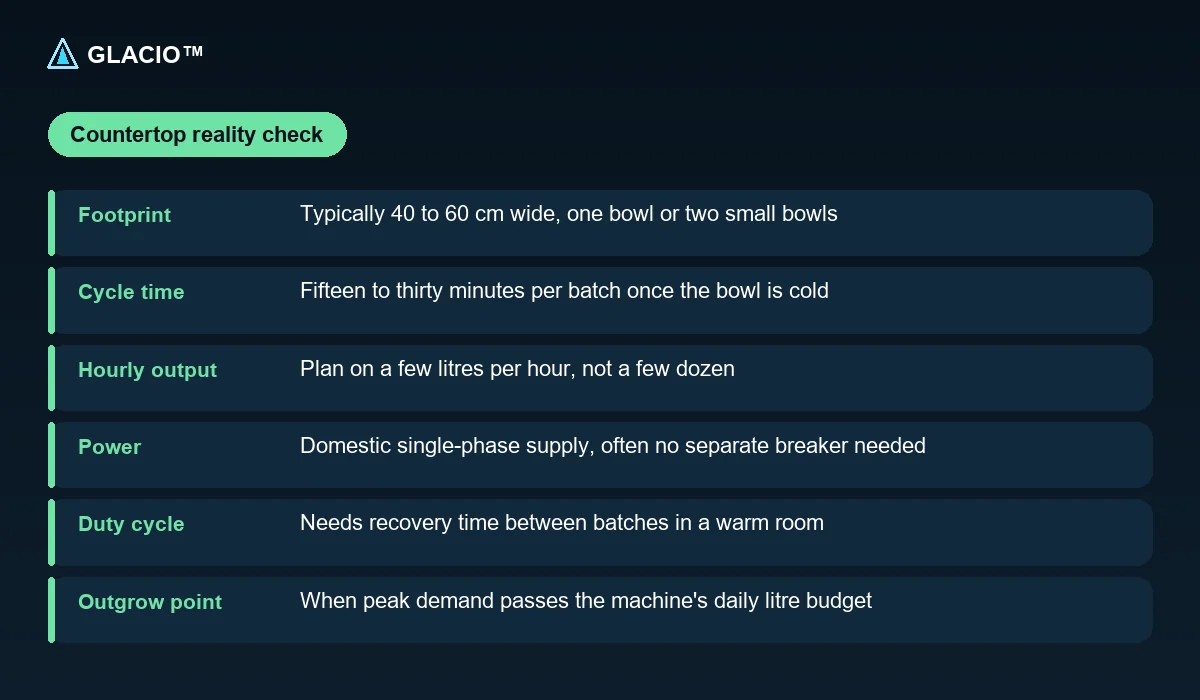
| Specification | Realistic countertop range | Why it matters |
|---|---|---|
| Width | About 40 to 60 cm | Fits under a standard counter with airflow behind |
| Bowls | One bowl, occasionally two small ones | One batch at a time in practice |
| Cycle time | 15 to 30 minutes per batch | Sets your output ceiling |
| Recovery time | Several minutes between batches | Stops you running back-to-back all afternoon |
| Power | Domestic single phase | Usually no dedicated circuit needed |
| Heat | Air cooled, heat into the room | Needs extraction, not a desk fan |
The output arithmetic that prevents a bad purchase
Take the busiest hour of your week, not the average day. Then run three numbers:
- Litres needed in the peak hour = scoops served x grams per scoop / 1000, divided by the number of litres of mix per tub you sell.
- Batches needed = litres needed / batch size.
- Time available = batches needed x (cycle time + recovery time).
If step three is longer than sixty minutes, a single-bowl countertop machine cannot serve that hour on its own. You either pre-produce and store the product, add a second machine, or move to a floor-standing batch freezer with more bowls.
For a fuller model, including the storage and hardening side, see how to size a machine for peak hour capacity and batch freezer sizing by daily sales.
Texture, overrun and hardening
A countertop machine can make genuinely good gelato. What it cannot do is replace the rest of the chain:
- Hardening. Freshly frozen gelato is soft. It needs a hardening step and a storage freezer at a stable temperature, or it will be grainy the next day.
- Display. A display case holds product at serving temperature. Countertop machines do not double as a case for a full day of trade.
- Overrun control. Air incorporation decides yield and texture. Small machines usually give you less control, so recipes need tuning rather than copying from a bigger machine.
If texture is the current problem rather than capacity, the texture troubleshooting guide covers icy, greasy, gummy and grainy results.
Power, heat and where to put it
Countertop units typically run on a standard single-phase supply, which is one of the reasons they suit small sites. Two practical constraints remain:
- Leave 20 to 30 cm of clear space behind and beside the machine for condenser airflow.
- Keep the room under roughly 30 C where possible. Above that, cycle times stretch and the compressor works harder.
Our notes on heat and noise in a small shop explain how to position the machine without cooking the room, and the power requirements guide covers breaker sizing if you add equipment.
When a countertop machine is the right answer
- You are adding gelato to a café, bakery or restaurant dessert menu.
- You sell a few litres a day and can pre-produce before service.
- You want to test flavours before committing to a full parlour fit-out.
- Your space genuinely has no room for a floor-standing machine and a hardening cabinet.
When to move up
- You are turning customers away, or selling out before your busiest hour ends.
- You want more than four to six flavours available every day.
- You are supplying other businesses, where batch consistency is contractual.
- You have added a display case and now need to keep it full, not fill it once.
At that point, compare a commercial gelato machine by bowl count, cycle time and holding temperature, and check the home versus commercial comparison so the jump in capital matches the jump in revenue.
Frequently asked questions
Can a countertop gelato machine run a small shop?
Yes, for low daily volumes with pre-production and storage. It works best as a menu addition rather than the only production machine for a shop that sells scooped gelato all day.
How many litres per hour does a countertop machine produce?
Plan on a few litres per hour. A 1.5-litre batch with a 20-minute cycle plus recovery time gives roughly two to three litres per hour in real conditions, not the peak figure on the listing.
Do I need three-phase power for a countertop machine?
Usually not. Most countertop gelato machines run on single-phase domestic power. Floor-standing machines and higher-output batch freezers more often need a dedicated circuit or three-phase supply.
Can I display gelato straight from the machine?
You can serve it immediately, but gelato needs hardening and stable storage or display temperature to hold texture. Plan for a hardening cabinet or freezer and a display case.
Is a countertop machine good enough to start a gelato business?
It is a reasonable way to validate recipes and demand with limited capital. If the concept works, expect to add capacity within a season, so keep the upgrade path in mind when you design the counter.
Tell us the shop. We size the machine and price it.
Two numbers decide the model: how much you sell on a busy day, and how much you need in your busiest hour. Send those with your voltage and you get a model recommendation and an FOB quote within 24 hours.
- ✓ Sized to your peak hour
- ✓ FOB quote and lead time
- ✓ No obligation
Some information may be outdated
Comments
Questions about equipment capacity, voltage, or recipes? Leave a comment.
Loading comments...