

Ice Cream Sales in Winter: Keep Your Batch Freezer Working
Short answer: Ice cream sales in winter stay viable when you create demand you can schedule instead of waiting for walk-in traffic. Use hot pairings, a tighter winter menu, catering, events, and wholesale to cafes, bakeries, and bubble tea shops, then adjust batch sizes to match the lower volume. The goal is not to match July. It is to keep the batch freezer productive, your staff sharp, and cash coming in.
An idle batch freezer is not a free asset. It occupies counter space, ties up working capital, needs cleaning and routine checks, and leaves staff out of practice. When warm weather returns, a team that has not made ice cream for months will be slower and less consistent.
Winter also changes what customers buy. A family may skip a cold cone but still order a brownie with gelato, a hot chocolate float, or a dessert box for a holiday dinner. A cafe that normally buys nothing may want a small wholesale tray for its pastry case. Seasonal ice cream demand has not disappeared. It has moved into different occasions.
This plan is for bakery owners, cafe and bubble tea operators, gelato shop founders, and home bakers who want the machine to earn through the slow months. The expensive mistake is guessing: making the same summer flavors at the same summer volume, then discounting them before they lose quality. A better approach is to set a small menu, build repeat wholesale and catering orders, and run the freezer on a schedule tied to real demand.
Why ice cream sales in winter need a different plan
Summer demand is spontaneous. Winter demand is usually planned. That difference affects your menu, staffing, production timing, and packaging. If you wait for customers to decide they want ice cream, you will make too much on a mild weekend and too little before a holiday event.
Start with 3 weekly numbers. They take minutes to collect and show where the real opportunities are.
- Attachment rate: How many hot drinks, slices of cake, or pastry orders include a scoop? If you sell 100 hot drinks on a Saturday and only 6 include gelato, that is an offer problem, not proof that winter demand is dead.
- Sell-through: Record how many liters you made and how many sold within 7 days. Flavors below 70 percent sell-through should lose their slot before they hurt texture or freshness.
- Pre-booked revenue: Add up confirmed catering, event, and wholesale sales for the next 14 days. This number tells you when to run production instead of relying on a weather forecast.
Track those numbers by channel, not just as one store total. Retail, wholesale, and events behave differently. A cold rainy week can hurt walk-ins while a corporate dessert order keeps the freezer busy.
Keep the scope small at first. Choose 1 primary winter channel and 1 backup. A cafe might focus on hot drink pairings and add weekend dessert boxes. A bakery might lead with cake a la mode and wholesale trays for nearby restaurants. A home baker can use catering as the primary channel and home delivery as the backup.
Build an ice cream shop winter menu that earns its counter space
A winter menu should do 3 jobs: raise the average ticket, use flavors you already make well, and create a reason to serve ice cream when the weather is cold. Keep the list tight. Most small shops can run 6-10 flavors without spreading production, labels, and freezer space too thin.
Temperature does more work than decoration. Gelato is commonly served around -12 to -14 degrees C, while hard ice cream is often held around -14 to -18 degrees C. A scoop that is too cold tastes flat and damages the texture of a soft cake. A scoop that is too warm collapses before it reaches the table.
- Affogato and espresso floats: Pair 1 scoop of vanilla, coffee, or hazelnut gelato with a fresh hot shot. The drink adds margin without adding another production process.
- Cake and brownie a la mode: Warm the baked item, add 1 scoop, and serve immediately. This works especially well in bakeries because the dessert uses existing display stock.
- Bubble tea and milk tea floats: Add a small scoop of vanilla or brown sugar gelato to a warm milk tea. Test the recipe first because sugar level and drink temperature can change how quickly the scoop melts.
- Cookie or croissant ice cream sandwiches: Assemble to order instead of pre-making large batches. A warm cookie with a firm scoop gives contrast without a complicated plated dessert.
- Tasting flights: Offer 3 small scoops with hot chocolate or coffee. Flights move seasonal flavors faster and help customers commit to a full tub later.
Name winter items around the occasion, not the weather. “Holiday dessert box” is easier to pre-sell than “winter collection.” Include reheating or serving instructions so the customer knows how to plate the product at home.
Limit new flavors to 1 rotating slot. A new flavor can create interest, but 5 untested flavors create waste, extra cleaning, and inconsistent freezer inventory. Choose the rotating flavor around the channel you are trying to grow. For wholesale accounts, a familiar chocolate or vanilla often sells better than a bold experimental recipe. For retail gift boxes, a seasonal flavor with a clear visual identity is easier to market. If you need help narrowing the list, this guide on how to choose ice cream flavors without overbuying uses the same sell-through logic.
Choose revenue channels before you cut production
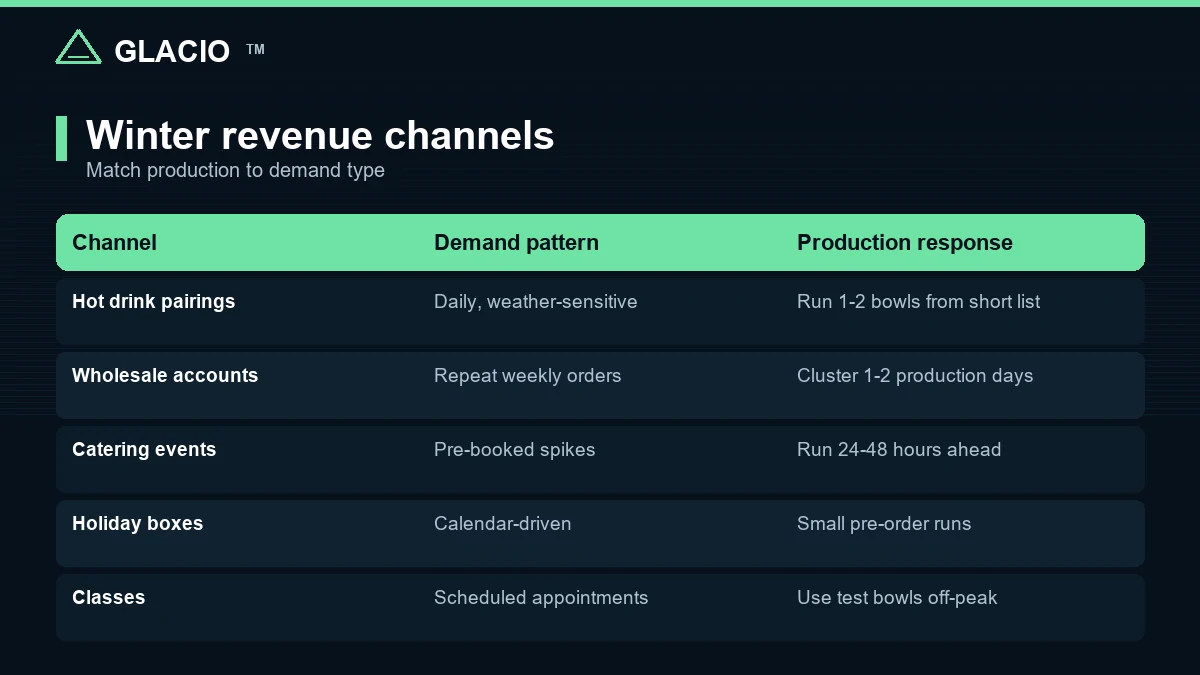
Do not chase every winter idea at once. Each channel has a different order pattern, lead time, and production response. Pick the ones that fit your staff, delivery range, and freezer capacity.
| Winter channel | Demand pattern | Production response | Main risk |
|---|---|---|---|
| Hot drink pairings | Daily but weather-sensitive | Run 1-2 bowls from a short flavor list | Slow flavors block freezer space |
| Wholesale accounts | Repeat weekly orders | Cluster flavors into 1-2 production days | Thin margins after delivery |
| Catering and events | Pre-booked spikes | Run 24-48 hours before pickup or delivery | Rush fees and missed deadlines |
| Holiday dessert boxes | Calendar-driven | Make small runs against pre-orders | Packaging and unsold gift stock |
| Classes and tastings | Scheduled appointments | Use test bowls during off-peak hours | Staff time and cleanup |
Give each channel a clear minimum. A wholesale order that requires a separate delivery route may lose money even if the product margin looks healthy. An event that needs 2 hours of setup should not be priced like a simple counter sale. When the order does not cover labor, packaging, delivery, and cleanup, either raise the minimum or bundle it with another channel.
Adjust batch size for lower winter volume
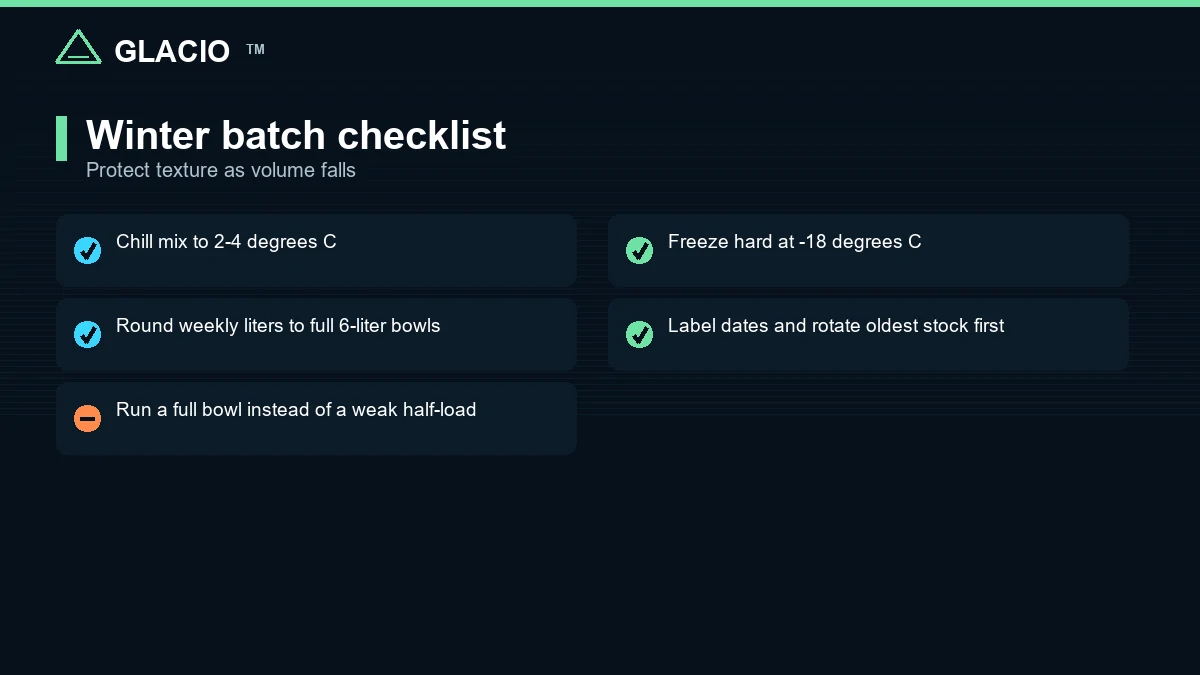
Lower volume does not automatically mean half batches. Partial loads can behave differently from full loads because the mix level affects agitation, freezing, and texture development. Do not assume a half-filled bowl will produce the same result. If you cannot sell a full bowl, coordinate flavors, sell smaller portions, or schedule production less often.
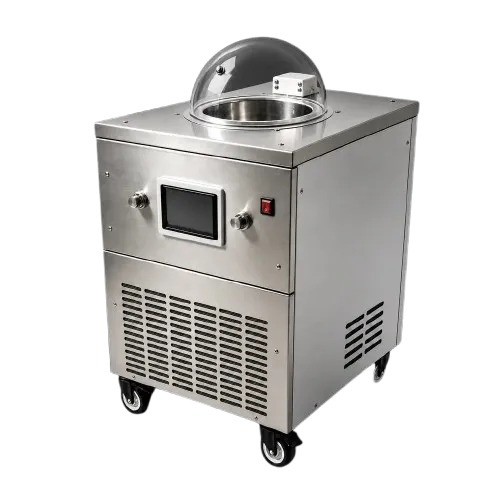
A batch freezer needs a repeatable routine more than it needs constant use. For a GLACIO GB-Series machine, each bowl holds 6 liters. The typical cycle is 15-20 minutes per bowl, with output of roughly 14 liters per hour per bowl. Actual draw temperature, cycle time, and output depend on the mix, starting temperature, ambient conditions, and operating cycle.
A practical winter batch calculation
- Forecast servings by channel for the next 7 days. Separate retail, wholesale, and events because they sell at different portion sizes.
- Convert servings to liters. If you expect 120 servings at 100 ml, plan 12 liters before accounting for yield from the mix.
- Round to full 6-liter bowls. The 12-liter example becomes 2 bowls, which keeps the machine working within its intended batch pattern.
- Schedule production around order dates. Wholesale can run on a fixed day; catering should run 24-48 hours before service unless the recipe needs longer hardening.
- Chill the mix to 2-4 degrees C before loading. A warmer mix adds cycle time, and long cycles can draw soft product.
- Freeze hard at -18 degrees C, label the batch, and rotate stock. Retail tubs should move before back-stock created for wholesale.
For a small operation, one production day may be enough. Make the base flavors early, clean between allergen or color changes, and pack against confirmed orders first. If you are deciding whether to run fewer bowls more often or more bowls less often, use the same daily-sales math covered in this guide to batch freezer sizing. The right answer depends on sell-through, not on keeping every bowl full every day.
Home bakers should treat winter as a controlled production season. Run 1 bowl at a time, sell pre-orders before mixing, and freeze the finished product in the coldest part of the freezer. Do not thaw and refreeze finished ice cream to solve slow sales. That weakens texture and increases the chance of ice crystals.
Wholesale and catering basics that keep the batch freezer working
Wholesale and catering are the most practical ways to turn winter into planned production. They reduce the guesswork because you make against an order. They also demand discipline. A discounted tray with vague delivery terms is not a channel; it is unpaid work.
Build a wholesale offer
- Start with 3-5 accounts within a 20-minute drive. Cafes, bakeries, restaurants, hotels, and bubble tea shops are natural fits when they already sell dessert or hot drinks.
- Limit the wholesale list to 3 core flavors and 1 seasonal option. Fewer flavors mean fewer clean-downs, less inventory, and more reliable reorders.
- Set a 48-hour order cutoff. Give accounts a fixed delivery day or 2, and charge enough to cover the route, packaging, and invoice handling.
- Label every case with flavor, production date, allergens, and storage instructions. Follow local food-labeling and temperature rules for your market.
- Start with prepaid orders or short payment terms. Small accounts can be excellent customers until unpaid invoices turn the route into a loss.
Catering without losing money
Price the whole job: product, containers, cold transport, setup, serving tools, staff time, and cleanup. A 20-portion order can be profitable as an add-on to a bakery delivery, but it can lose money when it requires 2 hours of separate setup. Quote a minimum that covers the real work.
- Use 72 hours as a standard lead time for simple catering and 2 weeks for custom flavors, large counts, or branded packaging.
- Keep product at -18 degrees C until setup. Move only what you need into smaller service pans and replace pans from the freezer instead of letting large tubs soften.
- Use the 2-hour food-safety rule for perishable items that leave temperature control. If service runs longer, rotate small pans and discard product that has been out too long.
- Build a 20 percent buffer for events. Last-minute guests, larger scoops, and serving errors are normal, not emergencies.
- Confirm the delivery address, loading access, setup time, and cleanup responsibility in writing. Those details decide whether the job is worth repeating.
Catering also keeps the machine honest. Every event tests your portioning, packing, transport, and thaw behavior. Record what worked and update the offer before the next booking.
The costs that quietly rise in winter
Winter profit can leak even when sales look acceptable. Short runs, small deliveries, gift packaging, and heated rooms all change the cost per liter. Review these costs monthly instead of waiting for a quarterly bank statement surprise.
| Cost pressure | Why it rises | Practical control |
|---|---|---|
| Small-batch production | Clean-down and changeover spread across fewer liters | Cluster flavors and schedule full bowls |
| Delivery and wholesale routes | Fuel and labor per order rise when drop sizes shrink | Set route days and minimum orders |
| Packaging and labels | Gift boxes, small tubs, and custom labels add handling | Use 2 standard sizes and pre-count supplies |
| Heating and refrigeration | Warm customer areas and blocked airflow make the machine work harder | Keep vents clear and separate cold production areas |
| Working capital | Ingredients and packaging are bought before winter orders are paid | Pre-sell events and require deposits |
Check the freezer and refrigerator seals, door gaskets, and condenser airflow at the start of the season. A machine placed beside a heater, under a low shelf, or behind stacked boxes may run longer and draw softer product. The fix can be as simple as clearing the space around it.
Also review the cost per liter after every large production day. If wholesale pricing only works when you fill every bowl and avoid delivery, the offer is fragile. Adjust the flavor list, minimum order, or delivery schedule before the route drains time from retail.
Run a weekly off-season production rhythm
A weekly rhythm prevents the freezer from becoming either idle or overloaded. The exact volumes change by shop, but the order of work should stay consistent.
- Monday: Review sell-through, freezer stock, confirmed wholesale orders, and upcoming events.
- Tuesday: Set the flavor list, order mix and packaging, and confirm delivery windows.
- Wednesday: Run the main production block. Make wholesale and catering orders first, then retail flavors.
- Thursday: Pack and deliver wholesale orders. Record shortages, damaged packaging, and account feedback.
- Friday: Prepare weekend catering, assemble dessert boxes, and check serving equipment.
- Saturday: Push hot pairings and retail add-ons. Note which menu items actually raise the ticket.
- Sunday: Clean the machine, check hard-to-see parts, and log anything that needs repair.
Cleaning is part of production capacity. A dirty machine runs badly, creates flavor carryover, and slows the next start. Use a written batch freezer cleaning and sanitizing protocol so the process does not depend on one experienced employee being on shift.
Add a monthly commercial ice cream machine maintenance check for gaskets, seals, controls, ventilation, and unusual noise. Small issues are easier to schedule in winter than during a summer rush.
Frequently asked questions
Does ice cream sell in winter?
Yes, but the sales mix changes. Winter demand is more likely to come from hot drink pairings, plated desserts, holiday events, and wholesale accounts. Walk-in traffic may fall, so planned channels such as catering and repeat orders matter more.
How often should I run a batch freezer in the off season?
Run it when you have confirmed demand, not simply because a day has passed. A shop with wholesale or catering may run 2 or 3 production days each week, while a cafe may run 1 day and rely on frozen stock. The goal is to avoid both idle weeks and unsold tubs.
What should an ice cream shop winter menu include?
Start with 6-10 flavors, including proven sellers and 1 seasonal rotation. Build items around affogato, cake a la mode, milk tea floats, dessert boxes, and tasting flights. Every item should use a flavor you can produce consistently and sell within its best quality window.
Can small shops make money from wholesale ice cream?
Wholesale can work when order minimums, delivery days, packaging, and payment terms are controlled. A small route with too many flavors and tiny drops usually loses money. Start with 3-5 nearby accounts, 3 core flavors, and a clear cutoff time.
How do I avoid waste when winter volume is lower?
Forecast by channel, use full 6-liter bowls where possible, and freeze hard at -18 degrees C. Sell pre-orders before production, rotate stock by date, and remove slow flavors before they occupy freezer space for weeks. Small consistent runs waste less than large speculative batches.
Do I need a smaller machine for winter?
Not normally. A machine with more bowls gives you flavor flexibility, but you can schedule fewer production days and run only the bowls you need. The GLACIO GB-Series ranges from 1 to 6 bowls, so a growing shop can match capacity to its channels rather than buying a second machine for winter.
Keep the batch freezer working through winter
The best winter plan is simple: sell against orders, keep a short menu, and run the machine on a schedule that matches real sell-through. Put hot pairings in front of retail customers, build 3-5 repeat wholesale accounts, quote catering with all labor and delivery costs included, and adjust batch size instead of letting the freezer sit idle. A GLACIO GB-Series machine gives you 1 to 6 six-liter bowls, so you can run a lean winter schedule without giving up flexibility when demand returns.
Request a machine recommendation and quote
Which winter channel is most realistic for your shop: hot pairings, wholesale, catering, or pre-sold dessert boxes?
Tell us the shop. We size the machine and price it.
Two numbers decide the model: how much you sell on a busy day, and how much you need in your busiest hour. Send those with your voltage and you get a model recommendation and an FOB quote within 24 hours.
- ✓ Sized to your peak hour
- ✓ FOB quote and lead time
- ✓ No obligation
Some information may be outdated
Comments
Questions about equipment capacity, voltage, or recipes? Leave a comment.
Loading comments...